05:00
Space = start/pause · Esc = exit

☢ NUCLEAR PHYSICS

AQA A-Level Physics | Topic 3.8
Student Booklet Teacher Booklet

Rutherford Scattering

Do Now — Lesson 1

Prerequisite knowledge: atomic structure (protons, neutrons, electrons, charge); Coulomb's law / electric force; kinetic energy (½mv²); properties of ionising radiation

Q1
Draw and label a simple diagram of an atom showing the nucleus, protons, neutrons, and electrons. State the relative charge of each particle. (3 marks)
Model Answer Nucleus at centre containing protons (+1 charge each) and neutrons (0 charge). Electrons (−1 charge) orbiting outside at a relatively large distance. Proton: +1; Neutron: 0; Electron: −1.
Q2
An alpha particle has charge +2e and a gold nucleus has charge +79e. State whether the electrostatic force between them is attractive or repulsive. Name this type of force. (2 marks)
Model Answer Repulsive — both are positively charged. The force is the electrostatic (Coulomb) force.
Q3
A particle has mass 6.64 × 10⁻²⁷ kg and speed 2.0 × 10⁷ m s⁻¹. Calculate its kinetic energy using EK = ½mv². (2 marks)
Model Answer EK = ½ × 6.64×10⁻²⁷ × (2.0×10⁷)² = ½ × 6.64×10⁻²⁷ × 4×10¹⁴ = 1.33 × 10⁻¹² J
Q4
State which type of radiation (α, β, or γ) has the shortest range in air and explain why in one sentence. (2 marks)
Model Answer Alpha (α) has the shortest range (~5 cm) because it is the most strongly ionising, losing energy rapidly through frequent collisions with air molecules.

Part 1 of 3 · The Geiger-Marsden Experiment

In 1909, Geiger and Marsden (working with Rutherford) fired alpha particles at thin gold foil inside an evacuated chamber. A zinc sulphide screen emitted light on impact, detected by a moving microscope in a dark room.

The accepted model at the time was Thomson's plum pudding model: a diffuse positive charge with electrons embedded throughout.

Results:

Why vacuum? Alpha particles have a range of only ~5 cm in air — they would be absorbed before reaching the foil.

Why thin gold foil? To avoid multiple scattering events, so each deflection comes from a single nucleus.
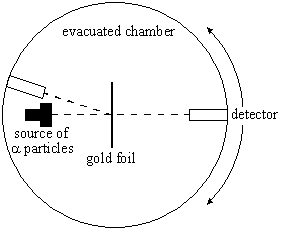
Fig 1.1 — Rutherford scattering apparatus
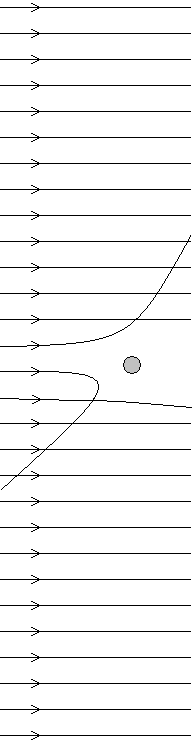
Fig 1.1 — Rutherford scattering apparatus

Fig 1.2 — Alpha particle scattering paths

Fig 1.2 — Alpha particle scattering paths

Questions — Part 1

Q1
State what may be concluded about the structure of the atom from the observation that most alpha particles passed straight through the gold foil with little or no deflection. (2 marks)
Model Answer The atom is mostly empty space. Most of the atom's volume contains no significant mass or charge to deflect the alpha particles.
Q2
State what may be concluded from the observation that about 1 in 8000 alpha particles were scattered through angles greater than 90°. (2 marks)
Model Answer The positive charge and most of the mass of the atom are concentrated in a very small, dense region (the nucleus). This concentrated charge is large enough to repel the positive alpha particle back.
Q3
Explain why the gold foil and alpha source were placed in a vacuum. (2 marks)
Model Answer Alpha particles have a range of only ~5 cm in air. They would be absorbed by air molecules before reaching the foil or detector if air were present.
Q4
Explain why the gold foil had to be very thin. (2 marks)
Model Answer A thin foil ensures each alpha particle only encounters a single gold nucleus. Multiple scattering events in a thick foil would make results uninterpretable.

Part 2 of 3 · The Nuclear Model

Rutherford used the scattering results to propose the nuclear model:

Upper limit on nuclear radius — distance of closest approach, when all KE converts to electric PE:

EK = qQ / (4πε₀r)  ⟹  r = qQ / (4πε₀ × ½mv²)

Typical nuclear diameter: ~10−14 m  |  Typical atom diameter: ~10−10 m  (nucleus is ~10,000× smaller)
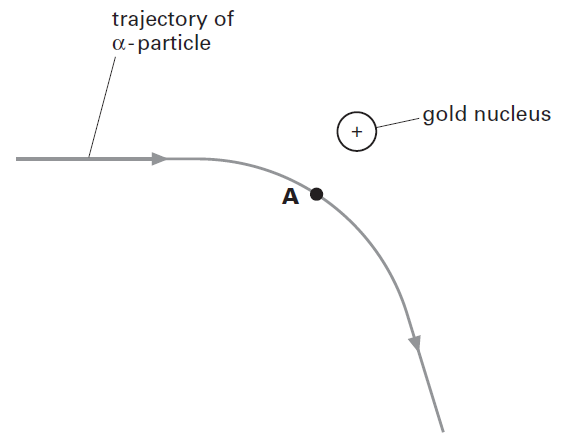
Fig 1.3 — Alpha particle trajectory past a gold nucleus

Fig 1.3 — Alpha particle trajectory past a gold nucleus

Questions — Part 2

Q5
A very small percentage of alpha particles were scattered through angles greater than 90°. State two properties of the nucleus that can be deduced from this. (2 marks)
Model Answer 1. The nucleus has a large positive charge (to provide sufficient repulsion to deflect alpha particles through large angles).
2. The nucleus is very small / has a very large mass (concentrated in a tiny volume), so direct hits are rare.
Q6
An alpha particle travelling at 1.5 × 10⁷ m s⁻¹ approaches a gold nucleus (Z = 79) head-on. Calculate the distance of closest approach. (mass of alpha = 6.64 × 10⁻²⁷ kg, e = 1.6 × 10⁻¹⁹ C, ε₀ = 8.85 × 10⁻¹² C² J⁻¹ m⁻¹) (4 marks)
Model Answer EK = ½mv² = ½ × 6.64×10⁻²⁷ × (1.5×10⁷)² = 7.47×10⁻¹³ J
At closest approach: EK = qQ/(4πε₀r)
r = (2e × 79e)/(4πε₀ × EK) = (2 × 79 × (1.6×10⁻¹⁹)²)/(4π × 8.85×10⁻¹² × 7.47×10⁻¹³)
r ≈ 4.8 × 10⁻¹⁴ m
Q7
The diagram shows an alpha particle passing near a gold nucleus. Name the force responsible for the deflection. (1 mark)
Model Answer Electrostatic (Coulomb) force / electromagnetic force.
Q8
State a typical value for the diameter of an atomic nucleus. (1 mark)
Model Answer ~10⁻¹⁵ m (femtometre range) — approximately 10⁻¹⁴ to 10⁻¹⁵ m.

Part 3 of 3 · Particle Scattering Techniques

Different particles reveal different structural information. For diffraction to reveal structure, the wavelength must be comparable to or smaller than the feature being studied.

de Broglie wavelength (relativistic / high-energy electrons):

λ = h/p ≈ hc/E  (where E is kinetic energy in joules, c = 3.0 × 10⁸ m s⁻¹)

Diffraction minimum (first minimum gives nuclear diameter D):
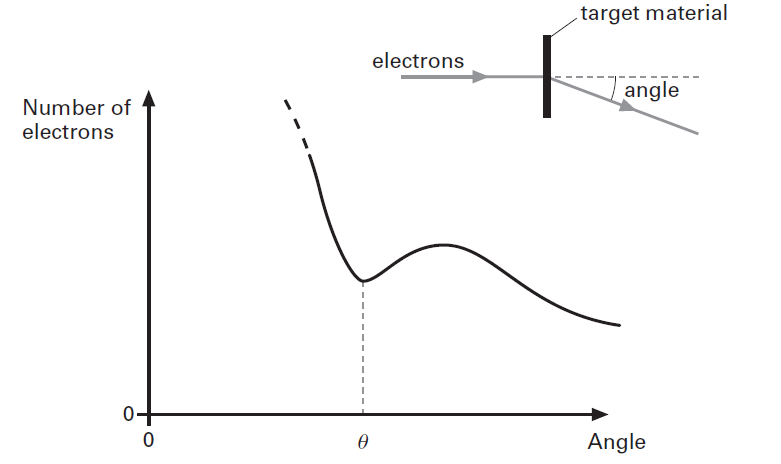
sin θ ≈ 0.61λ/D
Fig 1.4 — Electron diffraction pattern (first minimum at θ)
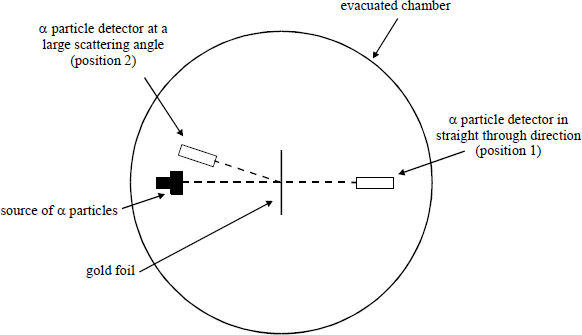
Fig 1.4 — Electron diffraction pattern

Questions — Part 3

Q9
Name three techniques used to investigate the crystalline structure of matter. (3 marks)
Model Answer 1. X-ray diffraction   2. Electron diffraction   3. Neutron diffraction
Q10
High-speed electrons are diffracted by atomic nuclei. (a) What does electron diffraction demonstrate about the nature of high-speed electrons? (b) Suggest a typical wavelength for electrons used to investigate nuclear size. (2 marks)
Model Answer (a) Electrons have wave-like properties (wave-particle duality); they have a de Broglie wavelength comparable to nuclear dimensions.
(b) ~10⁻¹⁵ m (of order femtometres, comparable to nuclear diameter).
Q11
For a wavelength of 2.0 × 10⁻¹⁰ m, calculate: (a) the frequency of X-rays of this wavelength; (b) the speed of electrons with this de Broglie wavelength (me = 9.11 × 10⁻³¹ kg, h = 6.63 × 10⁻³⁴ J s); (c) the speed of neutrons with this de Broglie wavelength (mn = 1.67 × 10⁻²⁷ kg). (5 marks)
Model Answer (a) f = c/λ = 3×10⁸ / 2×10⁻¹⁰ = 1.5 × 10¹⁸ Hz
(b) p = h/λ = 6.63×10⁻³⁴/2×10⁻¹⁰ = 3.315×10⁻²⁴ kg m s⁻¹; v = p/m = 3.315×10⁻²⁴/9.11×10⁻³¹ ≈ 3.64 × 10⁶ m s⁻¹
(c) v = p/m = 3.315×10⁻²⁴/1.67×10⁻²⁷ ≈ 1.99 × 10³ m s⁻¹
Q12
In an electron-diffraction experiment, 420 MeV electrons fired at carbon nuclei give a first diffraction minimum at θ = 52°. Calculate the diameter of a carbon nucleus. (1 eV = 1.6 × 10⁻¹⁹ J) (4 marks)
Model Answer E = 420 × 10⁶ × 1.6×10⁻¹⁹ = 6.72 × 10⁻¹¹ J
λ = hc/E = (6.63×10⁻³⁴ × 3×10⁸) / 6.72×10⁻¹¹ = 2.96 × 10⁻¹⁵ m
sin 52° = 1.22λ/d → d = 1.22 × 2.96×10⁻¹⁵ / sin 52° = 4.58 × 10⁻¹⁵ m
Nuclear diameter ≈ 4.6 × 10⁻¹⁵ m

Additional Questions — Lesson 1

A1
The spacing between atoms in a solid is typically 2.0 × 10⁻¹⁰ m. For diffraction the incident wavelength must be comparable to or less than this spacing. For a wavelength of 2.0 × 10⁻¹⁰ m, calculate: (a) the frequency of the X-rays (c = 3.0 × 10⁸ m s⁻¹); (b) the speed of electrons with this de Broglie wavelength (me = 9.11 × 10⁻³¹ kg); (c) the speed of neutrons with this de Broglie wavelength (mn = 1.67 × 10⁻²⁷ kg). (5 marks)
Model Answer (a) f = c/λ = 3.0×10⁸ / 2.0×10⁻¹⁰ = 1.5 × 10¹⁸ Hz
(b) p = h/λ = 3.315×10⁻²⁴ kg m s⁻¹; v = p/me3.64 × 10⁶ m s⁻¹
(c) v = p/mn1.99 × 10³ m s⁻¹
A2
The density of ordinary matter is about 10³ kg m⁻³. What does the nuclear density suggest about the structure of atoms? (2 marks)
Model Answer The nucleus is about 10¹⁴ times denser than ordinary matter. This means atoms are almost entirely empty space — almost all mass is concentrated in the tiny nucleus.
A3
List three key conclusions about the nature of the atom from the α-scattering experiment. (3 marks)
Model Answer 1. Most atomic mass is concentrated in a tiny, dense nucleus.
2. The nucleus is positively charged.
3. Most of the atom is empty space.

Exam-Style Questions — Lesson 1

Fig 1.5 — Rutherford scattering apparatus (exam diagram)

Fig 1.5 — Rutherford scattering apparatus (exam diagram)

Exam Q1 · Rutherford Scattering Apparatus (9 marks)
(a) Why is it necessary to remove the air from the apparatus? (2)

(b) Explain why the gold foil should be very thin. (2)

(c) The count rate at position 1 (straight through) is much greater than at position 2 (large scattering angle). Explain this and state what can be deduced about the structure of the atom and the properties of the gold nucleus. (5)
Mark Scheme (a) Alpha particles are strongly ionising and have very short range (~5 cm) in air. Without vacuum, alphas would be absorbed before reaching foil. [2]

(b) Thin foil ensures each alpha particle encounters only one nucleus. Multiple scattering would make deflection angles uninterpretable. [2]

(c) Most alpha particles pass straight through → the atom is mostly empty space / most of its volume contains little mass or charge. Very few are deflected at large angles → charge and mass are concentrated in a tiny region (the nucleus) / the nucleus is very small. The nuclear charge is positive → it repels the positive alpha particle. The nucleus is very dense and has large positive charge. [5]
Exam Q2 · Rutherford Scattering Setup (6 marks)
(a) Why is it necessary to remove the air from the apparatus? (2)
(b) Explain why the gold foil should be very thin. (2)
(c) Explain why the count rate at position 1 (straight through) is much greater than at position 2 (large angle). State what can be deduced. (2)
Model Answer (a) Alpha particles have range ~5 cm in air and would be absorbed before reaching the foil; vacuum ensures they travel unimpeded.
(b) Thin foil avoids multiple scattering so each deflection is due to a single nucleus.
(c) Most of the atom is empty space so most alphas pass through undeflected (high count at 1). Only close approach to the tiny, massive, positive nucleus causes large deflection (low count at 2). Deductions: nucleus is very small, massive, and positively charged.
Exam Q2 · Alpha Scattering Analysis (7 marks)
(a)(i) In which direction will the number of alpha particles per second be a maximum? (1)
(a)(ii) What does this suggest about the structure of the atoms in the metal? (1)
(b) A small number of alpha particles are scattered through 180°. Explain what this suggests about the structure of atoms. (2)
(c)(i) Name the force responsible for the deflection of the alpha particle. (1)
(c)(ii) The nucleus is replaced with one having a larger mass number but smaller proton number. Describe how the path of the alpha particle changes. (2)
Mark Scheme (a)(i) Straight through (0° / forward direction). [1]
(a)(ii) Atoms are mostly empty space. [1]
(b) The nucleus is very small and very dense. It has sufficient mass and positive charge to completely reverse an alpha particle's direction — the nucleus must be much more massive than the alpha particle. [2]
(c)(i) Electrostatic (Coulomb) force. [1]
(c)(ii) Smaller proton number → smaller nuclear charge → smaller repulsive force → alpha particle gets closer before turning (smaller distance of closest approach) / deflected through a smaller angle. [2]

Ionising Radiation

Do Now — Lesson 2

Prerequisite knowledge: composition and properties of α, β, and γ radiation; electromagnetic spectrum; electric deflection of charged particles

Q1
Name the three main types of ionising radiation and state the composition of each. (3 marks)
Model Answer Alpha (α): 2 protons + 2 neutrons (helium-4 nucleus).
Beta-minus (β⁻): fast electron from nucleus.
Gamma (γ): high-energy electromagnetic radiation.
Q2
State whether each radiation type (α, β, γ) is deflected by an electric field, giving the direction of deflection for each. (3 marks)
Model Answer α: deflected towards negative plate (positively charged).
β⁻: deflected towards positive plate (negatively charged); deflected more than α.
γ: not deflected (uncharged).
Q3
Which type of radiation has the greatest penetrating power? What thickness of what material is typically needed to reduce its intensity significantly? (2 marks)
Model Answer Gamma (γ) has the greatest penetrating power. Several centimetres of lead (or ~1 m of concrete) is needed to significantly reduce its intensity.
Q4
State what is meant by ionisation and give one reason why ionising radiation is harmful to living tissue. (2 marks)
Model Answer Ionisation: removal of electrons from atoms/molecules to produce ions.
Harmful because it can break chemical bonds in DNA, causing cell death or mutation leading to cancer.

Part 1 of 3 · Alpha and Beta Radiation

Ionisation is the removal of electrons from atoms. Radiation entering a GM tube ionises the gas inside; electrons travel to the positive wire, producing a detectable current.

PropertyAlpha (α)Beta-minus (β⁻)
CompositionHelium nucleus (2p + 2n)Fast electron (from n→p)
Relative mass41/2000
Relative charge+2−1
Deflection by E/MYes (towards −ve plate)Yes (towards +ve plate)
Ionising powerHighMedium
Range in air~5 cm2–3 m
Stopped bySkin / paper~3 mm aluminium
Inside body riskVery high — cell death/mutationModerate

Questions — Part 1

Q1
Complete the table of radiation properties. For alpha and beta-minus: state the composition, relative mass, relative charge, ionising power, and what stops each. (4 marks)
Model Answer See tables above. Alpha: helium nucleus, mass 4, charge +2, high ionising, stopped by skin/paper.
Beta-minus: fast electron, mass ~1/2000, charge −1, medium ionising, stopped by ~3mm aluminium.
Q2
Which ionising radiation produces the greatest number of ion pairs per mm in air? (1 mark)
Model Answer Alpha (α) radiation — it produces the greatest number of ion pairs per mm in air due to its large charge and relatively slow speed.
Q2b(i)
State the typical maximum range in air for: alpha particles and beta particles. (2 marks)
Model Answer Alpha particles: ~5 cm (0.05 m). Beta particles: ~2–3 m.
Q2b(ii)
Gamma rays have a range of at least 1 km in air. However, a gamma detector placed 0.5 m from a gamma source detects a noticeably smaller count-rate when moved a few centimetres further away. Explain this. (2 marks)
Model Answer Gamma radiation obeys the inverse square law — intensity decreases with 1/d². A small increase in distance causes a measurable decrease in count rate because intensity ∝ 1/d².
Q2c
Following an accident, a room is contaminated with dust containing americium (an alpha emitter). Explain the most hazardous aspect to an unprotected person entering the room. (3 marks)
Model Answer Alpha particles are stopped by the skin when outside the body (low external hazard). However, if the dust is inhaled or ingested, alpha emitters inside the body are extremely dangerous — alpha is highly ionising, causing severe localised cell damage to lung tissue / digestive tract, potentially leading to cancer.

Part 2 of 3 · Gamma Radiation and the Inverse Square Law

PropertyGamma (γ)
NatureHigh-frequency electromagnetic wave
Relative mass / charge0 / 0
Deflection by E/MNo
Ionising powerLow
Penetrating powerVery high
Stopped byLead / thick concrete (reduces, never stops completely)
UsesMedical/industrial tracers; sterilising surgical equipment

Inverse Square Law — gamma from a point source spreads isotropically (equal intensity in all directions):

I ∝ 1/x²   ⟹   I₁x₁² = I₂x₂²

Background radiation must always be subtracted from measured count rates to obtain the corrected count rate due to the source.

UK background sources (approx.): Radon/Thoron 51% · Ground/rocks 14% · Food/drink 12% · Medical 12% · Cosmic rays 10% · Other <1%
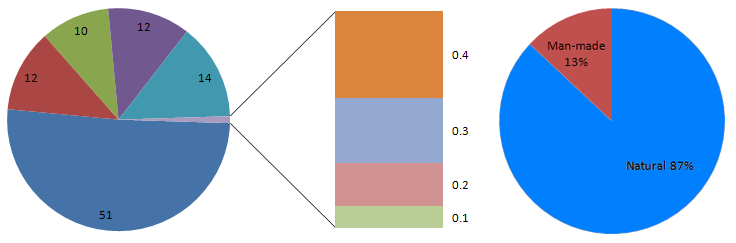
Fig 2.1 — Sources of background radiation in the UK

Fig 2.1 — Sources of background radiation in the UK

Questions — Part 2

Q4
A gamma source is 0.15 m from a detector giving a corrected count rate of 2010 counts min⁻¹. Calculate the expected corrected count rate at 0.90 m from the source. (3 marks)
Model Answer Using IAxA² = IBxB²:
2010 × (0.15)² = IB × (0.90)²
IB = 2010 × 0.0225 / 0.81 = 55.8 counts min⁻¹
Q5
A gamma detector gives a count rate of 2050 counts min⁻¹ at 0.15 m (background = 40 counts min⁻¹). Calculate the corrected count rate at 0.90 m. (3 marks)
Model Answer Corrected count at 0.15 m = 2050 − 40 = 2010 counts min⁻¹
Using inverse square law: IB = 2010 × (0.15/0.90)² = 2010 × 0.0278 ≈ 55.8 counts min⁻¹
Q6
Explain why a student recording a count rate at 0.90 m from a source might choose to record for longer than 5 minutes. (1 mark)
Model Answer The count rate at 0.90 m is very low, so recording for longer accumulates more counts, giving a more precise (statistically reliable) measurement.
Q7
State one source of background radiation that has increased in the past 100 years. (1 mark)
Model Answer Medical radiation (X-rays, nuclear medicine) / nuclear weapons fallout / air travel / nuclear power plants.

Part 3 of 3 · Radiation Hazards and Safety

The danger from radiation depends on type, dose, and whether the source is inside or outside the body.

Gamma sterilisation of surgical instruments: Gamma rays penetrate packaging and kill micro-organisms. They do not make instruments radioactive — the gamma photons are absorbed and leave no residual radioactivity.

Checking for beta emission: Place ~3 mm of aluminium between source and detector. A significant drop in count rate (beyond that expected from gamma alone) indicates beta is also present.
Questions — Part 3

Q8
Following an accident, a room is contaminated with dust containing americium (an alpha emitter). Explain the most hazardous aspect of this contamination to an unprotected person entering the room. (2 marks)
Model Answer If the americium dust is inhaled, it becomes an internal source. Alpha radiation is highly ionising inside the body, causing severe cell damage / cancer to lung tissue. External alpha is not dangerous as it is stopped by skin.
Q9
Explain why the public need not worry that gamma-sterilised surgical instruments become radioactive. (1 mark)
Model Answer Gamma photons are absorbed by the instruments but do not cause nuclear reactions that would make the material radioactive. No radioactive isotopes are produced.
Q10
A student measures count rates at three distances from a gamma source (background-corrected): d = 0.20 m → 9013; d = 0.50 m → 1395; d = 1.00 m → 242. Explain with calculations why these data are NOT consistent with an inverse square law. (3 marks)
Model Answer For inverse square law: I × d² should be constant.
0.20 m: 9013 × 0.04 = 360.5
0.50 m: 1395 × 0.25 = 348.8
1.00 m: 242 × 1.00 = 242
Values decrease with distance — not constant. Data are not consistent with the inverse square law. (Could be due to absorption in air, background not fully subtracted, or source having finite size.)

Exam-Style Questions — Lesson 2

Exam Q1 · Radioactive Decay & Gamma Intensity (5 marks)
(a) Describe the changes that occur in the proton number and nucleon number of a nucleus that decays by alpha emission followed by gamma emission. (2)

(b) Comment on the relative penetrating powers of alpha and gamma radiation. (1)

(c) Gamma rays travel from a point source to a detector. The distance is changed from 1.0 m to 3.0 m. Calculate the ratio: intensity at 3.0 m / intensity at 1.0 m. (2)
Mark Scheme (a) Alpha decay: proton number decreases by 2, nucleon number decreases by 4. Gamma emission: no change to proton number or nucleon number (energy only). [2]
(b) Gamma radiation has much greater penetrating power than alpha — gamma requires several cm of lead to be significantly attenuated, while alpha is stopped by a sheet of paper or the skin. [1]
(c) I3/I1 = (1.0)²/(3.0)² = 1/9 ≈ 0.11 [2]
Exam Q2 · Gamma Source Investigation (6 marks)
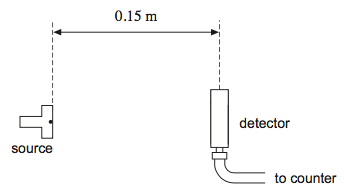
Fig 2.2 — Gamma source and detector arrangement

Fig 2.2 — Gamma source and detector arrangement

(a)(i) Calculate the corrected count rate expected when the gamma source is placed 0.90 m from the detector (corrected count rate at 0.15 m = 2010 min⁻¹). (3)
(a)(ii) Explain why the student should record for longer than 5 minutes at 0.90 m. (1)
(a)(iii) The count rate at 0.90 m is lower than expected. It is suggested the source also emits beta particles. Explain how this can be checked. (2)
Mark Scheme (a)(i) I ∝ 1/d²: I₂ = I₁ × (d₁/d₂)² = 2010 × (0.15/0.90)² = 2010/36 ≈ 55.8 counts min⁻¹ [3]
(a)(ii) Count rate is very low at 0.90 m → longer recording reduces percentage uncertainty / improves statistical precision. [1]
(a)(iii) Place ~3 mm aluminium between source and detector. Measure count rate with and without the aluminium. If count rate drops significantly more than can be explained by absorption of gamma alone, beta particles are also present. [2]
Exam Q3 · Radiation Investigation (5 marks)
(a) Which radiation is most appropriate for sterilising metallic surgical instruments? Give a reason. (1)
(b)(i) Explain how to ensure only gamma is detected during an inverse-square law investigation, given a source emitting α, β, and γ. (2)
(b)(ii) The corrected gamma count rate is 64 counts s⁻¹ at 50 mm. Calculate the expected count rate at 80 mm. (2)
Model Answer (a) Gamma radiation — penetrates packaging/metal, kills micro-organisms, does not make instruments radioactive.
(b)(i) Place ~3 mm aluminium (stops α and β) between source and detector. Remaining count is due to γ only.
(b)(ii) I₂ = I₁(x₁/x₂)² = 64 × (50/80)² = 64 × 0.3906 = 25 counts s⁻¹
Exam Q4 · Inverse-Square Law Data Analysis (5 marks)
(c) A student records corrected count rates: d = 0.20 m → 9013 min⁻¹ | d = 0.50 m → 1395 min⁻¹ | d = 1.00 m → 242 min⁻¹. Show with calculations these are NOT consistent with an inverse-square law. (3)
(d) State two possible reasons why the results do not follow the inverse-square law. (2)
Model Answer (c) If I ∝ 1/d² then Id² = constant. 9013×(0.20)² = 360.5; 1395×(0.50)² = 348.8; 242×(1.00)² = 242. Not constant → NOT inverse-square law.
(d) Background not fully corrected; source is not a point source (extended source); gamma absorbed by air over long distances; nearby objects causing scattering.

Radioactive Decay

Do Now — Lesson 3

Prerequisite knowledge: exponential functions; natural logarithm (ln); unit conversions for time; concept of half-life from GCSE

Q1
A sample starts at 800 counts min⁻¹. Each 5 minutes the count rate halves. What is the count rate after: (a) 5 min, (b) 10 min, (c) 20 min? (3 marks)
Model Answer (a) 400 counts min⁻¹   (b) 200 counts min⁻¹   (c) 50 counts min⁻¹
Q2
State two reasons why radioactive decay is described as both random and spontaneous. (2 marks)
Model Answer Random: it cannot be predicted which specific nucleus will decay next, or when.
Spontaneous: external conditions (temperature, pressure, chemical state) have no effect on the decay rate.
Q3
Calculate: (a) ln(2); (b) e−1.386; (c) the value of t if ln 2 / t = 3600 s. (3 marks)
Model Answer (a) ln(2) = 0.693   (b) e−1.386 = 0.250   (c) t = ln2/3600 s = 1.93 × 10⁻⁴ s
Q4
Convert 4.5 × 10⁹ years into seconds. (1 year = 3.15 × 10⁷ s) (2 marks)
Model Answer 4.5 × 10⁹ × 3.15 × 10⁷ = 1.42 × 10¹⁷ s

Part 1 of 3 · Decay Constant and Activity

Radioactive decay is random (cannot predict which nucleus decays next) and spontaneous (unaffected by temperature, pressure, or chemical state).

Decay constant λ — the probability that a given nucleus decays per unit time. Unique to each isotope.  Units: s⁻¹

Activity A — number of nuclear decays per second.  1 Becquerel (Bq) = 1 decay per second.

A = −dN/dt = λN

The minus sign indicates N (number of undecayed nuclei) is decreasing. Activity decreases continuously as undecayed nuclei are used up.

Questions — Part 1

Q1
What is meant by the term 'decay constant'? Give its units. (2 marks)
Model Answer The decay constant λ is the probability per unit time that a nucleus will decay. Units: s⁻¹ (per second).
Q2
What is meant by the 'activity' of a radioactive source? State the unit. (2 marks)
Model Answer Activity is the number of nuclear decays per second from a radioactive sample. Unit: Becquerel (Bq), where 1 Bq = 1 decay per second.
Q3
A sample contains one mole of sodium (half-life = 2.6 years). Calculate: (a) the decay constant in s⁻¹; (b) the initial activity. (4 marks)
Model Answer (a) T½ = 2.6 × 3.15×10⁷ = 8.19×10⁷ s; λ = ln2 / T½ = 0.693 / 8.19×10⁷ = 8.46 × 10⁻⁹ s⁻¹
(b) N = 6.02×10²³; A = λN = 8.46×10⁻⁹ × 6.02×10²³ = 5.09 × 10¹⁵ Bq
Q4
What type of decay curve describes radioactive decay? (1 mark)
Model Answer Exponential decay curve — the activity (and number of undecayed nuclei) decreases exponentially with time.

Part 2 of 3 · Half-Life and Exponential Decay

Half-life T½ — the time taken for the number of undecayed nuclei (or the activity) to fall to half its initial value.

Exponential decay equations:

N = N₀e−λt     A = A₀e−λt     T½ = ln 2 / λ

Reading T½ from a graph: Choose any starting value; find the time for it to fall to half — that is T½. Repeat from a different starting point for reliability.

Linearising: Take ln of both sides: ln A = ln A₀ − λt. A graph of ln A vs t gives a straight line with gradient −λ.
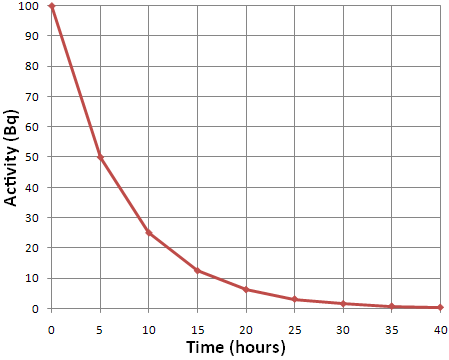
Fig 3.1 — Activity vs time (exponential decay)
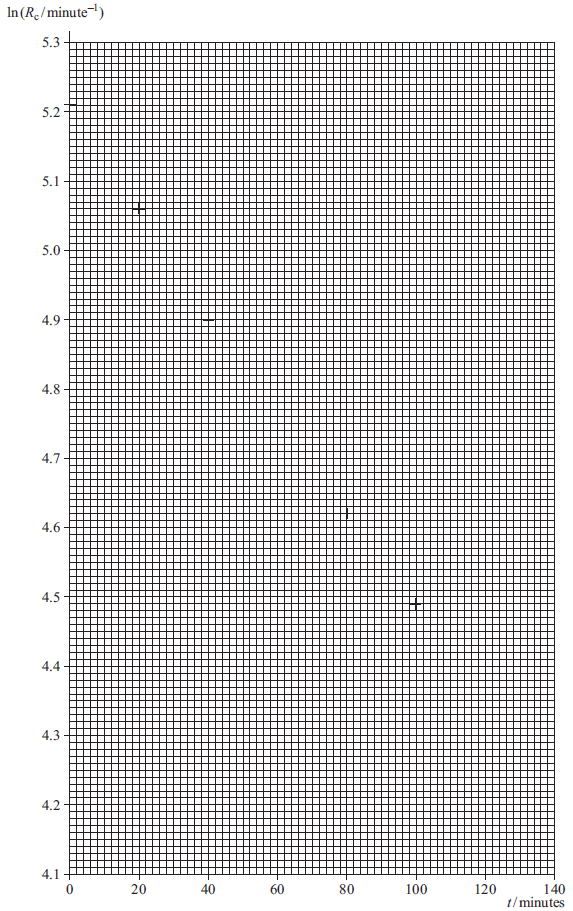
Fig 3.1 — Activity vs time

Fig 3.2 — ln(activity) vs time (straight line)

Fig 3.2 — ln(activity) vs time

Questions — Part 2

Q5
How are the decay constant and half-life related? State the equation. (2 marks)
Model Answer T½ = ln 2 / λ = 0.693 / λ. A larger decay constant gives a shorter half-life.
Q6
Iodine-124 has a half-life of 4.2 days. Estimate the fraction of the original sample remaining after 10 days. (3 marks)
Model Answer λ = ln2 / (4.2 × 86400) = 1.91 × 10⁻⁶ s⁻¹
N/N₀ = e−λt = e−1.91×10⁻⁶ × 10×86400 = e−1.6500.19 (about 19%)
(Alternatively: 10/4.2 ≈ 2.38 half-lives → fraction = (½)^2.38 ≈ 0.19)
Q7
Background-corrected count rates (counts min⁻¹) for Zn-63 were measured: t=0: 229; t=0.5h: 128; t=1.0h: 71; t=1.5h: 46; t=2.0h: 26; t=2.5h: 19; t=3.0h: 7. (a) Describe how you would find the half-life from a graph of count rate vs time. (b) Describe how plotting ln(count rate) vs time would give a more reliable value. (4 marks)
Model Answer (a) Plot count rate vs time. Draw a smooth curve. Choose a convenient starting value (e.g. 200 counts min⁻¹), read the time when it falls to 100. Repeat from another starting value and average the result.
(b) Plot ln(count rate) vs time — this gives a straight line with gradient −λ. T½ = ln2/λ. A straight-line graph is more reliable as it uses all data points and allows best-fit line.
Q8
Explain how you would find the half-life of a substance if it is known to be more than 10,000 years, given that a sample can be isolated. (3 marks)
Model Answer Measure the activity A of a known mass of the sample. Calculate N (number of undecayed nuclei) from the mass and molar mass. Use λ = A/N to find the decay constant. Then T½ = ln2/λ.

Part 3 of 3 · Radioactive Dating and Medical Applications

Carbon dating: Living wood continuously exchanges carbon with the atmosphere, maintaining a constant ratio of ¹⁴C to ¹²C (1 in 10¹²). Once wood is cut, ¹⁴C decays without replacement. The age is found from:

A = A₀e−λt  ⟹  t = (1/λ) × ln(A₀/A)

Limitations: Assumes constant atmospheric ¹⁴C ratio; very low activity gives large statistical uncertainty; contamination affects results.

Medical tracers (e.g. Tc-99m) are injected and detected externally by gamma cameras. Requirements:

Questions — Part 3

Q9
In living wood, 1 in 10¹² carbon atoms is radioactive ¹⁴C with a decay constant of 3.84 × 10⁻¹² s⁻¹. A sample of 3.00 × 10²³ carbon atoms is taken from living wood. (a) Calculate the half-life of ¹⁴C in years. (1 year = 3.15 × 10⁷ s) (b) Show that the activity of ¹⁴C in this living wood sample is approximately 1.15 Bq. (5 marks)
Model Answer (a) T½ = ln2/λ = 0.693/(3.84×10⁻¹²) = 1.804×10¹¹ s = 1.804×10¹¹ / 3.15×10⁷ ≈ 5730 years
(b) NC-14 = 3.00×10²³ / 10¹² = 3.00×10¹¹; A = λN = 3.84×10⁻¹² × 3.00×10¹¹ = 1.15 Bq ✓
Q10
A 3.00 × 10²³ carbon sample from an ancient boat has a ¹⁴C activity of 0.65 Bq. Calculate the age of the ancient boat in years. (λ = 3.84 × 10⁻¹² s⁻¹, 1 year = 3.15 × 10⁷ s) (3 marks)
Model Answer A₀ = 1.15 Bq (living wood, from Q9); A = 0.65 Bq
t = 1λ ln A₀A = (1/3.84×10⁻¹²) × ln(1.15/0.65) = 2.604×10¹¹ × 0.570 = 1.48×10¹¹ s
t = 1.48×10¹¹ / 3.15×10⁷ ≈ 4700 years
Q12
Explain why a gamma emitter such as Tc-99m is suitable for use as a medical tracer, while an alpha emitter would not be suitable. (3 marks)
Model Answer Gamma: penetrates the body so can be detected externally by a scanner; relatively low ionising power so less damage to tissue. Short half-life limits the radiation dose received.
Alpha emitter: would not be suitable because alpha is highly ionising, causing severe damage to surrounding cells and tissue if inside the body; also cannot be detected externally.
Q3
A scientist makes these measurements on a rock sample: decay rate of potassium = 0.16 Bq; mass of potassium = 0.6 × 10⁻⁶ g; mass of argon = 4.2 × 10⁻⁶ g (molar mass of K = 40 g mol⁻¹). Show that the decay constant of potassium is 1.8 × 10⁻¹⁷ s⁻¹ and its half-life is 1.2 × 10⁹ years. (4 marks)
Model Answer N = (0.6×10⁻⁶ / 40) × 6.02×10²³ = 9.03×10¹µ nuclei
λ = A/N = 0.16 / 9.03×10¹µ = 1.77×10⁻¹⁷ ≈ 1.8×10⁻¹⁷ s⁻¹
T½ = ln2/λ = 0.693/1.77×10⁻¹⁷ = 3.9×10¹⁶ s / (3.15×10⁷) = 1.2×10⁹ years
Q4
Calculate the age of the rock (originally no argon). λ = 1.77 × 10⁻¹⁷ s⁻¹. (4 marks)
Model Answer K decayed to Ar, so original N₀ = N(K now) + N(Ar). Mass ratio: 0.6 g K and 4.2 g Ar; molar mass same (K→38Ar, ~equal). N₀ proportional to (0.6+4.2)=4.8, N=0.6 (remaining).
N = N₀ e^(-λt) → t = (1/λ) ln(N₀/N) = (1/1.77×10⁻¹⁷) × ln(4.8/0.6)
= 5.65×10¹⁶ × ln(8) = 5.65×10¹⁶ × 2.079 = 1.17×10¹⁷ s
= 1.17×10¹⁷ / 3.15×10⁷ ≈ 3.7 × 10⁹ years
Q5
Identify and explain a difficulty involved in measuring the decay rate of 0.16 Bq. (2 marks)
Model Answer The activity (0.16 Bq = 0.16 decays per second) is extremely low and very close to background radiation levels. It would be very difficult to distinguish the signal from background noise without very long counting times (many days/weeks) to accumulate sufficient counts for statistical reliability.
Q11
Give two reasons why it is difficult to obtain a reliable age for the ancient boat from carbon dating. (2 marks)
Model Answer 1. The ratio of ¹⁴C to ¹²C in the atmosphere may not have remained constant over time (e.g. variation in cosmic ray intensity, industrial CO₂ dilution), making the assumed initial activity unreliable.
2. The very low activity (~0.65 Bq) gives large statistical uncertainty; contamination by modern carbon (e.g. from organisms re-occupying the boat or laboratory contamination) could falsely increase the measured activity.

Exam-Style Questions — Lesson 3

EXAM Q1 · Carbon Dating (11 marks)

Exam Q1a
What is meant by the decay constant? (1)
Model Answer The probability that a given nucleus will decay per unit time. Units: s⁻¹.
Exam Q1b
Calculate the half-life of 14C in years, given λ = 3.84 × 10⁻¹² s⁻¹ and 1 year = 3.15 × 10⁷ s. Give your answer to an appropriate number of significant figures. (3)
Model Answer T½ = ln2 / λ = 0.693 / (3.84×10⁻¹²) = 1.804×10¹¹ s
In years: 1.804×10¹¹ / 3.15×10⁷ = 5730 years (4 s.f.)
Exam Q1c
Show that the rate of decay of 14C atoms in a living wood sample where N₀(14C) = 3.00 × 10¹¹ is 1.15 Bq. (2)
Model Answer A = λN = 3.84×10⁻¹² × 3.00×10¹¹ = 1.152 ≈ 1.15 Bq
Exam Q1d
A sample from an ancient boat has an activity of 0.65 Bq. Calculate the age of the boat in years. (3)
Model Answer t = (1/λ) ln(A₀/A) = (1/3.84×10⁻¹²) × ln(1.15/0.65)
= 2.604×10¹¹ × ln(1.769) = 2.604×10¹¹ × 0.5710
= 1.487×10¹¹ s = 1.487×10¹¹ / 3.15×10⁷ = 4720 years
Exam Q1e
Give two reasons why it is difficult to obtain a reliable age from this carbon dating. (2)
Model Answer 1. The ratio of ¹⁴C to ¹²C in the atmosphere may not have remained constant over time (e.g. due to variations in cosmic ray flux or industrial CO₂ emissions).
2. The very low activity (0.65 Bq) gives large statistical uncertainty in count measurements; contamination with modern carbon could also affect results.

EXAM Q2 · Half-Life Experiment (10 marks)

Fig 3.4 — Graph of ln(R) vs time for determining half-life
Fig 3.4 — Graph of ln(Rc) vs time for determining half-life by gradient
Exam Q2a
A correction has been made to count rate R to give corrected count rate Rc. Explain why this correction is needed, and deduce its value from the table where R at t = 0 is 203 min⁻¹ and Rc at t = 0 is 183 min⁻¹. (2)
Model Answer Background radiation contributes to the measured count rate and must be subtracted to find the count rate due to the source alone. Background = 203 − 183 = 20 min⁻¹.
Exam Q2b
A graph of ln(Rc) vs time gives a straight line. Using the values: at t = 0, ln Rc = 5.21; at t = 100 min, ln Rc = 4.49; determine the gradient and hence the half-life. (5)
Model Answer Gradient = (4.49 − 5.21) / (100 − 0) = −0.72/100 = −7.2×10⁻³ min⁻¹
Since gradient = −λ: λ = 7.2×10⁻³ min⁻¹
T½ = ln2 / λ = 0.693 / 7.2×10⁻³ = 96 min
Exam Q2c
What type of error occurs in radioactive count measurements due to the random nature of decay? (1)
Model Answer Random error — the number of decays in any given time interval fluctuates randomly around the mean.
Exam Q2d
The smallest total count C in the table is 546. Calculate (i) the uncertainty in C and (ii) the percentage uncertainty. (2)
Model Answer (i) Uncertainty = √C = √546 = 23.4 ≈ 23
(ii) Percentage uncertainty = (23.4/546) × 100 = 4.3%

Modes of Decay

Do Now — Lesson 4

Prerequisite knowledge: nuclear notation (AZX); conservation of nucleon and proton number; types of decay and particles emitted; antineutrinos

Q1
The isotope ²³⁸₉₂U undergoes alpha decay. State the nucleon number and proton number of the daughter nucleus, and name the element. (2 marks)
Model Answer Daughter nucleus: A = 238−4 = 234, Z = 92−2 = 90. Element: Thorium (Th).
Equation: ²³⁸₉₂U → ²³⁴₉₀Th + ⁴₂He
Q2
Write the nuclear equation for the beta-minus decay of ¹⁴₆C, including all particles emitted. (3 marks)
Model Answer ¹⁴₆C → ¹⁴₇N + ⁰₋₁e + ν̄e
(Carbon-14 decays to nitrogen-14, emitting a beta-minus particle (electron) and an electron antineutrino.)
Q3
In alpha decay, state the change in: (a) proton number Z, (b) nucleon number A, (c) neutron number N. (3 marks)
Model Answer (a) Z decreases by 2   (b) A decreases by 4   (c) N decreases by 2
Q4
Gamma emission follows alpha or beta decay. State the change in Z and A during gamma emission, and explain why. (2 marks)
Model Answer Z and A both remain unchanged. Gamma emission involves only a release of energy (electromagnetic radiation) — no particles are emitted, so the proton and nucleon numbers do not change.

Part 1 of 3 · The N–Z Graph and Nuclear Stability

The N–Z graph (neutron number vs proton number) shows the region of nuclear stability — the 'valley of stability'.

Why more neutrons in heavy nuclei? Protons repel each other electrostatically. The strong nuclear force acts only at very short range (~1–3 fm). As Z increases, distant protons only feel Coulomb repulsion. Extra neutrons provide strong-force binding without adding electrostatic repulsion.

Position on the N–Z graph predicts decay mode:
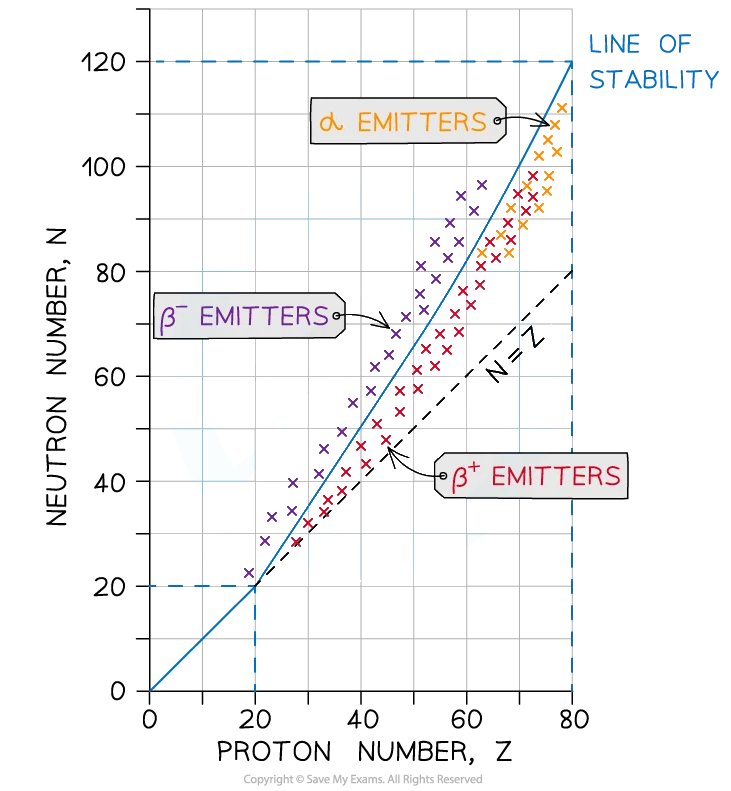
Fig 4.1 — N–Z stability graph (valley of stability)

Fig 4.1 — N–Z stability graph (valley of stability)

Questions — Part 1

Q1
Sketch a graph of neutron number N against proton number Z for stable nuclei over the range Z = 0 to 80. Show suitable values on the N axis. (2 marks)
Model Answer See diagram above. Starts along N = Z line for small Z, then curves above N = Z for large Z. N axis should show values up to ~120 for Z up to 80.
Q2
On your N–Z graph, mark a typical position for a nuclide that decays by: (i) α emission (label W), (ii) β⁻ emission (label X), (iii) β⁺ emission (label Y). (3 marks)
Model Answer W (α): top right of the graph (high Z, high N — large heavy nucleus).
X (β⁻): above the stability line (too many neutrons for its proton number).
Y (β⁺): below the stability line (too many protons for its neutron number).
Q3
Explain why, for low values of Z, stable nuclei have roughly equal numbers of protons and neutrons (N ≈ Z), whereas heavier stable nuclei have more neutrons than protons. (4 marks)
Model Answer For light nuclei: the strong force (short range) can act between all nucleons, binding them together with equal numbers of each providing the most stability.
For heavy nuclei: protons are further apart on average. The electrostatic repulsion between protons acts at longer range than the strong force. Extra neutrons provide additional binding (strong force) without adding to electrostatic repulsion — more neutrons than protons are needed to maintain stability.

Part 2 of 3 · Alpha, Beta-Minus, and Beta-Plus Decay

Alpha (α) Decay — ejects a helium-4 nucleus:

AZX → A−4Z−2Y + 42α

Loss: 2 protons, 2 neutrons. Moves the nuclide 2 left and 2 down on the N–Z graph.

Beta-minus (β⁻) Decay — a neutron transforms into a proton:

AZX → AZ+1Y + 0−1e + ν̄e

Loss: 1 neutron; Gain: 1 proton. Also emits an electron antineutrino. Moves nuclide 1 right, 1 down.

Beta-plus (β⁺) Decay — a proton transforms into a neutron:

AZX → AZ−1Y + 0+1e + νe

Loss: 1 proton; Gain: 1 neutron. Also emits an electron neutrino. Moves nuclide 1 left, 1 up.

Gamma (γ) emission — follows alpha or beta decay. The daughter nucleus is in an excited state and releases excess energy as a gamma photon. No change to Z or A.

Questions — Part 2

Q4
Write the equation for the alpha decay of radium-226 (Z = 88) to radon (Z = 86). (2 marks)
Model Answer ²²⁶₈₈Ra → ²²²₈₆Rn + ⁴₂He (α particle)
Q5
Write the equation for the beta-minus decay of carbon-14 (Z = 6) to nitrogen. (2 marks)
Model Answer ¹⁴₆C → ¹⁴₇N + ⁰₋₁e + ν̄e
Q6
A nuclide undergoes beta-plus decay. Describe what happens to: (a) the proton number, (b) the nucleon number. (2 marks)
Model Answer (a) Proton number Z decreases by 1. (b) Nucleon number A remains unchanged.
Q7
Describe what gamma ray emission is and explain why it produces no change in the nuclear structure. (2 marks)
Model Answer Gamma emission is the release of a high-energy electromagnetic photon from an excited daughter nucleus. No particles are emitted — only energy — so neither Z nor A changes.

Part 3 of 3 · Electron Capture and Nucleon Emission

Electron Capture: A proton-rich nucleus captures one of its own orbital electrons. The proton and electron combine to form a neutron and an electron neutrino:

AZX + 0−1e → AZ−1Y + νe

Effect: proton number decreases by 1, nucleon number unchanged. Same effect on N–Z graph as β⁺ decay.

Nucleon Emission (rare):

Decay chains: Heavy radioactive isotopes often undergo a series of alpha and beta decays before reaching a stable end-product. The decay sequence can be tracked on the N–Z graph.

Iodine-131 (treats overactive thyroid): decays by β⁻ to xenon, which then emits γ rays.
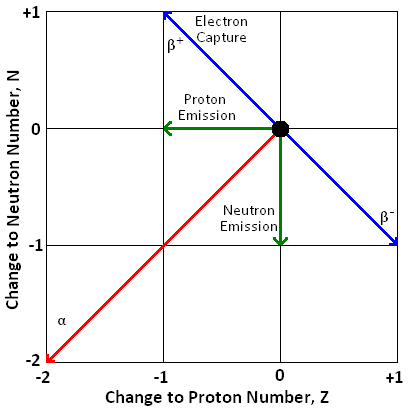
Fig 4.2 — Effect of each decay mode on proton/neutron numbers

Fig 4.2 — Effect of each decay mode on proton/neutron numbers

Questions — Part 3

Q8
Explain the process of electron capture. What change occurs to the proton number? (2 marks)
Model Answer ᴬ_Z X + ⁰_₋₁e → ᴬ_Z₋₁ Y + νe
Z decreases by 1; A remains unchanged. A neutrino is emitted.
Q9
The isotope 222Rn decays sequentially to 206Pb via alpha and beta-minus emissions. Four alpha particles are emitted. Calculate how many beta-minus particles are emitted. (3 marks)
Model Answer 4 alpha decays: A decreases by 4×4 = 16; Z decreases by 4×2 = 8.
After 4α: Z = 86 − 8 = 78, A = 222 − 16 = 206.
Target nucleus ²⁰⁶Pb has Z = 82, A = 206.
ΔZ needed = 82 − 78 = +4. Each β⁻ decay increases Z by 1.
4 beta-minus particles are emitted.
Q10
A nuclide is described as proton-rich. Discuss two ways in which it may decay. (4 marks)
Model Answer 1. Beta-plus (β⁺) decay: a proton converts to a neutron, emitting a positron (e⁺) and an electron neutrino (νe). The proton number Z decreases by 1; nucleon number A is unchanged. Moves the nucleus towards the line of stability.
2. Electron capture: the nucleus captures one of its inner orbital electrons; a proton combines with the electron to form a neutron and an electron neutrino is emitted. Z decreases by 1, A unchanged — same effect on the N–Z graph as β⁺ decay, but no positron is emitted.
Both processes increase N relative to Z, moving the nucleus back towards the line of stability.
Q11
Write the nuclear equation for the decay of iodine-131 by β⁻ emission. (2 marks)
Model Answer ¹³¹₅₃I → ¹³¹₅₄Xe + ⁰₋₁e + ν̅e
Mass number: 131 (unchanged). Proton number: 53 → 54 (+1). An electron antineutrino is also emitted.

Exam-Style Questions — Lesson 4

Exam Q1 · N–Z Graph and Decay Modes (12 marks)
(a) Sketch an N–Z graph for stable nuclei (Z = 0 to 80) and mark positions W (α emitter), X (β⁻ emitter), and Y (β⁺ emitter). (5)
(b) 222Rn decays to 206Pb via 4 alpha decays and n beta-minus decays. Calculate n. (2)
(c) A proton-rich nuclide can decay in two ways. Discuss both. (3)
(d) A nucleus of 208Pb decays by electron capture to thallium (Tl). Write the equation. (2)
Model Answer (a) Stability line: N = Z for small Z, curving above for Z > 20. W (α): top-right, heavy nuclei. X (β⁻): above stability line (too many neutrons). Y (β⁺): below stability line (too many protons).
(b) 4α removes 8 from Z: 86 → 78. Need Z = 82 (Pb), so β⁻ adds 4 to Z. n = 4
(c) β⁺ emission: proton → neutron + e⁺ + νe, Z decreases by 1. Electron capture: proton + orbital e⁻ → neutron + νe, Z also decreases by 1. Both move nuclide toward stability.
(d) 20882Pb + 0−1e → 20881Tl + νe
Exam Q2 · Technetium-99m Medical Use (3 marks)
Explain why the metastable form of technetium-99m (99m43Tc) is suitable for use in medical diagnosis. (3)
Model Answer Short half-life (~6 h) minimises radiation dose. Pure gamma emitter — penetrates tissue for external detection without depositing energy inside. Does not emit α or β which would cause unnecessary tissue damage. Can be attached to chemicals that target specific organs.
Exam Q3 · Nuclear Stability and Strong Force (9 marks)
(a)(i) Explain why, despite electrostatic repulsion between protons, nuclei of low nucleon number are stable. (3)
(a)(ii) Suggest why stable nuclei of higher nucleon number have more neutrons than protons. (3)
(a)(iii) All nuclei have approximately the same density. State what this suggests about the strong nuclear force. (3)
Model Answer (a)(i) The strong nuclear force acts between all nucleons at very short range (~1–3 fm) and is attractive. For small nuclei all nucleons are close enough for this to overcome electrostatic repulsion and bind the nucleus.
(a)(ii) As Z increases, protons further apart no longer all feel each other's strong force, only Coulomb repulsion. Extra neutrons provide additional strong-force binding without adding repulsion, stabilising the nucleus.
(a)(iii) Nuclear density is constant for all nuclei, meaning the strong force is short-range and saturating — each nucleon interacts only with nearest neighbours, so volume ∝ A.

Nuclear Radius

Do Now — Lesson 5

Prerequisite knowledge: electric potential energy (Coulomb's law); energy unit conversions (eV, MeV, J); de Broglie wavelength (λ = h/p); conditions for diffraction

Q1
Write the formula for electric potential energy between two point charges q and Q separated by distance r. State the unit of each quantity. (2 marks)
Model Answer EP = qQ / (4πε₀r)
q, Q in coulombs (C); r in metres (m); EP in joules (J); ε₀ = 8.85 × 10⁻¹² C² J⁻¹ m⁻¹
Q2
Convert 5.0 MeV into joules. (1 eV = 1.6 × 10⁻¹⁹ J) (2 marks)
Model Answer 5.0 MeV = 5.0 × 10⁶ × 1.6 × 10⁻¹⁹ = 8.0 × 10⁻¹³ J
Q3
State the de Broglie equation (λ = h/p) and calculate the wavelength of an electron with momentum 1.5 × 10⁻²⁴ kg m s⁻¹. (h = 6.63 × 10⁻³⁴ J s) (2 marks)
Model Answer λ = h/p = 6.63×10⁻³⁴ / 1.5×10⁻²⁴ = 4.42 × 10⁻¹⁰ m
Q4
For diffraction to reveal the structure of an object, what must be true of the wavelength of the incident wave relative to the size of the object? (2 marks)
Model Answer The wavelength must be comparable to or smaller than the size of the object being studied. If the wavelength is much larger, no significant diffraction occurs.

Part 1 of 3 · Closest Approach of Alpha Particles

When an alpha particle is fired head-on at a nucleus, it decelerates as the electrostatic repulsive force does work against it. At the point of closest approach, all KE has been converted to electric PE:

½mv² = qQ / (4πε₀r)   ⟹   r = qQ / (4πε₀ × ½mv²)

where q = 2e (alpha charge), Q = Ze (nuclear charge), ε₀ = 8.85 × 10⁻¹² C² J⁻¹ m⁻¹.

This gives an upper limit on the nuclear radius (the alpha stops before reaching the nucleus).

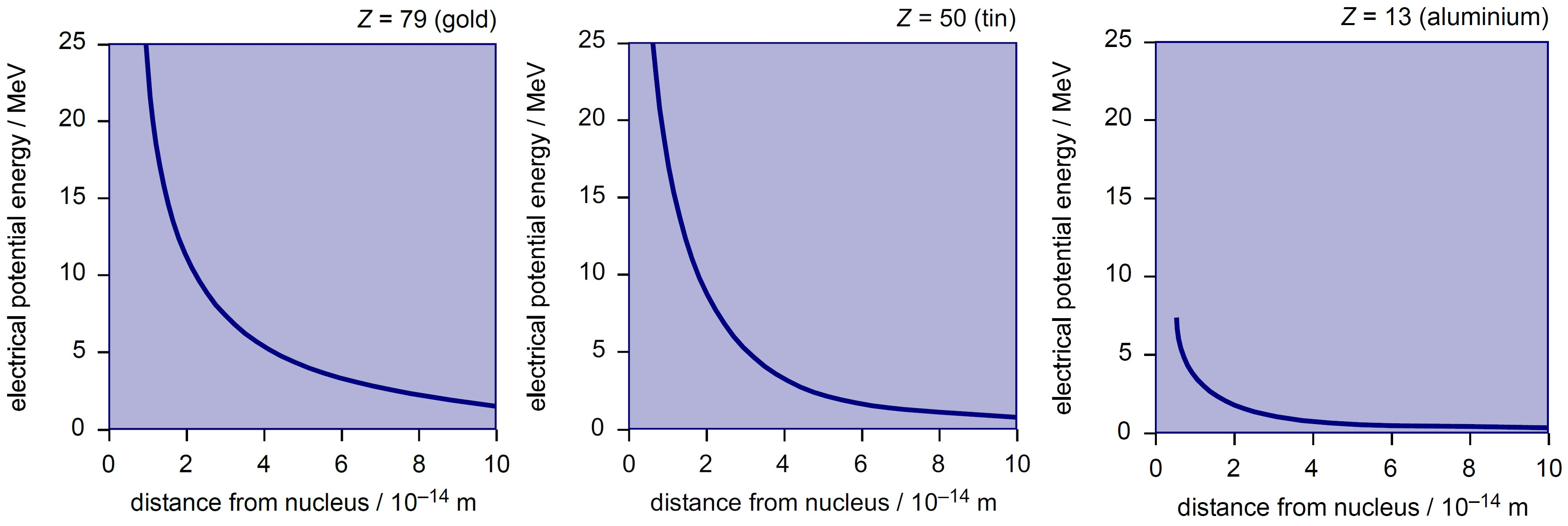
Example for gold (Z = 79): r ≈ 4.55 × 10⁻¹⁴ m. Modern measurements give ~6.5 fm.
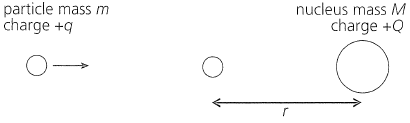
Fig 5.1 — Alpha particle approaching nucleus head-on

Fig 5.1 — Closest approach

Fig 5.2 — Electric PE vs distance for Au, Sn, Al

Fig 5.2 — Electric PE vs distance (Au, Sn, Al)

Questions — Part 1

Q1
An alpha particle (KE = 4.9 MeV) is directed head-on at a gold nucleus (Z = 79). Calculate the electric potential energy in joules at the point of closest approach. (1 eV = 1.6 × 10⁻¹⁹ J) (2 marks)
Model Answer EP = EK = 4.9 × 10⁶ × 1.6×10⁻¹⁹ = 7.84 × 10⁻¹³ J
Q2
Using Q1, calculate r, the distance of closest approach. (e = 1.6 × 10⁻¹⁹ C, ε₀ = 8.85 × 10⁻¹² C² J⁻¹ m⁻¹, Z_gold = 79) (3 marks)
Model Answer r = qQ/(4πε₀EK) = (2e × 79e)/(4πε₀ × EK)
r = (2 × 79 × (1.6×10⁻¹⁹)²) / (4π × 8.85×10⁻¹² × 7.84×10⁻¹³)
r = (2 × 79 × 2.56×10⁻³⁸) / (1.108×10⁻²³)
r ≈ 4.6 × 10⁻¹⁴ m
Q3
The target is changed to a nucleus with fewer protons. The alpha particle has the same initial KE. Explain, without calculation, what happens to the distance of closest approach. (2 marks)
Model Answer The distance of closest approach decreases. With fewer protons (smaller Z), the nuclear charge Q is smaller, so less work needs to be done against the repulsive force — the alpha particle can get closer before its kinetic energy is used up.
Q4
At a distance r = 1.0 × 10⁻¹⁴ m from a gold nucleus (Z = 79), show that the electrical potential energy of an alpha particle is between 20 and 25 MeV. (3 marks)
Model Answer EP = qQ/(4πε₀r) = (2 × 79 × (1.6×10⁻¹⁹)²) / (4π × 8.85×10⁻¹² × 1.0×10⁻¹⁴)
EP = (2 × 79 × 2.56×10⁻³⁸) / (1.112×10⁻²⁴) = 3.63×10⁻¹² J
Converting: 3.63×10⁻¹² / 1.6×10⁻¹³ = 22.7 MeV ✓ (between 20 and 25 MeV)

Part 2 of 3 · Electron Diffraction

High-energy electrons (hundreds of MeV) are diffracted by atomic nuclei. The de Broglie wavelength must be comparable to nuclear diameters (~few fm) for diffraction to reveal nuclear structure.

de Broglie wavelength (relativistic electrons, p = E/c approximation):

λ = h/p ≈ hc/E  (where E is kinetic energy in joules)

First diffraction minimum — gives nuclear diameter D:

sin θ ≈ 0.61λ/D

Electrons at 400 MeV have λ ≈ 3 × 10⁻¹⁵ m — comparable to nuclear diameters, giving finer resolution than X-rays for nuclear-scale features.
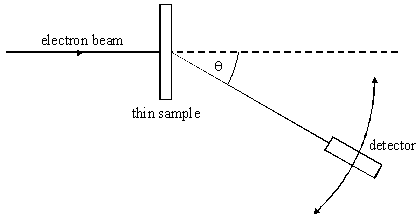
Fig 5.3 — Electron intensity vs scattering angle

Fig 5.3 — Electron intensity vs angle
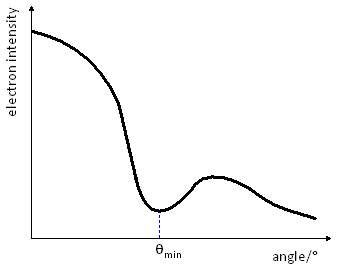
Fig 5.4 — Electron diffraction setup

Fig 5.4 — Electron diffraction setup

Questions — Part 2

Q5
In an electron diffraction experiment, electrons of energy 5.94 × 10⁻¹¹ J are fired at oxygen-16 nuclei. Show that the de Broglie wavelength is about 3.3 × 10⁻¹⁵ m. (Use approximation: p = E/c) (2 marks)
Model Answer p = E/c = 5.94×10⁻¹¹ / 3×10⁸ = 1.98×10⁻¹⁹ kg m s⁻¹
λ = h/p = 6.63×10⁻³⁴ / 1.98×10⁻¹⁹ ≈ 3.35 × 10⁻¹⁵ m ✓
Q6
For the oxygen-16 experiment above, the first minimum occurs at θ ≈ 41°. Calculate the radius of an oxygen-16 nucleus. (2 marks)
Model Answer sin θ = 0.61λ/D → D = 0.61λ/sin θ = 0.61 × 3.35×10⁻¹⁵ / sin 41° = 2.04×10⁻¹⁵ / 0.656 ≈ 3.1×10⁻¹⁵ m
Radius R = D/2 ≈ 1.55 × 10⁻¹⁵ m
Q7
Show that 400 MeV electrons have a de Broglie wavelength of about 3.0 × 10⁻¹⁵ m. (3 marks)
Model Answer E = 400 × 10⁶ × 1.6×10⁻¹⁹ = 6.4×10⁻¹¹ J
λ = hc/E = (6.63×10⁻³⁴ × 3×10⁸) / 6.4×10⁻¹¹ = 1.989×10⁻²⁵ / 6.4×10⁻¹¹ = 3.11×10⁻¹⁵ m ≈ 3.0 × 10⁻¹⁵ m ✓
Q8
A beam of 400 MeV electrons is scattered by carbon-12 nuclei. The first diffraction minimum is at 42°. Calculate the radius of a carbon-12 nucleus. (3 marks)
Model Answer λ ≈ 3.0 × 10⁻¹⁵ m (from Q7); D = 0.61λ/sin 42° = 0.61 × 3.0×10⁻¹⁵ / 0.669 = 2.74×10⁻¹⁵ m
Radius R = D/2 ≈ 1.37 × 10⁻¹⁵ m (about 1.4 fm)

Part 3 of 3 · Nuclear Radius Formula and Nuclear Density

Plotting nuclear radius R vs A1/3 gives a straight line through the origin, showing:

R = r₀A1/3  where r₀ ≈ 1.2–1.5 fm (radius of a single nucleon)

Nuclear density — the A cancels out, giving the same value for all nuclei:

ρ = mass/volume = Au / (⁴⁄₃πr₀³A) = u / (⁴⁄₃πr₀³) ≈ 1.4 × 10¹⁷ kg m⁻³

This is ~10¹⁴ × denser than ordinary matter (~10³ kg m⁻³), confirming atoms are almost entirely empty space.

Constant density implies the strong nuclear force is saturated — each nucleon interacts only with its nearest neighbours, not all others. Volume ∝ A.
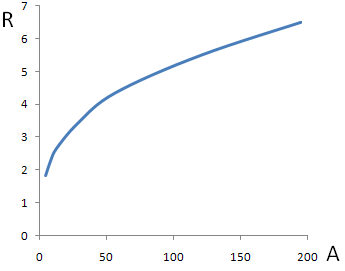
Fig 5.5 — R vs A (curve)
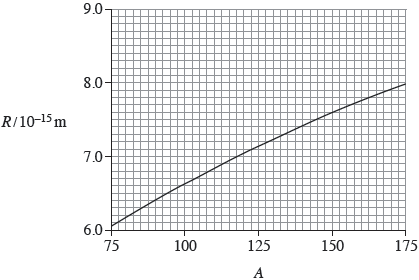
Fig 5.5 — R vs A (curve)

Fig 5.6 — R vs A^(1/3) (straight line)

Fig 5.6 — R vs A1/3 (linear)

Questions — Part 3

Q9
The radius of the gold nucleus is R = 7.16 × 10⁻¹⁵ m. Given R = r₀A1/3 and r₀ = 1.23 × 10⁻¹⁵ m, determine the number of nucleons in gold. (3 marks)
Model Answer (a) R = 1.3 × 12^(1/3) = 1.3 × 2.29 = 2.98 × 10⁻¹⁵ m ≈ 3.0 fm
(b) R = 1.3 × 238^(1/3) = 1.3 × 6.20 = 8.06 × 10⁻¹⁵ m ≈ 8.1 fm
Q10
Show that the radius of a 51V nucleus (A = 51) is about 5 × 10⁻¹⁵ m. (r₀ = 1.4 × 10⁻¹⁵ m) (2 marks)
Model Answer ρ = u / (⁴⁄₃πr₀³) = 1.66×10⁻²⁷ / (⁴⁄₃ × π × (1.3×10⁻¹⁵)³)
= 1.66×10⁻²⁷ / (⁴⁄₃ × π × 2.197×10⁻⁴⁵)
= 1.66×10⁻²⁷ / 9.20×10⁻⁴⁵
= 1.80×10¹⁷ kg m⁻³ ✓ (close to 3.4×10¹⁷ — small differences due to r₀ value chosen)
Q11
Calculate the density of a 51V nucleus. (u = 1.66 × 10⁻²⁷ kg, r₀ = 1.4 × 10⁻¹⁵ m) (3 marks)
Model Answer If the strong force were not saturated, each nucleon would attract all others and the nucleus would get denser as A increases. Constant density means each nucleon only interacts with its immediate neighbours — the force is short-range and saturated.

Questions — Additional

Add Q1
Show that if a first dark ring is seen at θ = 30°, the circular objects have diameter approximately twice the wavelength. [Use simplified formula sin θ = λ/d.] (2 marks)
Model Answer sin 30° = 0.5 = λ/d → d = λ/0.5 = 2λ. So diameter ≈ twice the wavelength. ✓
Add Q2
Use sin θ = 1.22λ/d to find the angle of the first dark ring for particles four wavelengths in diameter. (2 marks)
Model Answer sin θ = 1.22λ/(4λ) = 1.22/4 = 0.305 → θ = arcsin(0.305) ≈ 17.8°
Add Q3
Calculate the energy in joules of an electron with energy 100 MeV. (1 eV = 1.6 × 10⁻¹⁹ J) (2 marks)
Model Answer E = 100×10⁶ × 1.6×10⁻¹⁹ = 1.6 × 10⁻¹± J
Add Q4
Calculate the momentum of a 100 MeV electron. (c = 3.0 × 10⁸ m s⁻¹) (2 marks)
Model Answer p = E/c = 1.6×10⁻¹± / 3×10⁸ = 5.33 × 10⁻²² kg m s⁻¹
Add Q5
Calculate the de Broglie wavelength of 100 MeV electrons. (h = 6.63 × 10⁻³⁴ J s) (2 marks)
Model Answer λ = h/p = 6.63×10⁻³⁴ / 5.33×10⁻²² = 1.24 × 10⁻¹² m
Add Q6
The radius of a proton or neutron is ~1.2 × 10⁻¹⁵ m. What is the approximate ratio of the wavelength of 100 MeV electrons to the diameter of a proton? (2 marks)
Model Answer Proton diameter = 2×1.2×10⁻¹⁵ = 2.4×10⁻¹⁵ m
Ratio = 1.24×10⁻¹² / 2.4×10⁻¹⁵ = 517 ≈ 500
100 MeV electrons have wavelength ~500 times the proton diameter — too large to resolve individual nucleon structure.
Add Q7
A beam of 400 MeV electrons is scattered by carbon-12 nuclei (A = 12). The first minimum is at θ = 42° (sinθ = 0.67). Use λ = hc/E to show the radius of the carbon-12 nucleus is about 2.7 × 10⁻¹⁵ m. (3 marks)
Model Answer E = 400×10⁶ × 1.6×10⁻¹⁹ = 6.4×10⁻¹± J
λ = hc/E = (6.63×10⁻³⁴×3×10⁸) / 6.4×10⁻¹± = 3.11×10⁻¹⁵ m
sinθ = 0.61λ/R → R = 0.61×3.11×10⁻¹⁵ / 0.67 = 2.83 ≈ 2.7 × 10⁻¹⁵ m
Add Q8
A uranium-238 nucleus has a radius of about 7.4 × 10⁻¹⁵ m. Roughly what energy of electrons would be needed to determine its size? (2 marks)
Model Answer Need λ ≈ R = 7.4×10⁻¹⁵ m
E = hc/λ = (6.63×10⁻³⁴×3×10⁸) / 7.4×10⁻¹⁵ = 2.69×10⁻¹² J = 2.69×10⁻¹²/1.6×10⁻¹⁹ MeV ≈ 17 MeV

Exam-Style Questions — Lesson 5

Exam Q1 · Electron Diffraction and Nuclear Size (8 marks)
High-energy electrons are used to determine nuclear radii.

(a) Explain why high-energy electrons rather than low-energy electrons are used for this purpose. (2)

(b) A beam of electrons with de Broglie wavelength 3.3 × 10⁻¹⁵ m is diffracted by gold nuclei (A = 197). The first diffraction minimum is at θ = 11°. Calculate the radius of the gold nucleus. (3)

(c) Use R = r₀A^(1/3) to find r₀, and comment on your answer. (r₀ ≈ 1.2–1.5 fm is expected) (3)
Mark Scheme (a) High-energy electrons have shorter de Broglie wavelength (λ = h/p = hc/E), which must be comparable to or smaller than nuclear dimensions (~10⁻¹⁵ m). Low-energy electrons have too large a wavelength to resolve nuclear structure. [2]
(b) D = 0.61λ/sin θ = 0.61 × 3.3×10⁻¹⁵ / sin 11° = 2.013×10⁻¹⁵ / 0.191 = 1.054×10⁻¹⁴ m; R = D/2 ≈ 5.3 × 10⁻¹⁵ m [3]
(c) r₀ = R/A^(1/3) = 5.3×10⁻¹⁵ / 197^(1/3) = 5.3×10⁻¹⁵ / 5.82 ≈ 9.1 × 10⁻¹⁶ m ≈ 0.91 fm. This is at the low end of the expected range — variations occur because r₀ depends on the specific nucleon structure and method. [3]

Mass & Energy

Do Now — Lesson 6

Prerequisite knowledge: Einstein's E = mc²; atomic mass units (u); nuclear notation; concept of binding energy

Q1
State Einstein's mass-energy equation and calculate the energy released when a mass of 3.0 × 10⁻²⁹ kg is converted to energy. (c = 3.0 × 10⁸ m s⁻¹) (3 marks)
Model Answer E = mc²; E = 3.0×10⁻²⁹ × (3.0×10⁸)² = 3.0×10⁻²⁹ × 9×10¹⁶ = 2.7 × 10⁻¹² J
Q2
1 u = 1.66 × 10⁻²⁷ kg. A proton has mass 1.00728 u. Calculate its mass in kg. (2 marks)
Model Answer mp = 1.00728 × 1.66×10⁻²⁷ = 1.672 × 10⁻²⁷ kg
Q3
A nucleus of ⁵⁹₂₇Co has Z = 27. State the number of neutrons. Calculate the total mass of the separated protons and neutrons. (mp = 1.00728 u, mn = 1.00867 u) (3 marks)
Model Answer N = 59 − 27 = 32 neutrons
Total mass = 27 × 1.00728 + 32 × 1.00867 = 27.197 + 32.277 = 59.474 u
Q4
State what is meant by the binding energy of a nucleus in one sentence. (2 marks)
Model Answer The binding energy of a nucleus is the minimum energy required to completely separate the nucleus into its constituent protons and neutrons.

Part 1 of 3 · Mass Defect

The mass of a nucleus is always less than the total mass of its separated protons and neutrons. This difference is the mass defect Δm:

Δm = (Z × mp + N × mn) − mnucleus

Example — Helium-4 (2p + 2n): Mass of nucleons = 6.696 × 10⁻²⁷ kg; Mass of nucleus = 6.648 × 10⁻²⁷ kg; Δm = 0.029 u

ParticleMass (kg)Mass (u)
Proton1.673 × 10⁻²⁷1.00728
Neutron1.675 × 10⁻²⁷1.00867
Electron9.11 × 10⁻³¹0.00055

1 atomic mass unit:  1 u = 1.661 × 10⁻²⁷ kg

Questions — Part 1

Q1
Define the mass defect of a nucleus. (2 marks)
Model Answer The mass defect is the difference between the total mass of the separate constituent nucleons (protons and neutrons) and the actual mass of the nucleus. Δm = (Zmp + Nmn) − mnucleus
Q2
In Cockcroft and Walton's experiment: ¹H + ⁷Li → ⁴He + ⁴He. Masses: H = 1.0073 u, Li = 7.0160 u, He = 4.0015 u. Show that the mass decreases and calculate Δm. (3 marks)
Model Answer Mass before = 1.0073 + 7.0160 = 8.0233 u
Mass after = 2 × 4.0015 = 8.0030 u
Δm = 8.0233 − 8.0030 = 0.0203 u (mass decreases ✓)
Q3
Each alpha particle produced in Cockcroft and Walton's experiment had energy 8.5 MeV. Calculate the total kinetic energy gained and show it is consistent with ΔE = Δmc². (1 u = 931.3 MeV/c²) (3 marks)
Model Answer Total KE = 2 × 8.5 = 17.0 MeV
ΔE = Δm × 931.3 = 0.0203 × 931.3 = 18.9 MeV
Consistent within experimental error (the ~1.9 MeV difference is due to the kinetic energy of the incident proton). ✓

Part 2 of 3 · Binding Energy and Einstein's E = mc²

Einstein's mass-energy equivalence:

E = mc²

The binding energy of a nucleus is the energy required to completely separate it into its constituent protons and neutrons. It equals the mass defect times c²:

EB = Δm × c²

The mass defect arises because energy is released when nucleons bind together (strong force pulls them into a lower energy state). The 'missing' mass has been converted to this released energy.

Convenient unit: 1 u = 931.3 MeV/c²  (i.e. 1 u of mass defect ≡ 931.3 MeV of binding energy)

Example — Helium-4: Δm = 0.029 u → EB = 0.029 × 931.3 = 27 MeV

Questions — Part 2

Q4
State what is meant by the binding energy of a nucleus. (2 marks)
Model Answer The binding energy is the energy needed to completely separate a nucleus into its individual constituent protons and neutrons (it equals the energy equivalent of the mass defect: Ebinding = Δmc²).
Q5
Calculate the binding energy of a ⁵⁹Co nucleus in MeV. (nuclear mass = 58.93320 u; mp = 1.00728 u; mn = 1.00867 u; 1 u = 931.3 MeV/c²; Co-59 has Z = 27, N = 32) (4 marks)
Model Answer Mass of nucleons = 27 × 1.00728 + 32 × 1.00867 = 27.196 + 32.277 = 59.474 u
Δm = 59.474 − 58.933 = 0.541 u
Ebinding = 0.541 × 931.3 = 504 MeV
Q6
Calculate the average binding energy per nucleon of ⁶⁴Zn (Z = 30, N = 34). (atom mass = 63.92915 u; mp = 1.00728 u; mn = 1.00867 u; me = 0.00055 u; 1 u = 931.3 MeV) (5 marks)
Model Answer Mass of nucleons = 30 × 1.00728 + 34 × 1.00867 = 30.218 + 34.295 = 64.513 u
(Subtract electron masses: nuclear mass = 63.929 − 30 × 0.00055 = 63.929 − 0.0165 = 63.913 u)
Δm = 64.513 − 63.913 = 0.600 u
Ebinding = 0.600 × 931.3 = 558.8 MeV
BE per nucleon = 558.8 / 64 ≈ 8.73 MeV/nucleon

Part 3 of 3 · The Binding Energy Per Nucleon Graph

The graph of binding energy per nucleon vs nucleon number A is one of the most important in nuclear physics:

A higher binding energy per nucleon means more energy is needed to remove a nucleon → more stable.

Fusion: Light nuclei (A < 56) fusing release energy — products have higher BE/nucleon than reactants.

Fission: Heavy nuclei (A > 56) splitting release energy — fragments have higher BE/nucleon than the parent.
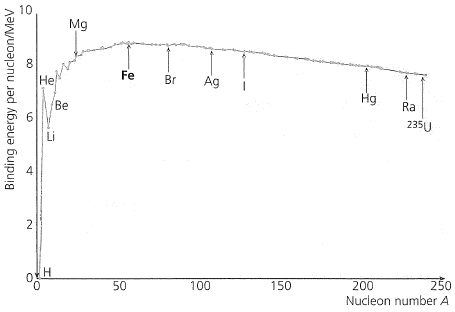
Fig 6.1 — Binding energy per nucleon vs nucleon number

Fig 6.1 — Binding energy per nucleon vs nucleon number

Questions — Part 3

Q7
Why would you expect 64Zn to be very stable based on its binding energy per nucleon? (1 mark)
Model Answer Its binding energy per nucleon (~8.7 MeV) is near the maximum on the BE/nucleon curve (peak is ~8.8 MeV at Fe-56). A high BE/nucleon means a large amount of energy is needed to remove a nucleon — the nucleus is tightly bound.
Q8
Explain why energy is released in nuclear fission of uranium-235. (2 marks)
Model Answer U-235 has a lower binding energy per nucleon (~7.6 MeV) than its fission fragments (typically ~8.4–8.5 MeV/nucleon). The fragments are more tightly bound — energy is released equal to the increase in total binding energy.
Q9
Explain why nuclear fusion of hydrogen isotopes releases energy. (2 marks)
Model Answer Deuterium (2H) has BE/nucleon ~1.1 MeV; tritium (3H) has BE/nucleon ~2.8 MeV. The helium-4 product has BE/nucleon ~7.1 MeV — a substantial increase. The products are more tightly bound than the reactants; energy is released as kinetic energy.
Q10
The fission of U-235: 235U + n → 133Sb + 99Nb + 4n. The mass of 235U = 235.0439 u, Sb-133 = 132.9152 u, Nb-99 = 98.9116 u, neutron = 1.0087 u. Show that the energy change per fission is about 200 MeV. (4 marks)
Model Answer Mass of reactants: 235.0439 + 1.0087 = 236.0526 u
Mass of products: 132.9152 + 98.9116 + 4×1.0087 = 231.8616 + 4.0348 = 235.8964 u
Δm = 236.0526 − 235.8964 = 0.1562 u
ΔE = 0.1562 × 931.3 ≈ 145.5 MeV ≈ ~150 MeV
(Note: book says ~200 MeV — different products give different values; typical range is 150–200 MeV)

Additional — Change in Energy & Mass (Cockcroft-Walton)

In Cockcroft and Walton's 1932 experiment, protons (energy 0.8 MeV) bombarded lithium: ¹H + ⁷Li → ⁴He + ⁴He. Masses (u): H = 1.0073, Li = 7.0160, He = 4.0015. 1 u = 931 MeV/c².

Add Q1
Show that mass decreases in this reaction. Calculate Δm in u and kg. (1 u = 1.6605 × 10⁻²⁷ kg) (3 marks)
Model Answer Reactants: 1.0073 + 7.0160 = 8.0233 u
Products: 2 × 4.0015 = 8.0030 u
Δm = 8.0233 − 8.0030 = 0.0203 u = 0.0203 × 1.6605×10−27 = 3.37 × 10⁻²⁹ kg (mass decreases ✓)
Add Q2
Each alpha particle had energy 8.5 MeV. Calculate the total kinetic energy gained and show it is consistent with E = mc². (3 marks)
Model Answer Total KE of 2 alphas = 2 × 8.5 = 17 MeV; initial proton KE ~0.8 MeV (Li ~0 KE). Net gain ≈ 17 − 0.8 = 16.2 MeV
E = mc² = 0.0203 × 931.3 = 18.9 MeV
These are consistent to within experimental uncertainty (some energy carried by recoil/neutrinos).
Add Q3
Two deuterium nuclei can fuse: 2H + 2H → 3He + n. Masses: 2H = 2.014102 u, 3He = 3.016030 u, n = 1.008665 u. Calculate the energy released per fusion event in MeV and joules. (4 marks)
Model Answer Δm = 2 × 2.014102 − (3.016030 + 1.008665) = 4.028204 − 4.024695 = 0.003509 u
E = 0.003509 × 931.3 = 3.27 MeV
In joules: 3.27 × 106 × 1.6×10−19 = 5.23 × 10⁻¹³ J

Additional — Fusion in a Kettle

The ratio of deuterium (2H) atoms to ordinary hydrogen in water is roughly 1:7000. A litre of water contains about 55.6 moles (H2O molar mass ≈ 18 g mol−1). Deuterium fusion releases about 3.27 MeV per pair of nuclei fused.

Kettle Q1
Write the balanced equation for the fusion of two deuterium nuclei 2H to give 3He plus one other particle. (2 marks)
Model Answer 2H + 2H → 3He + 1n
(Check: A: 2+2=4 → 3+1 ✓; Z: 1+1=2 → 2+0 ✓)
Kettle Q2
A litre of water contains about 55.6 moles. How many H2O molecules does it contain? (NA = 6.02 × 10²³ mol−1) (2 marks)
Model Answer N = 55.6 × 6.02×1023 = 3.35 × 1025 molecules
Kettle Q3
How many molecules of heavy water (D2O, with two deuterium atoms) are in the kettle? (ratio D:H ≈ 1:7000 so 1 in 7000 water molecules is D2O — approximately) (2 marks)
Model Answer N(D2O) = 3.35×1025 / 7000 = 4.78 × 10²¹ molecules
Each has 2 deuterium atoms, so 2 × 4.78×1021 = 9.56×10²¹ D atoms
Kettle Q4
Each pair of deuterium nuclei that fuses releases 5.23 × 10⁻¹³ J. Calculate the total energy released if all the deuterium in the kettle fused. (3 marks)
Model Answer Pairs available = 9.56×10²¹/2 = 4.78×10²¹
Total energy = 4.78×1021 × 5.23×10−13 = 2.50 × 10⁹ J
Kettle Q5
It requires 4200 J to heat 1 kg of water by 1 K. How many litres of water could be heated through 100 K by the fusion energy calculated above? (2 marks)
Model Answer Energy to heat 1 litre by 100 K = 4200 × 1 × 100 = 420,000 J
Litres heated = 2.50×10⁹ / 4.2×1055950 litres

Exam-Style Questions — Lesson 6

EXAM Q1 · Binding Energy of Zinc-64 (12 marks)

Exam Q1a(i)
State what is meant by binding energy of a nucleus and explain how it arises. (3)
Model Answer The binding energy is the energy required to completely separate a nucleus into its individual protons and neutrons. It arises because the nucleons in a nucleus are in a lower energy state than when separated — the strong nuclear force does work to pull them together, releasing energy when the nucleus forms (the "missing" mass is converted to this energy).
Exam Q1a(ii)
State what is meant by mass difference (mass defect). (2)
Model Answer The mass defect is the difference between the total mass of the separated nucleons and the actual mass of the nucleus: Δm = (Zmp + Nmn) − mnucleus. The nucleus is lighter than its parts.
Exam Q1a(iii)
State the relationship between binding energy and mass difference. (1)
Model Answer Ebinding = Δm × c²
Exam Q1b
Calculate the average binding energy per nucleon in MeV/nucleon for 64Zn (Z = 30, N = 34). (atom mass = 63.92915 u; mp = 1.00728 u; mn = 1.00867 u; me = 0.00055 u; 1 u = 931.3 MeV) (5)
Model Answer Nuclear mass = 63.92915 − 30(0.00055) = 63.92915 − 0.01650 = 63.91265 u
Mass of nucleons = 30(1.00728) + 34(1.00867) = 30.2184 + 34.2948 = 64.5132 u
Δm = 64.5132 − 63.91265 = 0.60055 u
Ebinding = 0.60055 × 931.3 = 559.3 MeV
BE/nucleon = 559.3 / 64 = 8.74 MeV/nucleon
Exam Q1c
Why would you expect the zinc nucleus to be very stable? (1)
Model Answer Its BE/nucleon (~8.74 MeV) is close to the maximum on the curve (~8.8 MeV for 56Fe), so it is very tightly bound and requires a large amount of energy per nucleon to disassemble.

EXAM Q2 · Reactor Fission (10 marks)

Exam Q2a
Uranium nuclei undergo induced fission with thermal neutrons. Explain: (i) induced fission, (ii) thermal neutrons. (3)
Model Answer (i) Induced fission: fission triggered by absorption of a neutron (as opposed to spontaneous fission). The nucleus absorbs the neutron, becomes unstable and splits.
(ii) Thermal neutrons: neutrons that have been slowed by the moderator to thermal energies (~0.025 eV at room temperature, ~2×10³ m s⁻¹). U-235 captures thermal neutrons far more readily than fast neutrons.
Exam Q2b(i)
For 23592U + n → 9236Kr + 14156Ba + N neutrons, calculate N. (1)
Model Answer Nucleon conservation: 235 + 1 = 92 + 141 + N → N = 3
Exam Q2b(ii)
How do the product neutrons differ from the initial neutron? (1)
Model Answer The product (fission) neutrons are fast neutrons (~10⁷ m s⁻¹, ~MeV energies), whereas the initial neutron was a thermal (slow) neutron (~10³ m s⁻¹, ~0.025 eV).
Exam Q2b(iii)
Calculate the energy released in MeV per fission. (mn = 1.00867 u; m(235U nucleus) = 234.99333 u; m(92Kr nucleus) = 91.90645 u; m(141Ba nucleus) = 140.88354 u; 1 u = 931 MeV) (5)
Model Answer Reactants: 234.99333 + 1.00867 = 236.00200 u
Products: 91.90645 + 140.88354 + 3(1.00867) = 235.81600 u
Δm = 236.00200 − 235.81600 = 0.18600 u
ΔE = 0.18600 × 931 = 173 MeV

EXAM Q3 · Uranium Fission to Tc and In (8 marks)

Exam Q3a
State what is meant by the binding energy of a nucleus. (2)
Model Answer The energy required to completely separate a nucleus into its constituent protons and neutrons (or equivalently the energy released when free nucleons combine to form the nucleus).
Exam Q3b(i)
When 23592U absorbs a slow neutron it can fission to 11243Tc and 12249In. Complete: 1n + 235U → 112Tc + 122In + ? (1)
Model Answer A: 236 = 112 + 122 + x → x = 2 neutrons: + 210n
Exam Q3b(ii)
Calculate energy released in MeV. (BE/nucleon: 235U = 7.59 MeV, 112Tc = 8.36 MeV, 122In = 8.51 MeV) (3)
Model Answer Total BE of products: 112×8.36 + 122×8.51 = 936.3 + 1038.2 = 1974.5 MeV
Total BE of U-235: 235×7.59 = 1783.7 MeV
Energy released = 1974.5 − 1783.7 = 190.8 ≈ 191 MeV
Exam Q3b(iii)
Calculate the loss of mass in kg. (1 MeV = 1.6 × 10⁻¹³ J, c = 3.0 × 10⁸ m s⁻¹) (2)
Model Answer ΔE = 191 × 1.6×10⁻¹³ = 3.06×10⁻¹¹ J
Δm = ΔE/c² = 3.06×10⁻¹¹ / (3×10⁸)² = 3.4×10⁻²⁸ kg

EXAM Q4 · Iron-59 and Cobalt-59 (10 marks)

Exam Q4a
Calculate the binding energy in MeV of a 5927Co nucleus. (Nuclear mass = 58.93320 u; mp = 1.00728 u; mn = 1.00867 u; 1 u = 931.3 MeV) (3)
Model Answer Z = 27, N = 32. Mass of nucleons = 27(1.00728) + 32(1.00867) = 27.197 + 32.277 = 59.474 u
Δm = 59.474 − 58.93320 = 0.5408 u
EB = 0.5408 × 931.3 = 503.5 MeV
Exam Q4b
Fe-59 decays by β⁻ to Co-59. Total energy released = 2.52 × 10⁻¹³ J. Fe-59 can decay to excited states of Co-59 at energies 2.29 × 10⁻¹³ J, 2.06 × 10⁻¹³ J, and 1.76 × 10⁻¹³ J above the ground state. Calculate the maximum KE in MeV of the β⁻ when Fe-59 decays to the highest excited state. (3)
Model Answer Highest excited state = 2.29×10⁻¹³ J above ground.
KEmax = 2.52×10⁻¹³ − 2.29×10⁻¹³ = 0.23×10⁻¹³ J
In MeV: 0.23×10⁻¹³ / 1.6×10⁻¹³ = 0.144 MeV
Exam Q4c
State the maximum number of discrete gamma-ray wavelengths that could be emitted. (1)
Model Answer Three excited states can de-excite to ground: 3 direct transitions. But each excited state can also decay via intermediate states. Maximum = 6 (= 3+2+1 transitions between 4 levels).
Exam Q4d
Calculate the longest wavelength of the emitted gamma radiation. (h = 6.63 × 10⁻³⁴ J s, c = 3.0 × 10⁸ m s⁻¹) (3)
Model Answer Longest λ corresponds to lowest energy transition. The three levels differ by: 2.29−2.06 = 0.23×10⁻¹³ J; 2.06−1.76 = 0.30×10⁻¹³ J; 1.76−0 = 1.76×10⁻¹³ J. Smallest gap = 0.23×10⁻¹³ J.
λ = hc/E = (6.63×10⁻³⁴ × 3×10⁸) / (0.23×10⁻¹³) = 8.6×10⁻¹² m

Fission & Fusion

Do Now — Lesson 7

Prerequisite knowledge: binding energy per nucleon graph; mass-energy equivalence; nuclear equations with conservation laws; chain reactions

Q1
Sketch the binding energy per nucleon graph (BE/nucleon vs A). Mark: (a) the peak nucleus and its approximate value in MeV/nucleon; (b) where hydrogen isotopes lie; (c) where uranium lies. (3 marks)
Model Answer (a) Peak at ⁵⁶Fe, A ≈ 56, BE/nucleon ≈ 8.8 MeV.
(b) Hydrogen isotopes at very low A (A = 1, 2, 3) with very low BE/nucleon (~0 to 2.8 MeV).
(c) Uranium at very large A (~238) with BE/nucleon ~7.6 MeV (to the right of the peak, declining).
Q2
State whether energy is released or absorbed when nucleons bind together to form a nucleus. Explain in terms of binding energy per nucleon. (2 marks)
Model Answer Energy is released. The product nucleus has higher binding energy per nucleon than the separate nucleons — it is in a lower energy state — so energy is released as the nucleons bind together.
Q3
A nucleus of ²³⁵₉₂U absorbs a thermal neutron. Write the unstable compound nucleus formed. (2 marks)
Model Answer ²³⁵₉₂U + ¹₀n → ²³⁶₉₂U (uranium-236, an unstable compound nucleus)
Q4
Define 'critical mass' of a fissile material in your own words. (2 marks)
Model Answer The critical mass is the minimum mass of fissile material needed for a self-sustaining chain reaction — the smallest amount in which, on average, at least one neutron from each fission causes a further fission.

Part 1 of 3 · Nuclear Fission

Nuclear fission — a heavy nucleus splits into two smaller daughter nuclei, releasing energy and free neutrons. Typically 2–3 neutrons released per fission, along with ~200 MeV.

Induced fission: A slow (thermal) neutron is absorbed by a fissile nucleus (e.g. U-235, Pu-239). The resulting unstable nucleus splits:

23592U + 10n → [23692U]* → 14156Ba + 9236Kr + 310n

Chain reaction: Free neutrons trigger further fissions, each producing more neutrons — a self-sustaining reaction.

Critical mass: The minimum mass of fissile material needed for a self-sustaining chain reaction.
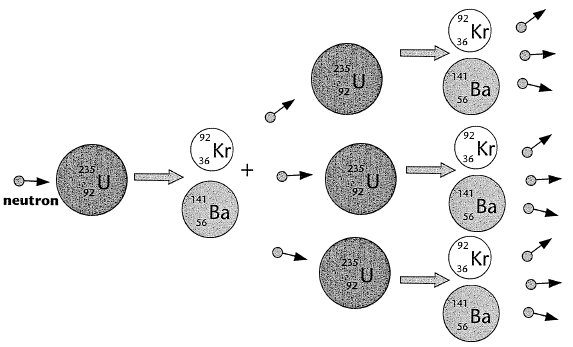
Fig 7.1 — Chain reaction in U-235 fission

Fig 7.1 — Chain reaction in U-235 fission

Questions — Part 1

Q1
Write two balanced equations for the fission of U-235: first showing the formation of the unstable U-236 intermediate, then showing one possible decay to Ba-144 and Kr-90. (3 marks)
Model Answer Step 1: ²³⁵₉₂U + ¹₀n → ²³⁶₉₂U* [1]
Step 2: ²³⁶₉₂U* → ¹⁴⁴₅₆Ba + ⁹⁰₃₆Kr + 2¹₀n [1]
Check: A: 236 = 144 + 90 + 2 ✓; Z: 92 = 56 + 36 ✓ [1]
Q2
In the fission 235U + n → 92Kr + 141Ba + N neutrons, calculate N. (2 marks)
Model Answer Each fission releases neutrons that can cause further fissions, which release more neutrons, and so on — a chain reaction. For the reaction to be self-sustaining, on average at least one neutron from each fission must cause a further fission (the multiplication factor k ≥ 1). This requires the mass of fissile material to be at or above the critical mass.
Q3
Masses: 235U nucleus = 234.993 u, 92Kr nucleus = 91.906 u, 141Ba nucleus = 140.884 u, neutron = 1.009 u. Calculate the energy released in MeV per fission. (1 u = 931 MeV) (5 marks)
Model Answer Energy per fission = 200 × 10⁶ × 1.6×10⁻¹⁹ = 3.2×10⁻¹¹ J
Number of fissions per second = P/E = 3.0×10⁹ / 3.2×10⁻¹¹ = 9.4 × 10¹⁹ fissions s⁻¹

Part 2 of 3 · Nuclear Fusion

Nuclear fusion — two light nuclei combine to form a heavier nucleus, releasing energy.

Nuclei must reach very high kinetic energies (temperatures ~10⁸ K) to overcome the Coulomb barrier (mutual electrostatic repulsion). Once close enough, the strong nuclear force takes over and pulls them together.

Deuterium-tritium fusion (most promising for reactors):

21H + 31H → 42He + 10n + 17.6 MeV

Deuterium-deuterium fusion:

21H + 21H → 32He + 10n + energy

Fusion produces far more energy per kg of fuel than fission, and the fuel (hydrogen isotopes from water) is abundant. Achieving and sustaining the extreme temperatures needed is the major engineering challenge.

Questions — Part 2

Q4
Explain why extremely high temperatures are needed to initiate nuclear fusion between two protons. (3 marks)
Model Answer Both nuclei are positively charged → they repel each other electrostatically. To get close enough for the short-range strong nuclear force to overcome this repulsion (within ~3 fm), the nuclei need very high kinetic energy. Very high temperature (~10⁸ K) provides this kinetic energy to overcome the Coulomb (electrostatic) barrier.
Q5
For the fusion reaction ²₁H + ³₁H → ⁴₂He + ¹₀n, verify that nucleon number and proton number are conserved. (2 marks)
Model Answer Nucleon number (A): 2 + 3 = 4 + 1 = 5 ✓
Proton number (Z): 1 + 1 = 2 + 0 = 2 ✓
Both conserved ✓
Q6
State two advantages of nuclear fusion over nuclear fission as a power source. (2 marks)
Model Answer Any two of: Fuel (deuterium) is abundant in seawater; No long-lived radioactive waste produced; Much greater energy per unit mass of fuel; No risk of uncontrolled meltdown.

Part 3 of 3 · Fission vs Fusion: Binding Energy Perspective

Both fission and fusion release energy by increasing the average binding energy per nucleon of the products compared to the reactants.

Energy per nucleon: Fusion releases more energy per nucleon than fission (e.g. H→He gain ~6 MeV/nucleon vs ~1 MeV/nucleon for fission).

Fission fragments are neutron-rich: Heavy nuclei (N >> Z) split into fragments that retain the original high N/Z ratio. These fall above the stability line → likely β⁻ emitters.
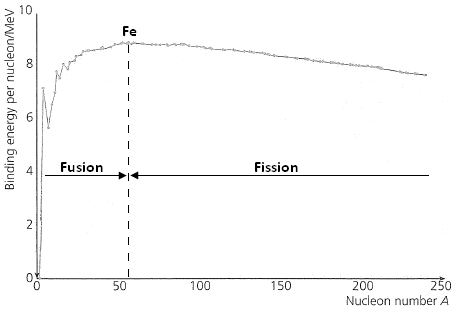
Fig 7.3 — Binding energy per nucleon vs nucleon number

Fig 7.3 — Binding energy per nucleon vs nucleon number

Questions — Part 3

Q9
Explain, with reference to the BE/nucleon graph, why energy is released in both fission and fusion. (4 marks)
Model Answer Both processes move nuclei toward the peak of the BE/nucleon curve (~8.8 MeV/nucleon at Fe-56). Fission: heavy nucleus (A~235, ~7.6 MeV/nucleon) splits into fragments nearer peak → total BE increases → energy released. Fusion: light nuclei (e.g. H, ~1 MeV/nucleon) combine to heavier nucleus nearer peak → total BE increases → energy released.
Q10
Explain why energy released per nucleon from fusion is greater than from fission, with reference to the graph. (2 marks)
Model Answer The curve rises more steeply on the left (light nuclei) than it falls on the right (heavy nuclei). The gain in BE/nucleon for fusion (~6 MeV/nucleon for H → He) is much larger than for fission (~1 MeV/nucleon for U-235).
Q11
Explain why fission fragments are unstable and what radiation they are likely to emit. (3 marks)
Model Answer Heavy nuclei have a high N/Z ratio for stability. Fission fragments inherit this ratio, but for lighter nuclei a lower N/Z is needed. Fragments therefore have too many neutrons → lie above the stability line → decay by β⁻ emission, converting neutrons to protons.
Q12
Calculate the mass difference in kg for the O-16 nucleus. (nucleus mass = 15.991 u; u = 1.661 × 10⁻²⁷ kg; Z = 8, N = 8) (3 marks)
Model Answer Nucleon mass = 8(1.00728) + 8(1.00867) = 16.1276 u
Δm = 16.1276 − 15.991 = 0.1366 u
Δm in kg = 0.1366 × 1.661×10⁻²⁷ = 2.27 × 10⁻²⁸ kg

Nuclear Reactors

Do Now — Lesson 8

Prerequisite knowledge: fission chain reactions; thermal vs fast neutrons; neutron capture; power and efficiency calculations

Q1
Describe what happens in a nuclear chain reaction and explain why it can be dangerous if uncontrolled. (3 marks)
Model Answer Each fission releases neutrons that trigger further fissions, each producing more neutrons — an exponential increase in fission rate. If uncontrolled, the rate of fissions increases rapidly (super-critical), releasing enormous amounts of energy in a very short time → explosion or meltdown.
Q2
Fission neutrons travel at ~10⁷ m s⁻¹. State approximately what speed they must be slowed to before U-235 can capture them, and by roughly what factor. (2 marks)
Model Answer Must be slowed to ~2 × 10³ m s⁻¹ (thermal neutrons, ~0.025 eV at 20°C). Factor of ~10⁷/2×10³ = 5000 times slower.
Q3
State two materials used as control rods and explain what single property makes them suitable. (2 marks)
Model Answer Boron or hafnium (also cadmium). They have a very high neutron absorption cross-section — they readily absorb neutrons without undergoing fission, so they remove neutrons from the chain reaction.
Q4
A reactor produces 2.0 × 10⁹ W of thermal power with an efficiency of 35%. Calculate the electrical output power in MW. (2 marks)
Model Answer Pelectrical = efficiency × Pthermal = 0.35 × 2.0×10⁹ = 7.0×10⁸ W = 700 MW

Part 1 of 3 · Fuel Rods and the Moderator

A nuclear fission reactor generates heat from controlled nuclear fission. This heat produces steam to drive turbines connected to electrical generators.

Fuel Rods: Made from enriched uranium (higher proportion of U-235 than natural uranium). Natural uranium is 99.28% U-238 and only 0.72% U-235.

Moderator: Fission neutrons are released at ~10⁷ m s⁻¹ — too fast for U-235 to capture. The moderator slows them to thermal speeds (~2×10³ m s⁻¹) through repeated collisions.
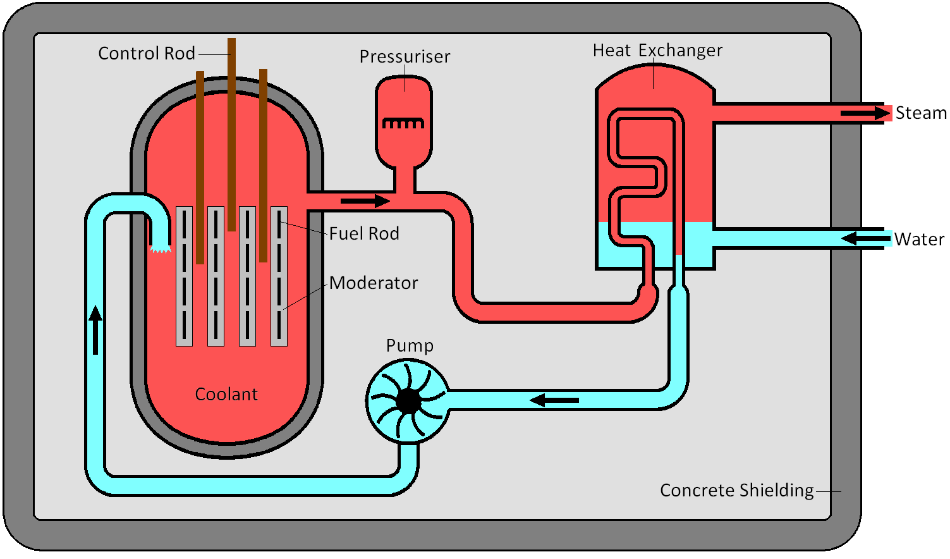
Fig 8.1 — Pressurised water reactor schematic

Fig 8.1 — Pressurised water reactor schematic

Questions — Part 1

Q1
Fill in the blanks: Nuclear reactors use rods of enriched _____ rich in ²³⁵U as fuel for _____ reactions. These produce neutrons which induce further fissions — a _____ reaction. Neutrons must be slowed down by a _____ before they can cause fission in ²³⁵U. (3 marks)
Model Answer Rods of enriched uranium rich in ²³⁵U as fuel for fission reactions. These produce neutrons — a chain reaction. Neutrons must be slowed by a moderator.
Q2
Explain the role of the moderator in a nuclear reactor. (3 marks)
Model Answer Neutrons transfer maximum kinetic energy per collision when the target particle has a similar mass. A low mass number (similar mass to a neutron) means more kinetic energy is transferred per collision — the neutron slows down in fewer collisions.
Q3
State two properties a good moderator material should have and explain why each is important. (4 marks)
Model Answer Natural uranium contains only 0.72% U-235 (which fissions with thermal neutrons). At this concentration, too few thermal neutrons encounter U-235 nuclei to sustain a chain reaction — the remaining 99.28% U-238 absorbs neutrons without fissioning.

Part 2 of 3 · Control Rods and Coolant

Control Rods: Absorb excess neutrons to control the rate of fission and the power output. Each fission produces 2–3 neutrons but only 1 is needed to sustain the chain reaction.

Coolant: Carries heat from the reactor core to the heat exchanger. Hot coolant transfers heat to a secondary water circuit, producing steam to drive turbines.
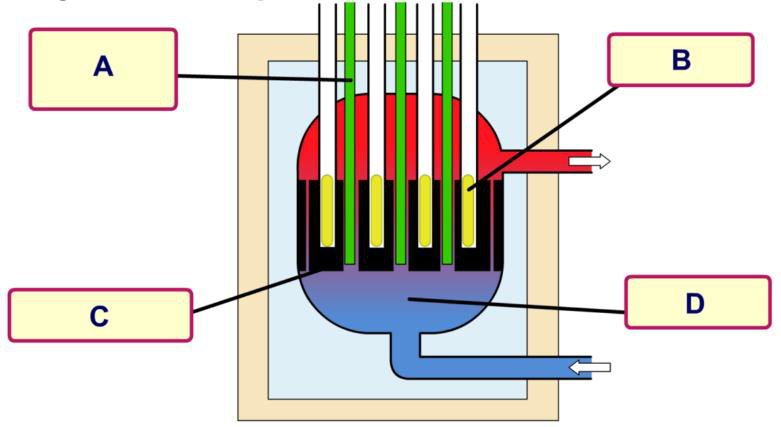
Fig 8.2 — Label the reactor components (A–D)

Fig 8.2 — Label reactor components (A–D)
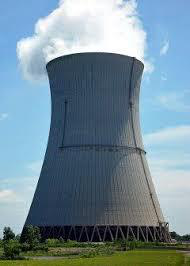
Fig 8.3 — Nuclear power station cooling towers

Fig 8.3 — Cooling towers

Questions — Part 2

Q5
Explain the role of control rods in a nuclear reactor and how they are used to vary power output. (3 marks)
Model Answer Control rods absorb excess neutrons to control the rate of fission and hence the power output. Each fission produces 2–3 neutrons but only 1 is needed to sustain a steady chain reaction. Rods are inserted deeper into the core to absorb more neutrons (reduce power); raised to allow more neutrons to cause fission (increase power).
Q6
State two properties of a good coolant and explain why each is important. (4 marks)
Model Answer 1. High specific heat capacity — can carry a large amount of thermal energy away from the core per kg, keeping the core at safe temperature.
2. Low neutron absorption cross-section — avoids becoming radioactive itself; ensures neutrons remain available for the chain reaction rather than being captured by the coolant.
Q7
Describe how the heat produced in a nuclear reactor is converted to electrical energy. (3 marks)
Model Answer Heat from fission in the fuel rods is transferred to the coolant (primary circuit). The hot coolant passes through a heat exchanger, transferring heat to water in a secondary circuit, producing steam. The high-pressure steam drives turbines connected to electrical generators. Waste steam from the turbines is condensed (in cooling towers or a river) and recycled.
Q8
What is coming out of a cooling tower at a nuclear power station? Is it radioactive? (2 marks)
Model Answer Water vapour (steam). The cooling tower dissipates waste heat from the non-radioactive secondary circuit water by evaporation. It is not radioactive — this water has never been in contact with the reactor core or primary coolant.

Part 3 of 3 · Chain Reaction Management and Reactor Operation

In normal operation the reactor is maintained at criticality: exactly 1 neutron per fission event causes another fission (multiplication factor k = 1).

Not all produced neutrons cause fission: some escape through the surface, some are absorbed by U-238, some by the moderator or coolant, some travel too fast.

Emergency shut-down (SCRAM): Control rods are immediately fully inserted into the core, absorbing all available neutrons and stopping fission. Secondary control rods held by electromagnets drop automatically on power failure.

After shut-down: Fuel rods continue to produce heat from decay of radioactive fission products. Emergency cooling is essential even after the reactor is off.

Neutron activation: Neutrons escaping the core can be absorbed by shielding nuclei, making them unstable (radioactive). This is why shielding becomes radioactive over time.

Questions — Part 3

Q9
Explain what is meant by a chain reaction in a nuclear reactor. (2 marks)
Model Answer Each fission event produces 2–3 neutrons which can trigger further fissions, each releasing more neutrons — a self-sustaining reaction. For steady operation exactly 1 neutron per fission must cause another fission (k = 1, criticality). Control rods absorb excess neutrons to maintain this.
Q10
Explain why backup generators are essential for nuclear power plants even when the reactor is shut down. (3 marks)
Model Answer After shutdown, radioactive fission products in the fuel rods continue to decay, generating decay heat. Without cooling the fuel would overheat, possibly melting cladding and releasing radioactive material. Backup generators run the emergency cooling pumps to remove this heat.
Q11
Neutrons released in the first collisions with the moderator may excite its nuclei. Describe the radiation emitted and explain subsequent collisions. (4 marks)
Model Answer Excited moderator nuclei de-excite by emitting gamma radiation (photons). In subsequent elastic collisions neutrons transfer KE to moderator atoms. Maximum KE transfer per collision occurs when masses are equal (billiard-ball effect), which is why low-mass-number moderators are chosen. The neutrons slow to thermal energies and the moderator heats up.
Q12
U-238 absorbs a neutron and eventually produces Pu-239. Write the nuclear equation for the β⁻ decay of Np-239 (Z = 93) to Pu-239 (Z = 94). (2 marks)
Model Answer 23993Np → 23994Pu + 0−1e + ν̅e

Exam-Style Questions — Lesson 8

Exam Q1 · Nuclear Reactor Components (10 marks)
(a) State the function of each of the following components of a nuclear fission reactor, and give a typical material used for each: (i) moderator (ii) control rods (iii) coolant. (6)

(b) Explain why the fuel in a nuclear reactor consists of enriched uranium rather than natural uranium. (2)

(c) A nuclear power station converts thermal energy from 5.0 × 10²² fissions per day into electrical energy with an efficiency of 32%. Each fission releases 180 MeV. Calculate the electrical power output. (2)
Mark Scheme (a) (i) Moderator: slows down fast fission neutrons to thermal speeds so they can be captured by U-235. Material: graphite or water. [2]
(ii) Control rods: absorb neutrons to control the rate of fission and reactor power. Material: boron or hafnium. [2]
(iii) Coolant: removes thermal energy from the core and transfers it to the steam generator/heat exchanger. Material: water or CO₂. [2]
(b) Natural uranium contains only 0.72% U-235. Enriched uranium has a higher % of U-235, increasing the probability that thermal neutrons will cause fission and sustain a chain reaction. [2]
(c) Energy per fission = 180 × 10⁶ × 1.6×10⁻¹⁹ = 2.88×10⁻¹¹ J; Total thermal energy per day = 5.0×10²² × 2.88×10⁻¹¹ = 1.44×10¹² J; Thermal power = 1.44×10¹²/(24×3600) = 1.667×10⁷ W; Electrical power = 0.32 × 1.667×10⁷ = 5.3 × 10⁶ W = 5.3 MW [2]

Nuclear Safety

Do Now — Lesson 9

Prerequisite knowledge: half-life and activity calculations; reactor components and their roles; radioactive decay and decay heat; properties of ionising radiation

Q1
A sample of radioactive waste has an initial activity of 5.0 × 10⁸ Bq and a half-life of 30 years. Calculate the activity after 90 years. (3 marks)
Model Answer 90 years = 3 half-lives; A = 5.0×10⁸ × (½)³ = 5.0×10⁸ / 8 = 6.25 × 10⁷ Bq
Q2
Name the three components of a nuclear reactor responsible for: (a) controlling the chain reaction, (b) slowing neutrons, (c) removing heat from the core. (3 marks)
Model Answer (a) Control rods   (b) Moderator   (c) Coolant
Q3
Explain why a nuclear reactor continues to generate heat after it has been shut down, and why this is a safety concern. (3 marks)
Model Answer After shutdown, fission stops but the many unstable (radioactive) fission products continue to decay. This releases decay heat (radioactive decay of fission products). Even without fission, the decay heat (initially ~5–7% of normal power) can cause overheating and meltdown if cooling fails — as occurred at Fukushima (2011).
Q4
State two types of radiation emitted from a reactor core that the shielding must stop, and name a suitable material for absorbing each. (2 marks)
Model Answer Neutrons: concrete (thick) or water absorbs neutrons.
Gamma radiation: lead or thick concrete absorbs gamma photons.

Part 1 of 3 · Reactor Safety Systems

Nuclear reactors require multiple overlapping safety systems.

Fuel Design: Solid fuel rods reduce risk of spills. Remote-controlled handling eliminates direct human contact.

Reactor Shielding:

Emergency Shut-Down (SCRAM):

Questions — Part 1

Q1
Explain why the shielding around a reactor core becomes radioactive over time. (3 marks)
Model Answer Neutrons escaping from the reactor core are absorbed by the nuclei of atoms in the shielding material. This neutron capture transmutes these atoms into unstable (radioactive) isotopes. These activated isotopes then decay, making the shielding itself a source of radiation.
Q2
Describe how an emergency shutdown (SCRAM) of a nuclear reactor is achieved. (3 marks)
Model Answer All control rods are fully inserted into the reactor core — they absorb all available neutrons, stopping the chain reaction (fission ceases). Secondary emergency rods fall automatically under gravity if power to the electromagnets holding them fails. Emergency cooling systems activate to remove decay heat from the fission products.
Q3
Explain why backup cooling is still necessary even after a reactor has been shut down. (2 marks)
Model Answer Fission products (unstable nuclei produced during the chain reaction) continue to decay radioactively after shutdown, releasing decay heat. This heat (initially ~5–7% of full power) can overheat and melt the fuel rods if cooling is not maintained, potentially releasing radioactive material.

Part 2 of 3 · Classification of Radioactive Waste

Radioactive waste is classified into three levels depending on its radioactivity and half-life:

LevelWhat it isDisposal methodTime scale
High-LevelSpent fuel rods; reprocessing wasteCooling ponds → steel containers → glass blocks → deep underground storageDangerous for thousands of years
Intermediate-LevelFuel cladding; contaminated equipment; hospital radioisotopesSteel drums encased in concrete; deep underground storageThousands of years
Low-LevelLab equipment; protective clothing; cooling pond waterSealed metal drums; buried in supervised repositories; treated water releasedA few months

Questions — Part 2

Q4
Spent fuel rods are stored underwater in cooling ponds immediately after removal from the reactor. Explain two reasons for this. (2 marks)
Model Answer 1. The water cools the rods — which still generate significant decay heat from fission products decaying.
2. The water absorbs neutrons and gamma radiation, shielding workers from the intense radiation emitted by the spent fuel.
Q5
Explain why high-level nuclear waste must be stored for thousands of years before it is considered safe. (2 marks)
Model Answer High-level waste contains long-lived radioisotopes (e.g. plutonium-239: T½ = 24,110 years; neptunium-237: T½ = 2.1 million years). The activity decreases with half-lives, but for these long-lived isotopes the waste remains dangerously radioactive for many half-lives — thousands to millions of years.

Part 3 of 3 · Extended Nuclear Reactor Questions

This section brings together concepts from across the nuclear physics topic. Key reminders:
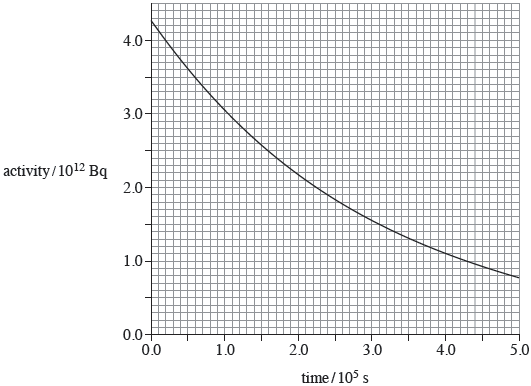
Questions — Part 3

Q7
In a nuclear reactor, uranium-238 absorbs a neutron and eventually produces plutonium-239. Write the nuclear equation for the beta-minus decay of neptunium-239 (23993Np) to plutonium-239. (2 marks)
Model Answer 23993Np → 23994Pu + 0−1e + ν̅e
Q8
A sample of Np-239 has an initial activity of 4.0 × 10¹² Bq. The activity drops to about 2.0 × 10¹² Bq after approximately 2.0 × 10⁵ s. Show that the decay constant is about 3.4 × 10⁻⁶ s⁻¹. (3 marks)
Model Answer Activity has halved, so t = 2.0×10⁵ s = T½
λ = ln 2 / T½ = 0.693 / 2.0×10⁵ = 3.47×10⁻⁶ s⁻¹ ≈ 3.4 × 10⁻⁶ s⁻¹
Q9
Estimate the number of Np-239 nuclei in a sample at t = 5.0 × 10⁵ s, given the activity at this time is about 1.0 × 10¹² Bq and λ = 3.4 × 10⁻⁶ s⁻¹. (2 marks)
Model Answer N = A / λ = 1.0×10¹² / 3.4×10⁻⁶ = 2.9 × 10¹⁷
Q10
Give a full account of the components of a thermal nuclear reactor and the role of each. (6 marks)
Model Answer Fuel rods: enriched uranium (higher % of U-235); undergo induced fission with thermal neutrons releasing energy and 2–3 fast neutrons per fission.
Moderator (graphite or water): slows fast fission neutrons to thermal speeds through elastic collisions, enabling further fission of U-235. Must have low mass number and low neutron absorption.
Control rods (boron or cadmium): absorb neutrons to control reaction rate. Inserted deeper → less power; raised → more power. Maintain criticality (k = 1).
Coolant (CO₂ gas or water): removes heat from core; carries it to heat exchanger where it generates steam to drive turbines. Must have high specific heat capacity, low neutron absorption, be non-corrosive.
Pressure vessel and concrete shield: contain the core, absorb escaped neutrons and gamma radiation, protect workers and public.
Heat exchanger and turbines: steam produced drives turbines connected to electrical generators; waste heat expelled via cooling towers.

Exam-Style Questions — Lessons 8 & 9

EXAM Q1 · Reactor Physics and Waste Management (19 marks)

Fig 9.1 — Activity vs time for neptunium-239 sample

Fig 9.1 — Activity vs time for neptunium-239

Exam Q1a
A rod of uranium-238 is placed in the core of a nuclear reactor where it absorbs free neutrons, eventually forming plutonium-239. Write the nuclear equation for the beta-minus decay of neptunium-239 (23993Np) to plutonium-239. (2)
Model Answer 23993Np → 23994Pu + 0−1e + ν̅e
Exam Q1b(i)
Show that the decay constant of Np-239 is about 3.4 × 10⁻⁶ s⁻¹ (half-life read from the activity graph ≈ 2 × 10⁵ s). (2)
Model Answer λ = ln 2 / T½ = 0.693 / 2×10⁵ = 3.47×10⁻⁶ ≈ 3.4×10⁻⁶ s⁻¹
Exam Q1b(ii)
Estimate the number of Np-239 nuclei present at t = 5.0 × 10⁵ s, where A ≈ 1.0 × 10¹² Bq. (2)
Model Answer N = A / λ = 1.0×10¹² / 3.4×10⁻⁶ = 2.9 × 10¹⁷
Exam Q1c(i)
Explain what is meant by a chain reaction in a thermal nuclear reactor. (2)
Model Answer Each fission releases neutrons which trigger further fissions, each releasing more neutrons — a self-sustaining process. In a thermal reactor neutrons are first thermalised by the moderator before causing fission in U-235. Exactly 1 neutron per fission causes another (k = 1) for steady operation.
Exam Q1c(ii)
Explain the purpose of a moderator in a thermal nuclear reactor. (3)
Model Answer Fission neutrons are released at ~10⁷ m s⁻¹ — too fast to cause further fission in U-235. The moderator slows them to thermal speeds (~2×10³ m s⁻¹) through repeated elastic collisions. Must have low mass number (maximum KE transfer per collision) and low neutron absorption cross-section.
Exam Q1c(iii)
Explain why the shielding around a reactor core becomes radioactive. (2)
Model Answer Neutrons that escape from the core can be absorbed by nuclei in the concrete shielding. This neutron capture produces unstable (radioactive) isotopes — a process called neutron activation. The shielding therefore becomes radioactive over time.
Exam Q1d
Describe, with reference to the source and treatment, the main problems in dealing with high-level radioactive waste. (6)
Model Answer Source: Spent fuel rods from reactor cores, plus highly radioactive materials from reprocessing. Highly radioactive and thermally hot.
Problem 1 — intense radioactivity: Must not be handled directly. Initially stored underwater in cooling ponds (water absorbs radiation and removes decay heat) for up to a year.
Problem 2 — very long half-lives: Remains hazardous for thousands of years. Eventually vitrified (incorporated into glass blocks) inside steel containers and planned for deep underground geological storage.
Problem 3 — heat generation: Decay heat must be continuously removed even after reactor shutdown, requiring powered cooling systems.
Problem 4 — containment: Must be kept isolated from groundwater and the biosphere indefinitely; no currently operating permanent storage facilities exist in most countries.