FORCESPART 2

AQA 8463 & 8464 · Lessons 1–5, 7–10
⬇ Student Booklet ⬇ Teacher Booklet

Key Terms — Forces Part 2

All Terms

01
Scalar
DefinitionA quantity with magnitude (size) only — no direction. Examples: distance, speed, energy, temperature, mass, time.
02
Vector
DefinitionA quantity with both magnitude and an associated direction. Examples: displacement, velocity, acceleration, force, weight, momentum.
03
Vector representation
DefinitionVectors are shown by an arrow — the length shows the size (magnitude), the direction of the arrow shows the direction.
04
Force
DefinitionA push or pull on an object when it interacts with another object. Measured in Newtons (N).
05
Contact forces
DefinitionA force acting between objects that are physically touching. Examples: friction, air resistance, tension, normal contact force.
06
Non-contact forces
DefinitionA force acting between objects that are physically separate. Examples: gravitational force, electrostatic force, magnetic force.
07
Resultant force
DefinitionEqual to the sum of all the forces acting on an object — the single force that has the same effect as all forces combined.
08
Equilibrium
DefinitionWhen the forces acting on an object cancel each other out — the resultant force is zero.
09
Scale diagram
DefinitionVectors are drawn as arrows head-to-tail to show the final, resultant force. The resultant is the arrow from start to finish.
10
Free body diagram
DefinitionA diagram of all the forces acting on an object, shown as labelled arrows. Arrow length is proportional to force size.
11
Forcemeter (Newtonmeter)
DefinitionAn instrument (spring and scale) used to measure the size of a given force directly, in Newtons.
12
Force components
DefinitionWhen one force can be split into two vector parts (e.g. horizontal and vertical components).
13
Mass
DefinitionThe total amount of matter contained in an object, measured in kilograms (kg). Mass is a scalar and stays the same wherever the object is.
14
Weight
DefinitionThe force acting on an object due to gravity. Weight is a vector, measured in Newtons. W = m × g.
15
Gravitational field strength (g)
DefinitionThe size of the gravitational force in Newtons for each kilogram of mass at a given location. On Earth g = 9.8 N/kg.
16
Centre of mass
DefinitionA single point at which the weight of an object could be considered to act upon.
17
Forces balanced
DefinitionWhen the forces on an object cancel out — resultant force = 0. The object is either stationary or moving at constant velocity.
18
Forces not balanced
DefinitionWhen there is a net (resultant) force acting on an object — the object accelerates in the direction of the resultant.
19
Newton's 1st Law
DefinitionObjects stay at rest or at constant speed unless a resultant force acts upon them.
20
Newton's 2nd Law
DefinitionIf there is a resultant force, an object accelerates. Acceleration is proportional to force and inversely proportional to mass. F = ma.
21
Newton's 3rd Law
DefinitionFor each force on an object, the object reacts with the same force in return (equal and opposite reaction force).
22
Distance
DefinitionThe total length of the path travelled between two points. A scalar quantity (no direction).
23
Displacement
DefinitionDistance in a given direction — the straight-line distance from start to finish. A vector quantity.
24
Speed
DefinitionHow much distance is covered in a given time. A scalar quantity, measured in m/s.
25
Velocity
DefinitionSpeed in a given direction. A vector quantity, measured in m/s.
26
Acceleration
DefinitionHow much the velocity changes in a given time. Measured in m/s². A vector quantity. a = (v − u) / t.
27
Work done
DefinitionEnergy transferred when a force moves an object through a distance in the direction of the force. W = F × s. Units: Joules (J).
28
Stopping distance
DefinitionThe distance a vehicle travels between when a hazard is seen and when the vehicle has stopped. Stopping distance = thinking distance + braking distance.
29
Thinking distance
DefinitionThe distance travelled between when a hazard is seen and when the brake is pressed (reaction time).
30
Braking distance
DefinitionThe distance travelled between when the brake is pressed and the vehicle has completely stopped.
31
Momentum
DefinitionThe strength of motion of an object. p = mass × velocity. Units: kg m/s. A vector quantity.
32
Increasing time of impact
DefinitionIncreases the time over which momentum changes, which decreases the force acting on the object during a collision (F = Δp/t).
33
Seat belt (safety device)
DefinitionSlows down the time of deceleration of a person during a collision, reducing the force on their body.
34
Airbag (safety device)
DefinitionSpreads the time of deceleration of a person during a collision over a longer period, reducing the peak force.
35
Pythagoras' theorem
DefinitionFor a right-angled triangle: a² + b² = c², where c is the hypotenuse. Used to find the resultant of two perpendicular vectors.
36
Normal contact force
DefinitionThe perpendicular force exerted by a surface on an object resting on it. Also called the reaction force or normal force.

Introduction to Forces

Do Now

Q1
What is the SI unit of force?
Model AnswerThe Newton (N).
Q2
Name one instrument used to measure a force directly.
Model AnswerA Newton meter (force meter / spring balance).
Q3
State the difference between a scalar quantity and a vector quantity.
Model AnswerA scalar has magnitude (size) only. A vector has both magnitude and direction.
Q4
Give two examples of vector quantities and two examples of scalar quantities.
Model AnswerVectors (any two): force, velocity, acceleration, displacement, weight, momentum. Scalars (any two): mass, speed, distance, energy, temperature, time.

Part 1 · Forces, Scalars and Vectors

A force is a push or pull. Forces have units of Newtons (N). We measure force using a Newton meter.

Scalar quantities have size ("magnitude") only and no direction. Example: mass.

Scalar quantities can be added normally. Example: 36 kg + 14 kg = 50 kg.

Examples of scalars: mass, distance, speed, energy, time, power.

Vector quantities have both size (magnitude) and direction. Examples: force, velocity, acceleration, displacement, weight, momentum.

Questions

Q1
What is a force? (1)
Model AnswerA force is a push or pull.
Q2
What is the unit of force? (1)
Model AnswerNewtons (N).
Q3
What instrument do we use to measure forces? (1)
Model AnswerA Newton meter (force meter).
Q4
What is the definition of a scalar quantity? Give three examples of scalar quantities. (2)
Model AnswerA scalar quantity has magnitude (size) only, with no direction. Examples (any three): mass, distance, speed, energy, time, power.
Q5
What is the definition of a vector quantity? Give three examples of vector quantities. (2)
Model AnswerA vector quantity has both magnitude and direction. Examples (any three): force, velocity, acceleration, displacement, weight, momentum.

Part 2 · Scale Diagrams

In a scale diagram each force is drawn as an arrow of the appropriate length and direction (e.g. 1 cm = 1 N). Place the arrows head-to-tail. The resultant is the arrow from the start of the first to the end of the last.

Measure the resultant arrow length then multiply by the scale to find the magnitude of the resultant force.
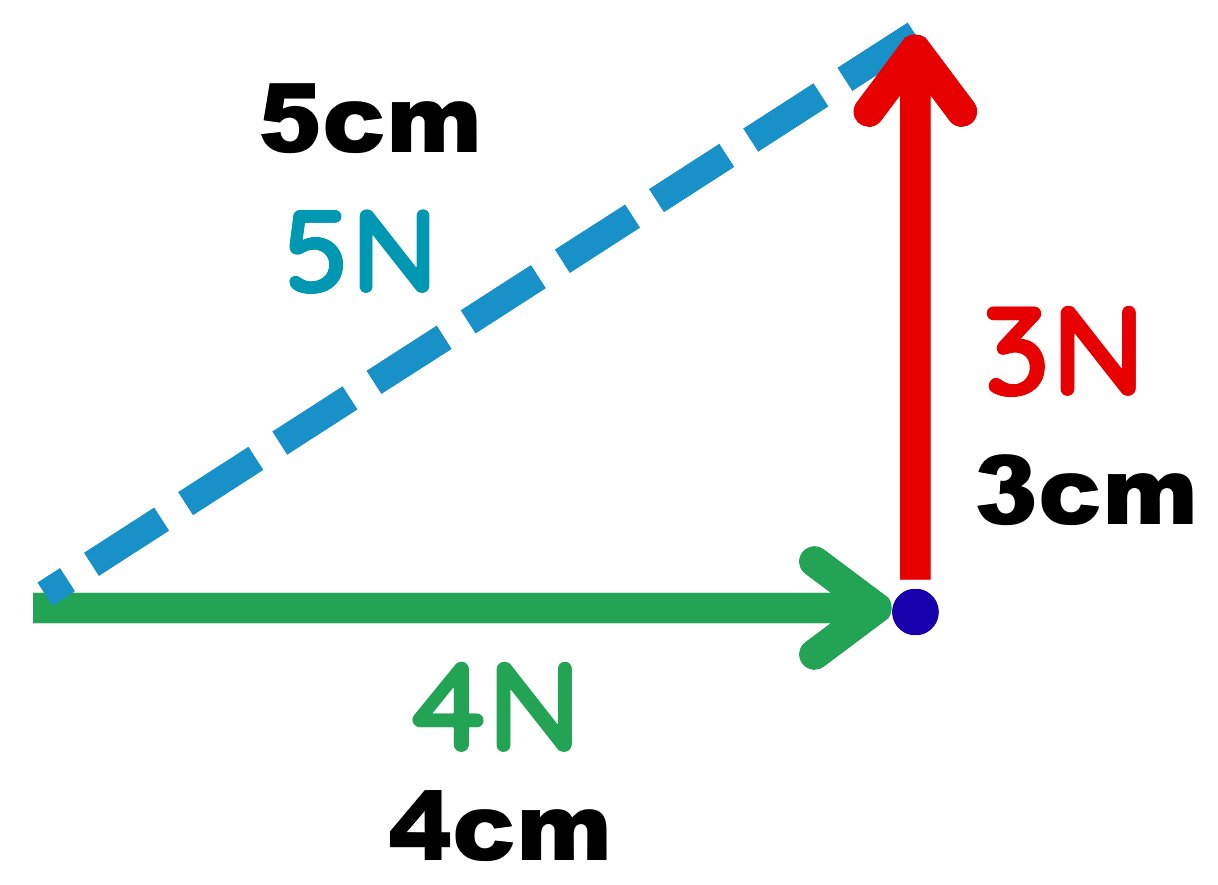
Steps to find resultant from a scale drawing

  • Step 1: Find the scale (1 cm = ? N)
  • Step 2: Draw vectors head-to-tail at the correct scale
  • Step 3: Measure the resultant arrow length (cm)
  • Step 4: Multiply by the scale to get the resultant force (N)
Scale diagram showing head-to-tail vector addition
Fig 1.1 — Finding resultants from scale drawings (scale: 1 cm = 1 N)

Questions — Scale Diagrams

Q6
Find the resultant for each scale diagram (see your booklet, Fig 1.1). For each: state the scale, measure the resultant length, and give the resultant force. (18 marks)
Model Answers (all scale 1 cm = 1 N) a: 4.5 N · b: 7.2 N · c: 6.3 N · d: 5.7 N · e: 5 N · f: 7.1 N · g: 6.3 N · h: 5 N · i: 14.1 N · j: 15 N · k: 10 N · l: 10 N · m: 25 N · n: 7.1 N · o: 25 N · p: 7.6 N · q: 7.2 N · r: 20 N
Q7–Q26
Draw a scale diagram for each pair of perpendicular forces and find the resultant using Pythagoras. (20 marks — see booklet table)
Model Answers — Resultants (using √(H²+V²)) Q7: 928.0 N · Q8: 5.0 N · Q9: 98.5 N · Q10: 25.0 N · Q11: 1000.0 N · Q12: 7.1 N · Q13: 50.0 N · Q14: 707.1 N · Q15: 10.0 N · Q16: 600.0 N · Q17: 100.0 N · Q18: 8.1 N · Q19: 390.5 N · Q20: 40.0 N · Q21: 960.5 N · Q22: 20.0 N · Q23: 700.0 N · Q24: 70.7 N · Q25: 500.0 N · Q26: 75.0 N
Q27
A woman walks 200 m east and then 100 m south. (a) Find the total distance travelled. (b) Find the resultant displacement (magnitude and direction). (3)
Model Answer(a) Total distance = 200 + 100 = 300 m. (b) Resultant = √(200² + 100²) = √50000 = 223.6 m south-east.
Q28
Dr Edmunds' cat Lola runs 40 m north and 30 m west. (a) What distance has Lola run? (b) What is Lola's resultant displacement? (3)
Model Answer(a) Distance = 40 + 30 = 70 m. (b) Resultant = √(40² + 30²) = √2500 = 50 m north-west.

Part 3 · Pythagoras' Theorem and Resultant Vectors

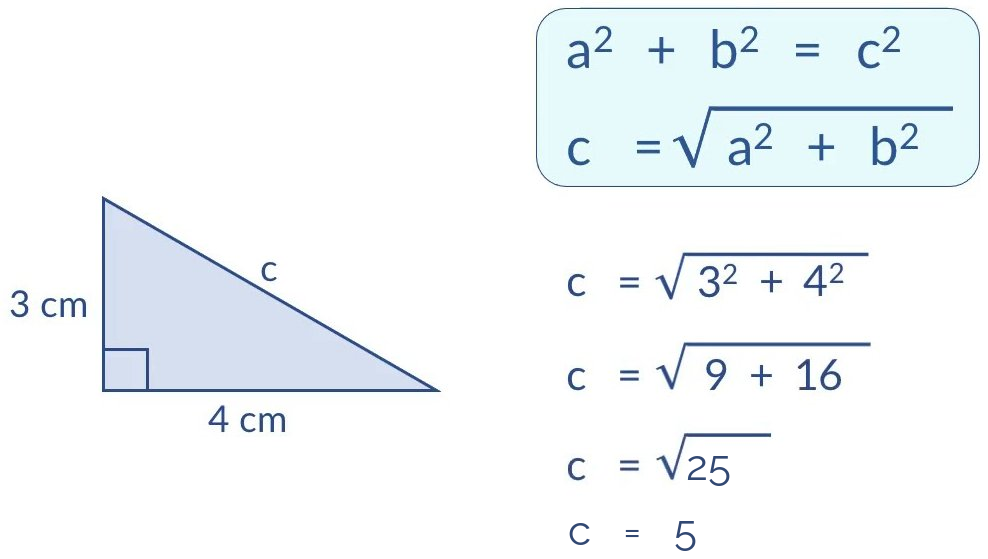
If one vector is at right angles to another, we can use Pythagoras' theorem to find the resultant vector.

a² + b² = c²

We can also use scale diagrams to find a resultant vector.

In a scale diagram, draw each vector as an arrow to scale. Join them head-to-tail. The resultant is the arrow from start to finish.

The resultant vector is found by placing vectors head-to-tail and drawing an arrow from the tail of the first to the head of the last.

The direction of the resultant can be measured with a protractor from the scale diagram.
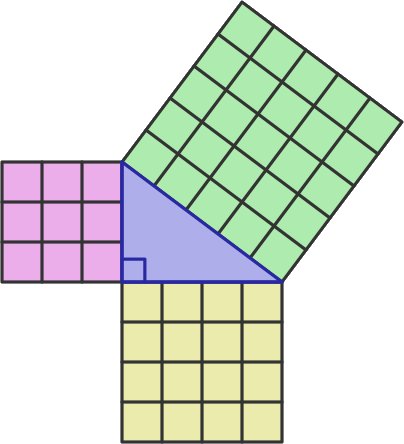
Pythagoras theorem diagram showing squares on each side
Fig 1.2 — Pythagoras' theorem: a² + b² = c² shown with squares on each side (a=3, b=4, c=5)
Pythagoras worked example diagram
Fig 1.3 — Finding a missing hypotenuse
Pythagoras worked example finding a missing side
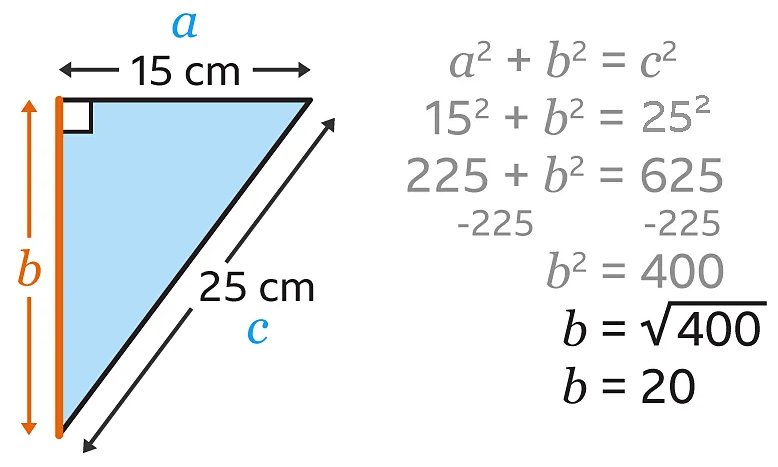
Fig 1.4 — Finding a missing shorter side: b = √(c² − a²)

Questions — Pythagoras

Q34
Use Pythagoras' theorem to find the resultant force c for each right-angled triangle (see booklet diagrams):(a) 6 N, 8 N(b) 9 N, 12 N(c) 0.3 N, 0.4 N(d) 5 N, 7 N(e) 30 N, 40 N(f) 0.6 N, 0.8 N(g) 60 N, 80 N(h) 7 N, 24 N(i) 300 N, 400 N(j) 600 N, 800 N. (10)
Model Answers(a) √(36+64) = 10.0 N(b) √(81+144) = 15.0 N(c) √(0.09+0.16) = 0.5 N(d) √(25+49) = 8.6 N(e) √(900+1600) = 50.0 N(f) √(0.36+0.64) = 1.0 N(g) √(3600+6400) = 100.0 N(h) √(49+576) = 25.0 N(i) √(90000+160000) = 500.0 N(j) √(360000+640000) = 1000.0 N
Q35
Use Pythagoras to find the missing vector (shorter side) for each:(a) 8 N, c=10 N(b) 9 N, c=15 N(c) 0.4 N, c=0.5 N(d) 7 N, c=25 N(e) 40 N, c=50 N(f) 0.6 N, c=1 N(g) 80 N, c=100 N(h) 5 N, c=13 N(i) 400 N, c=500 N(j) 600 N, c=1000 N. (10)
Model Answers(a) √(100−64) = 6.0 N(b) √(225−81) = 12.0 N(c) √(0.25−0.16) = 0.3 N(d) √(625−49) = 24.0 N(e) √(2500−1600) = 30.0 N(f) √(1−0.36) = 0.8 N(g) √(10000−6400) = 60.0 N(h) √(169−25) = 12.0 N(i) √(250000−160000) = 300.0 N(j) √(1000000−360000) = 800.0 N
Q29
An aeroplane travels at 100 m/s north and 20 m/s east. What is the plane's overall velocity (magnitude and direction)? (2)
Model Answerv = √(100² + 20²) = √10400 ≈ 102 m/s north-east.
Q30
A car travels 9 km east then 12 km north. (a) Find total distance. (b) Find resultant displacement (magnitude and direction). (3)
Model Answer(a) 9 + 12 = 21 km. (b) √(9² + 12²) = √225 = 15 km north-east.
Q31
A swimmer crosses a 40 m wide river. The current carries them 30 m downstream. (a) Total distance? (b) Resultant displacement? (3)
Model Answer(a) 40 + 30 = 70 m. (b) √(40² + 30²) = √2500 = 50 m (diagonally across-downstream).
Q32
A bird flies at 15 m/s south but is blown 8 m/s east. What is the bird's resultant velocity? (2)
Model Answerv = √(15² + 8²) = √289 = 17 m/s south-east.

Exam Question — Q1: Scalars, Vectors & Resultant Forces (6 marks)

EQ1a
State the difference between a scalar quantity and a vector quantity, giving one example of each. (4)
Model AnswerScalar: magnitude only, no direction. Example: speed / mass / distance. (2 marks) Vector: magnitude and direction. Example: velocity / force / displacement. (2 marks)
EQ1b
Draw scale diagrams (1 cm = 1 N) to work out the resultant force when: (i) 4 N east and 4 N north act on an object. (ii) 6 N east and 4 N north act on an object. (2)
Model Answer(i) Resultant = √(4² + 4²) = √32 = 5.7 N north-east. (ii) Resultant = √(6² + 4²) = √52 = 7.2 N north-east.

Mass, Weight and Gravity

Do Now

Q1
What is the difference between a scalar and a vector quantity? Give one example of each.
Model AnswerScalar: magnitude only, e.g. mass/speed. Vector: magnitude and direction, e.g. force/velocity.
Q2
An object is pushed right with 3 N and upwards with 4 N. What is the resultant force? (Use Pythagoras.)
Model AnswerResultant = √(3² + 4²) = √(9 + 16) = √25 = 5 N.
Q3
Why do objects fall?
Model AnswerObjects fall because gravity pulls them towards the centre of the Earth.
Q4
On the Moon, g ≈ 1.6 N/kg. On Earth, g = 9.8 N/kg. Suggest why the Moon has weaker gravity.
Model AnswerThe Moon has much less mass than Earth, so its gravitational pull is much weaker.

Part 1 · Gravity and Gravitational Field Strength

All objects attract each other due to the force of gravity. The strength of gravity at the surface of a planet is determined by its mass.

Gravitational field strength (g) is a measure of the gravitational force per kilogram at a location. On Earth, g = 9.8 N/kg.

Weight is the force on an object due to gravity. Weight is a vector, measured in Newtons (N).

Mass is the amount of matter an object contains. Mass is a scalar with SI unit kilogram (kg). Mass stays the same wherever the object is; weight changes with g.

The Moon has less mass than Earth, so its gravitational field strength is less (≈1.625 N/kg).

Questions

Q1
What is gravity? (1)
Model AnswerGravity is a force that attracts all objects towards each other.
Q2
What determines the strength of gravity at the surface of a planet? (1)
Model AnswerThe mass of the planet.
Q3
What is the gravitational field strength at the surface of the Earth? (1)
Model Answer9.8 N/kg.
Q4
What is the difference between mass and weight? State whether each is a scalar or a vector. (3)
Model AnswerMass is the amount of matter in an object (scalar, kg). Weight is the force on an object due to gravity (vector, N). Mass stays constant; weight depends on gravitational field strength.
Q5
Why would your weight be different on the Moon compared to on Earth, even though your mass stays the same? (2)
Model AnswerThe Moon has less mass than Earth, so its gravitational field strength is smaller (~1.6 N/kg vs 9.8 N/kg). Since W = m × g, a smaller g means a smaller weight.

Part 2 · Calculating Weight: W = m × g

W = m × g

W = weight (N), m = mass (kg), g = gravitational field strength (N/kg). On Earth: g = 9.8 N/kg unless told otherwise.
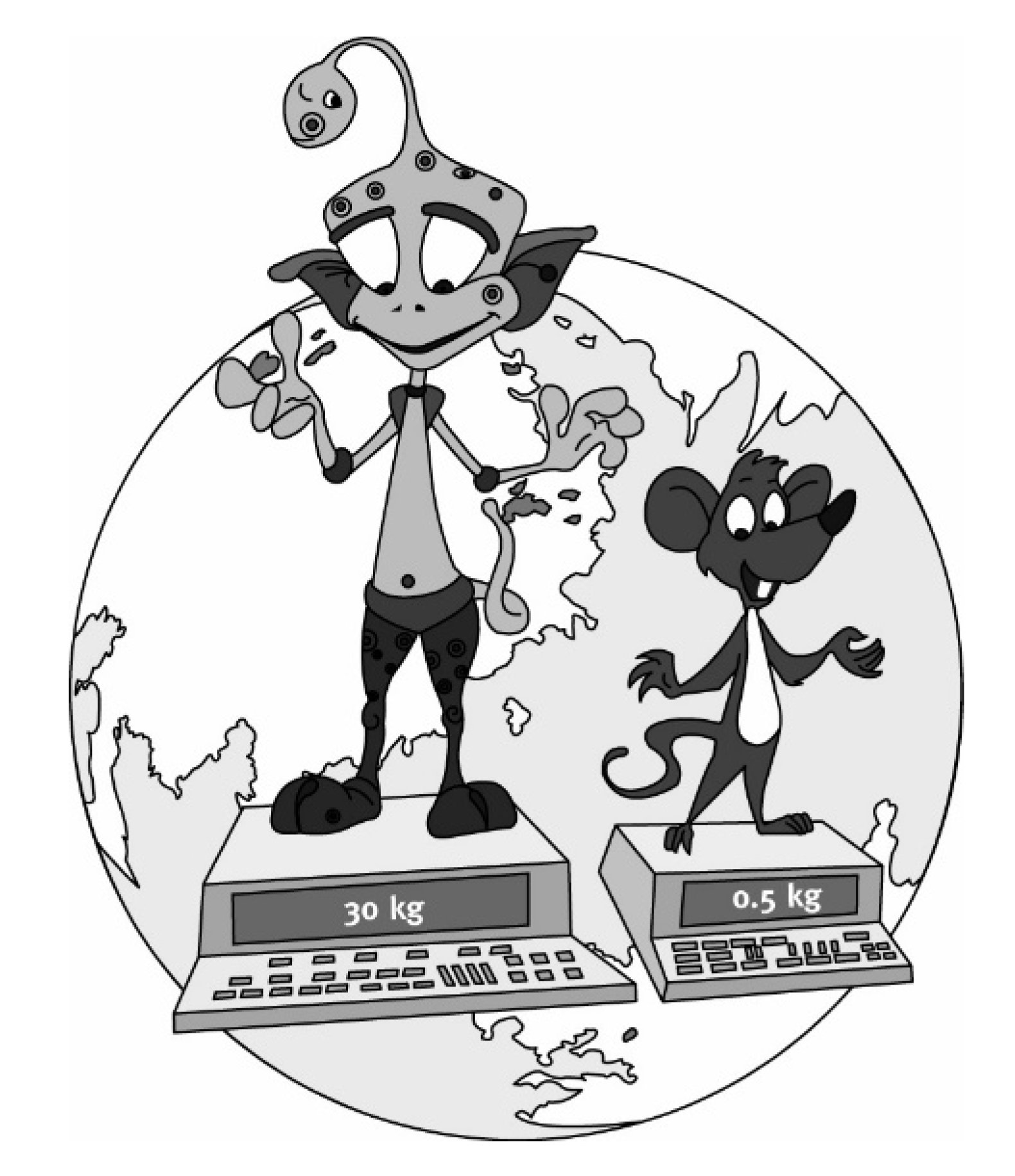
Arnie and Markey weighing themselves on different planets
Fig 2.1 — Arnie and Markey weigh themselves on different planets

Questions

Q6
Write down the equation for weight. State the units for each quantity. (2)
Model AnswerW = m × g. W in Newtons (N), m in kilograms (kg), g in N/kg.
Q7
Complete the table for Arnie (mass 30 kg) and Markey (mass 0.5 kg) on each planet using W = m × g. (3)
Arnie (30 kg) weights: Mercury 113.4 N · Venus 272.1 N · Earth 294 N · Moon 49.8 N · Mars 113.1 N · Jupiter 709.2 N · Saturn 274.8 N · Uranus 266.7 N · Neptune 337.5 N · Pluto 20.1 N
Markey (0.5 kg) weights: Mercury 1.89 N · Venus 4.54 N · Earth 4.9 N · Moon 0.83 N · Mars 1.89 N · Jupiter 11.82 N · Saturn 4.58 N · Uranus 4.45 N · Neptune 5.63 N · Pluto 0.34 N
Q8
Calculate the weight of: (a) 5 kg, (b) 70 kg, (c) 0.5 kg, (d) 2000 kg. (g = 9.8 N/kg) (3)
Model Answer(a) 5 × 9.8 = 49 N(b) 70 × 9.8 = 686 N(c) 0.5 × 9.8 = 4.9 N(d) 2000 × 9.8 = 19 600 N
Q9
A Formula 1 car weighs 7 150 N. Calculate its mass. (g = 9.8 N/kg) (2)
Model Answerm = W/g = 7150 / 9.8 = 729.6 kg
Q10
A cat weighs 42 N. Calculate its mass. (g = 9.8 N/kg) (2)
Model Answerm = 42 / 9.8 = 4.3 kg
Q11
A dog weighs 180 N. Calculate its mass. (g = 9.8 N/kg) (2)
Model Answerm = 180 / 9.8 = 18.4 kg
Q12
An iPad weighs 2.2 N. Calculate its mass. (g = 9.8 N/kg) (2)
Model Answerm = 2.2 / 9.8 = 0.224 kg
Q13
A Boeing 747 weighs 1.9 × 10⁶ N. Calculate its mass. (g = 9.8 N/kg) (2)
Model Answerm = 1.9×10⁶ / 9.8 = 1.94 × 10⁵ kg
Q14
A man of mass 70 kg weighs 1 750 N on a planet. Calculate the planet's gravitational field strength. (2)
Model Answerg = W/m = 1750 / 70 = 25 N/kg
Q15
The Curiosity Rover has a mass of 900 kg and weighs 3 400 N on Mars. Calculate Mars' gravitational field strength. (2)
Model Answerg = 3400 / 900 = 3.78 N/kg

Part 3 · Harder Calculations and Unit Conversions

When quantities are given with prefixes, convert to SI units first.
  • Unit conversion: 1 kN = 1 000 N; 1 tonne = 1 000 kg; 1 g = 0.001 kg.
  • An iPhone weighs 1.2 N on Earth: mass = 1.2 / 9.8 = 0.122 kg = 122 g.
  • A car weighs 12 kN = 12 000 N: mass = 12 000 / 9.8 = 1 224 kg.

Questions

Q16
An iPhone has a weight of 1.2 N. Calculate its mass in grams. (g = 9.8 N/kg) (2)
Model Answerm = 1.2 / 9.8 = 0.122 kg = 122 g
Q17
A bottle of water weighs 10 N. Calculate its mass in grams. (2)
Model Answerm = 10 / 9.8 = 1.02 kg = 1 020 g
Q18
A car has a weight of 12 kN on Earth. Calculate its mass in kg. (2)
Model AnswerW = 12 000 N. m = 12 000 / 9.8 = 1 224 kg
Q19
A rocket of mass 133 000 kg weighs 500 kN on Mars. Calculate g on Mars. (2)
Model AnswerW = 500 000 N. g = 500 000 / 133 000 = 3.76 N/kg

Exam Question — Q2: Mass, Weight and Gravity (9 marks)

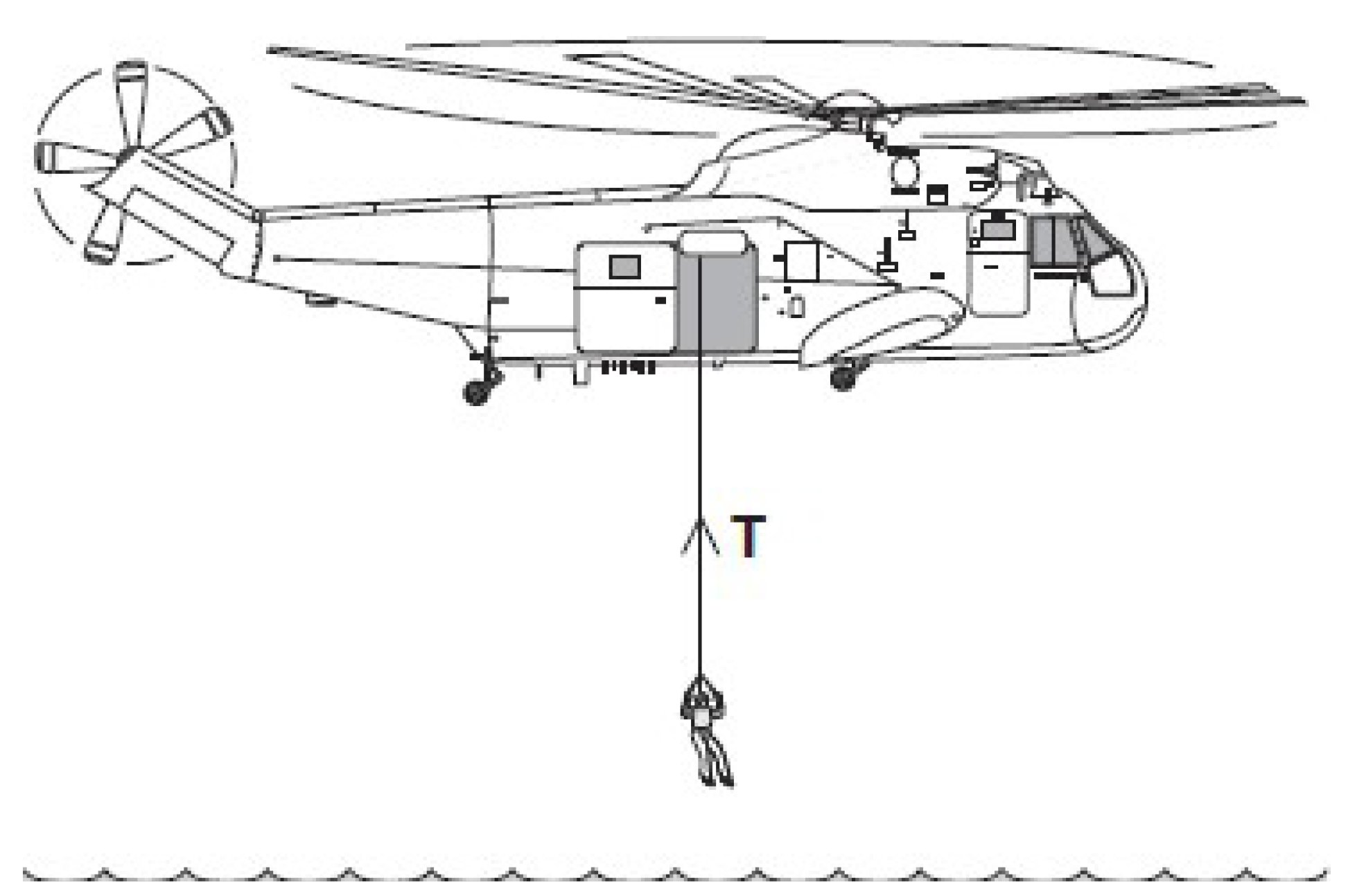
A helicopter rescuing a person from the sea
Fig 2.2 — A helicopter rescuing a person from the sea
EQ2a
The mass of the rescued person is 72 kg. Calculate the weight of the person. (g = 9.8 N/kg) Show your working. (2)
Model AnswerW = m × g = 72 × 9.8 = 705.6 N
EQ2b(i)
The motor transformed 21 600 J of energy. Complete: "The electric motor transforms electrical energy to kinetic energy. The kinetic energy is then transformed into useful ______ energy." (1)
Model Answergravitational potential
EQ2b(ii)
It takes 50 seconds to lift the person. Calculate the power of the motor. Show working and give the unit. (3)
Model AnswerP = E / t = 21 600 / 50 = 432 W (watts)

Resultant Force

Do Now

Q1
What is the equation for weight? Define each symbol.
Model AnswerW = m × g. W = weight (N), m = mass (kg), g = gravitational field strength (N/kg).
Q2
What is a scalar quantity? Give two examples.
Model AnswerA scalar has magnitude only (no direction). Examples: speed, distance, mass, temperature.
Q3
What is a vector quantity? Give two examples.
Model AnswerA vector has both magnitude and direction. Examples: force, velocity, acceleration, displacement.

Part 1 · Force Diagrams

The forces acting on any object can be shown using a force diagram (free body diagram) — labelled arrows showing all forces acting on the object.
  • The direction of each arrow shows the direction of the force
  • The length of each arrow is proportional to the size (magnitude) of the force
  • The resultant force is the single force that has the same effect as all forces combined
  • To find the resultant: draw arrows tip to tail, then draw a line from start to finish
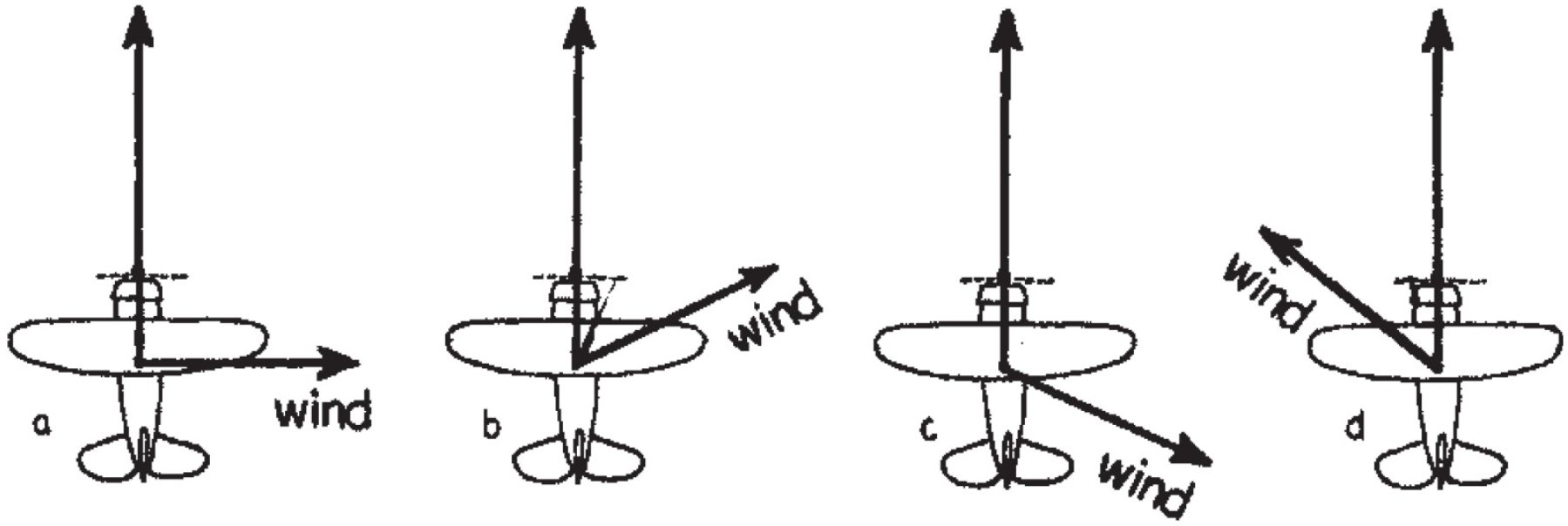
Top view of an aeroplane blown off course by wind in four different directions
Fig 3.2 — Top view of an aeroplane blown off course by wind in four different directions

Questions

Q1
What does the length of an arrow in a force diagram show? (1)
Model AnswerThe size (magnitude) of the force.
Q2
What does the direction of an arrow in a force diagram show? (1)
Model AnswerThe direction of the force.
Q3
Draw the resultant force of 3 N upward and 4 N to the right. Add one force onto the end of the other and draw a line from start to finish. (2)
Model AnswerDraw 3 N up (3 cm) and 4 N right (4 cm) tip-to-tail. Resultant = √(3² + 4²) = 5 N (diagonal arrow from origin to end point).
Q4
For planes a–d in Fig 3.2 (wind blowing in different directions): (a) Sketch the resultant for each plane. (b) Which plane is accelerating the most? Explain. (c) Which is accelerating the least? Explain. (4)
Model Answer(a) Draw resultant arrow tip-to-tail for each case. (b) The plane with the largest resultant force is accelerating the most — where the wind is perpendicular (90°) to the plane's direction of travel. (c) The plane with the smallest resultant force (or zero) is accelerating the least — where the wind exactly opposes or is parallel to the plane's motion.

Part 2 · What the Resultant Means

  • If there is a resultant force → the object is accelerating
  • If there is no resultant force → no acceleration
  • No acceleration means the object is either stationary OR moving at a constant velocity
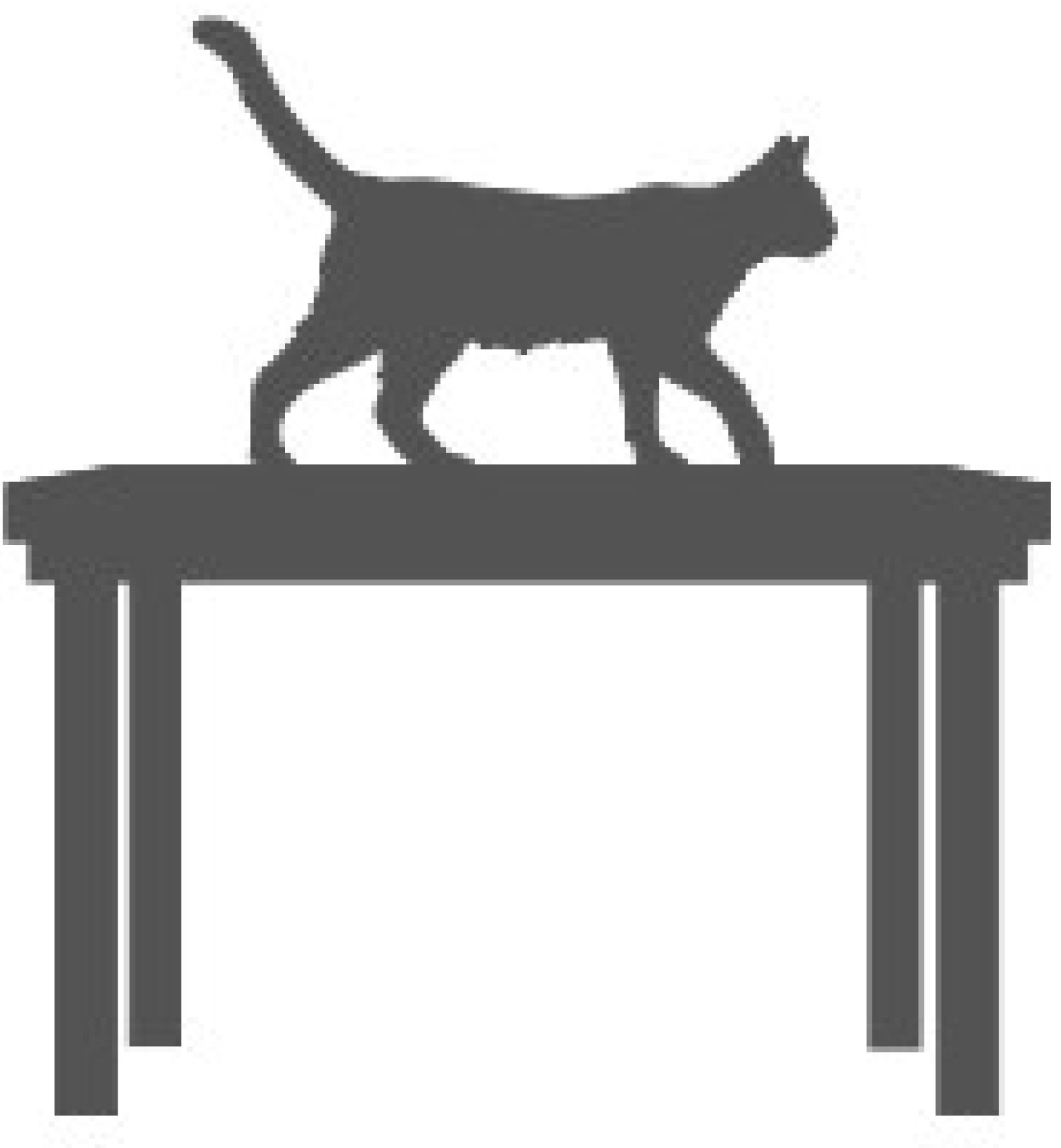
Cat sitting on a table
Fig 3.1 — A cat sitting on a table
Boat with force arrows
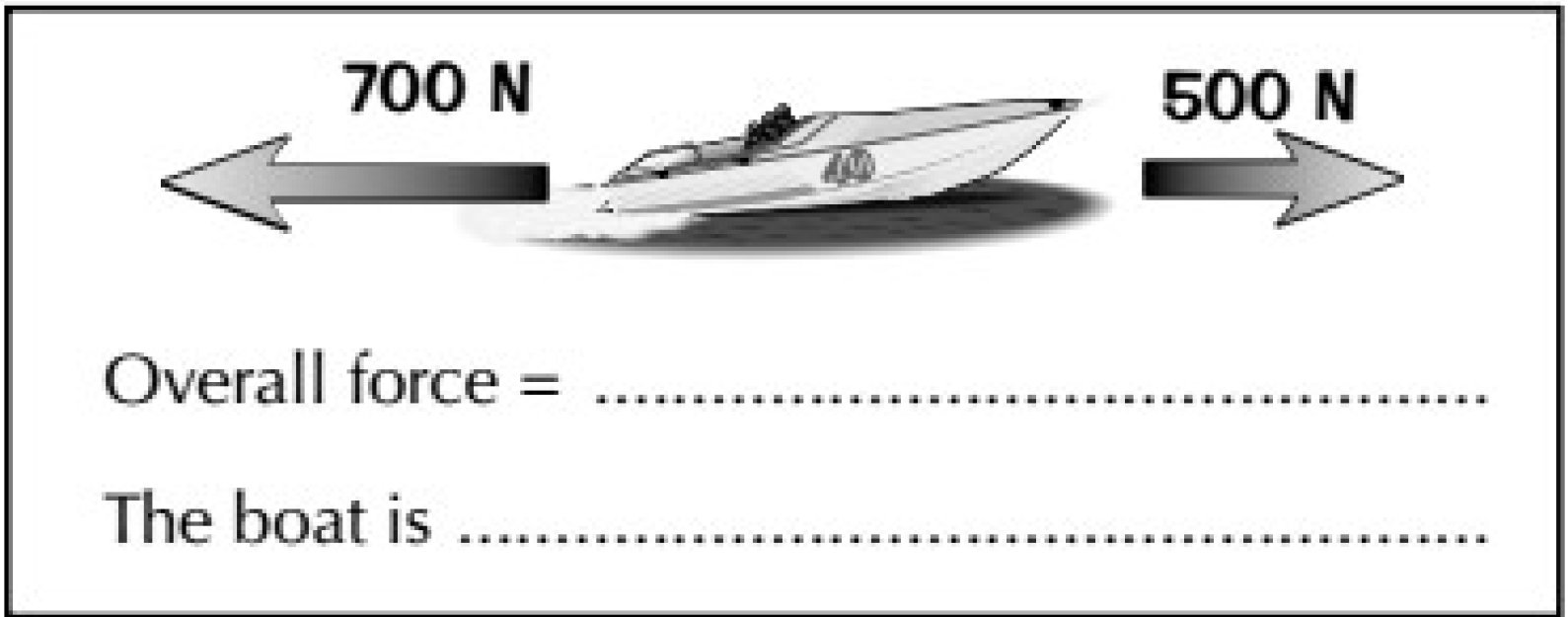
Fig 3.3a — Boat scenario
Car with force arrows
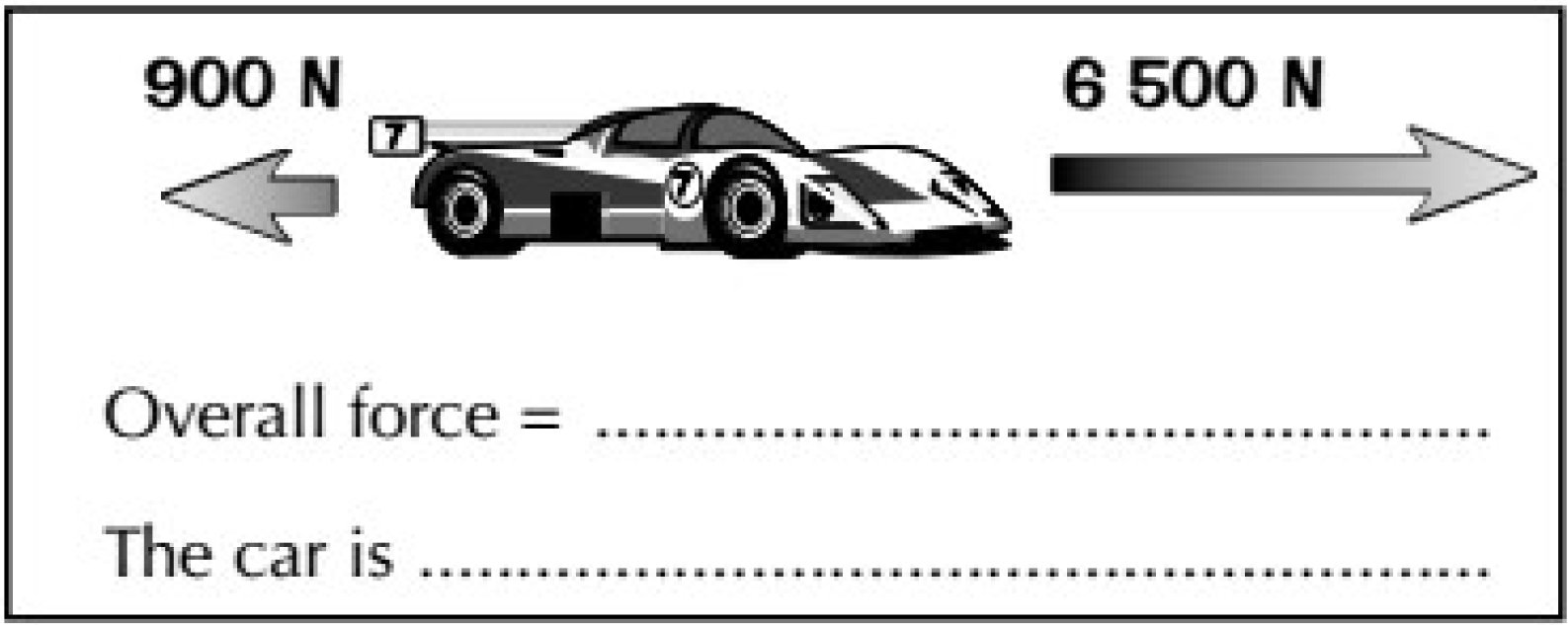
Fig 3.3b — Car scenario
Skydiver with force arrows
Fig 3.3c — Skydiver scenario

Questions

Q5
A cat has a weight of 35 N and is standing still on a table. (a) What direction does weight act? (b) Name the other force. (c) What direction does it act? (d) What is its size? (e) Draw and label both forces on a diagram. (3)
Model Answer(a) Downwards. (b) Normal contact force (reaction force). (c) Upwards. (d) 35 N (equal and opposite to weight, since no acceleration). (e) Two equal-length arrows: one down labelled "weight 35 N", one up labelled "normal contact force 35 N".
Q6
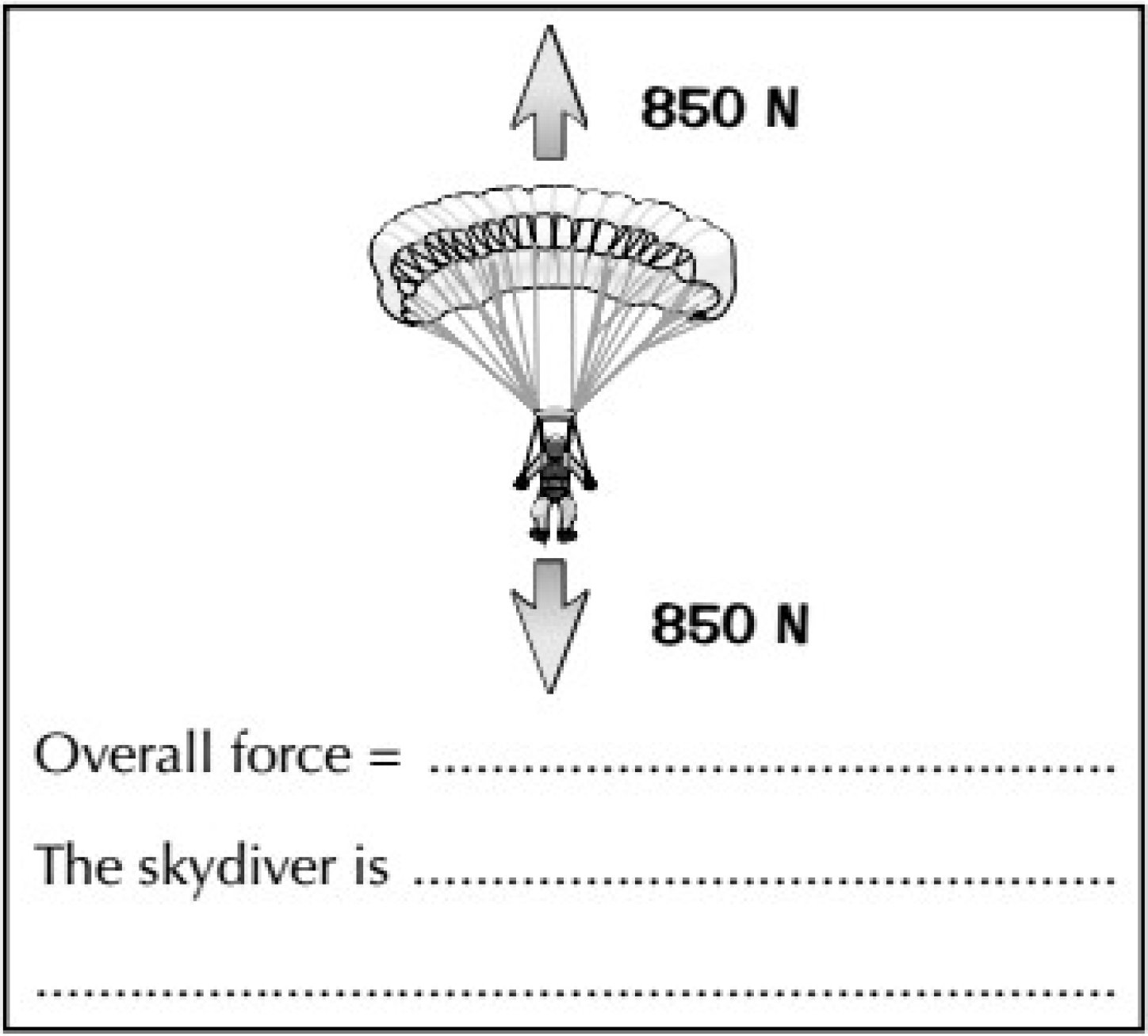
In each example below, calculate the resultant force and state whether the object is stationary, at constant speed, or accelerating (and in which direction): (a) boat: 700 N left, 500 N right. (b) car: 6500 N right, 900 N left. (c) skydiver: 850 N down, 850 N up. (3)
Model Answer(a) 700 − 500 = 200 N left. The boat is decelerating (accelerating to the left). (b) 6500 − 900 = 5600 N right. The car is accelerating to the right. (c) 850 − 850 = 0 N. The skydiver is stationary or moving at constant speed (terminal velocity).

Part 3 · Resultant Force with Perpendicular Vectors

When forces are perpendicular we can also look at them separately.

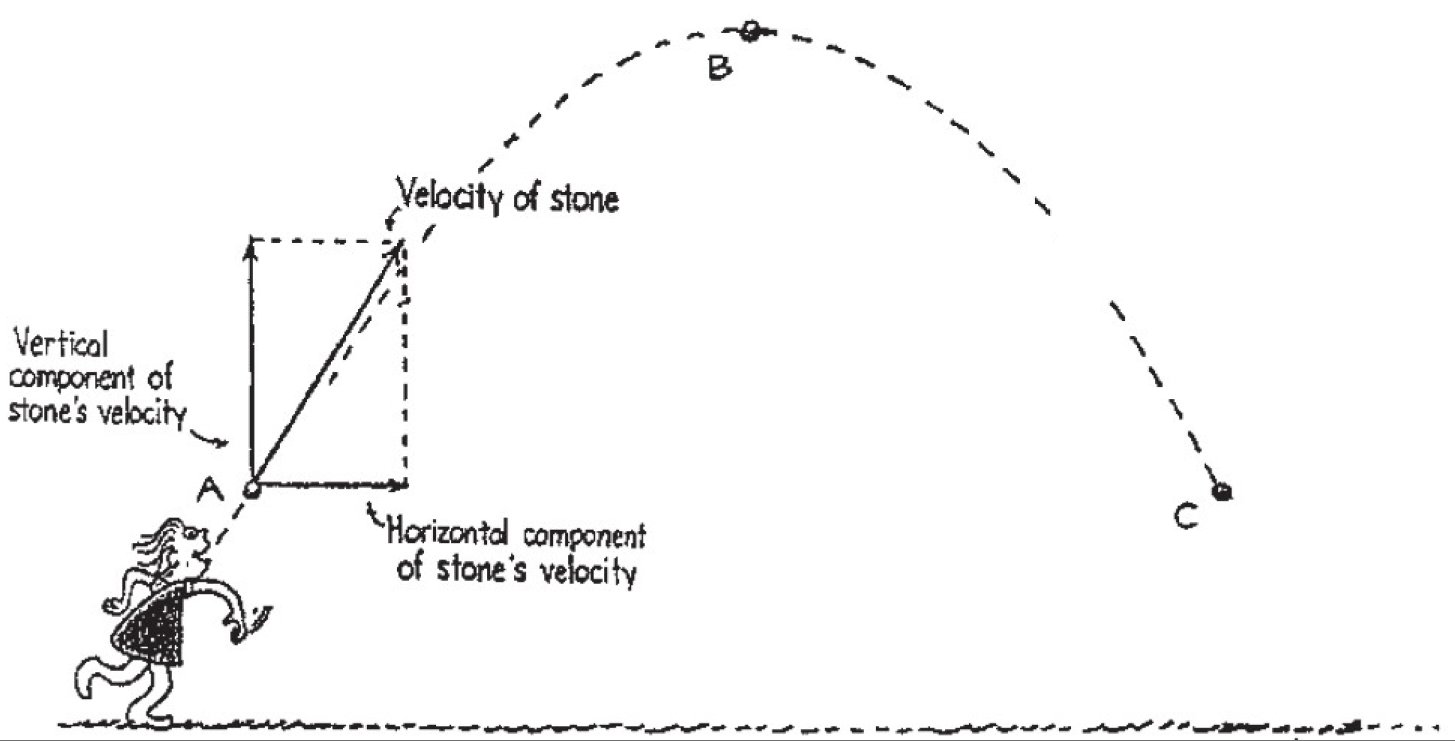
Sometimes there is no horizontal force. For example, if you throw an object (and air resistance is negligible) there is only gravity acting on it. Therefore it doesn't accelerate sideways at all — its horizontal velocity is constant.

If you shoot a bullet horizontally and drop a bullet at the same time, they will hit the ground at the same time — the sideways motion of the bullet doesn't matter as it is perpendicular to gravity.
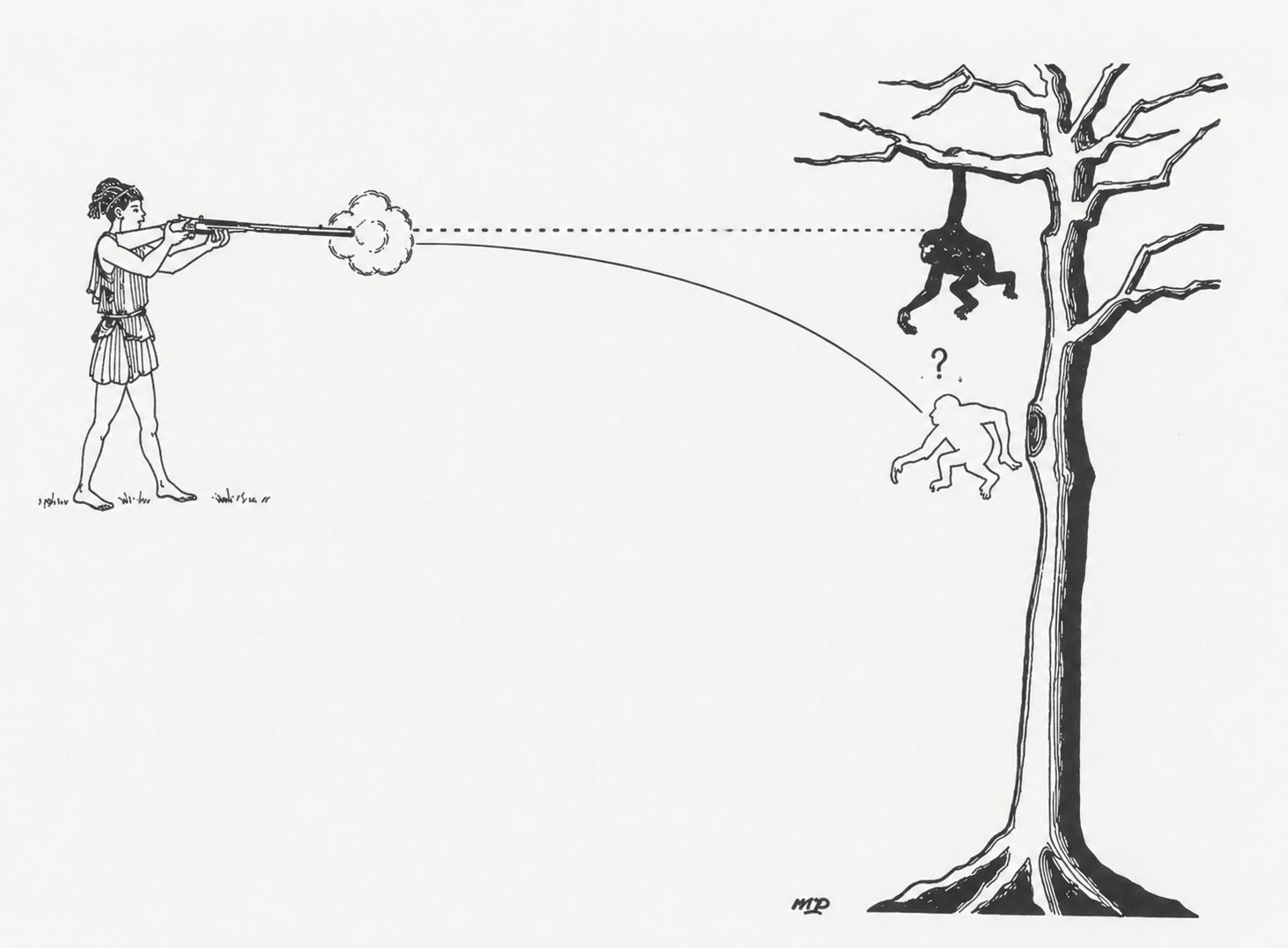
Bullet and monkey falling at the same rate
Fig 3.3 — The bullet and the monkey fall at the same rate; sideways motion is perpendicular to gravity.
Ug threw a rock — projectile motion diagram
Fig 3.4 — Ug threw a rock! Projectile motion: positions A, B and C.

Questions

Q7
Ignoring air resistance: (a) How does the horizontal component of velocity compare at positions A, B and C? (b) What is the vertical component of velocity at position B (highest point)? (c) How does the vertical component at C compare to that at A? (d) Draw the resultant velocities at B and C. (3)
Model Answer(a) The horizontal component is the same at A, B and C (no horizontal force = no horizontal acceleration). (b) The vertical component is zero at the highest point B. (c) The vertical component at C is equal in magnitude to that at A but in the opposite (downward) direction. (d) At B: resultant = horizontal arrow only. At C: resultant = diagonal arrow (horizontal + downward vertical component).

Exam Question — Q3: Resultant Force (10 marks)

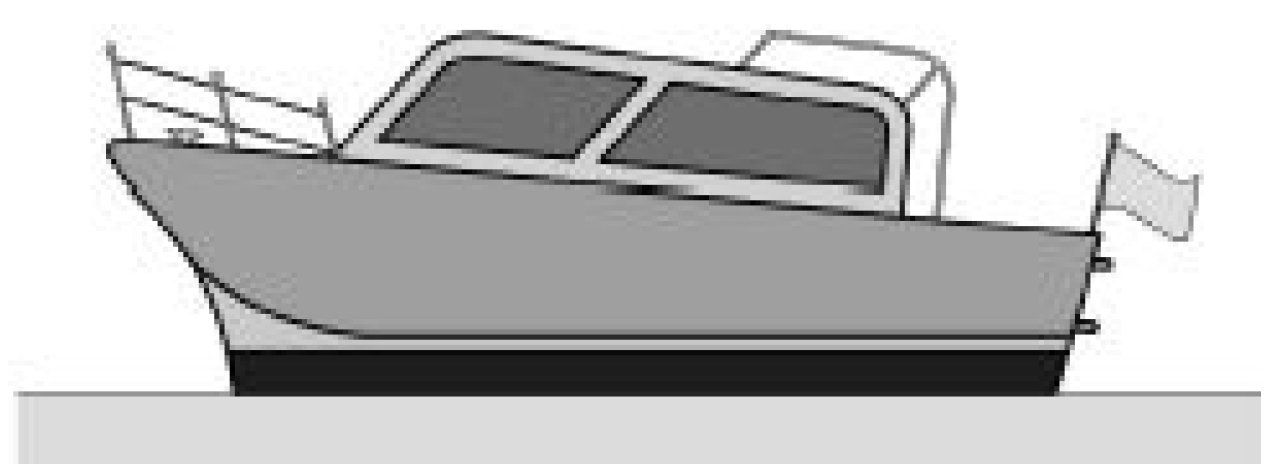
A boat floating on the sea
Fig 3.5 — A boat floating on the sea
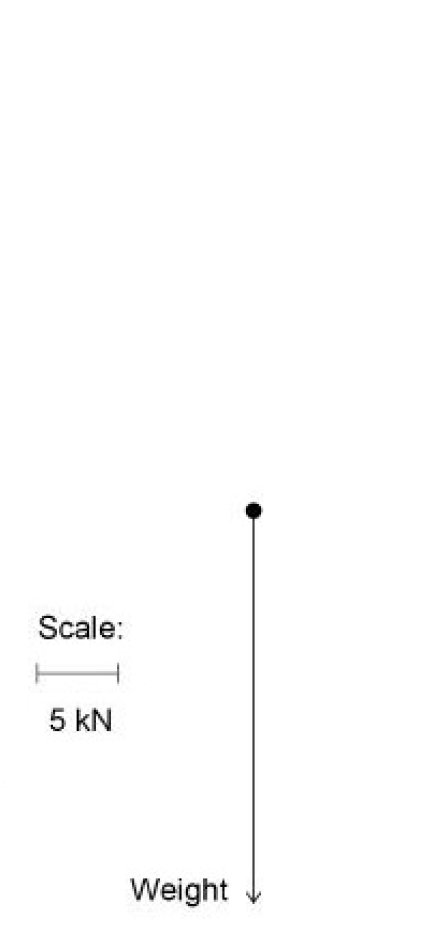
Part of the free body diagram for the boat
Fig 3.6 — Part of the free body diagram for the boat
The boat towing a dinghy
Fig 3.7 — The boat towing a dinghy
EQ3a
Fig 3.6 shows part of the free body diagram for the boat. Complete the free body diagram by adding the missing force. (2)
Model AnswerAdd an upward arrow labelled "upthrust" equal in size to the downward weight arrow. (The boat is in equilibrium — resultant = 0, so upthrust = weight.)
EQ3b
Calculate the mass of the boat using the information in Fig 3.6. (g = 9.8 N/kg) Give answer to 2 significant figures. (4)
Model AnswerRead weight from diagram (e.g. W = 20 000 N): m = W / g = 20 000 / 9.8 = 2 000 kg (2.0 × 10³ kg, 2 s.f.).
EQ3c
The tow rope exerts: 150 N forwards (horizontal) and 50 N upwards (vertical) on the dinghy. Draw a vector diagram to determine the magnitude of the tension and the direction of the force. (4)
Model AnswerResultant = √(150² + 50²) = √(22500 + 2500) = √25000 = 158 N. Direction = arctan(50/150) ≈ 18.4° above horizontal.

Work Done and Energy Transfer

Do Now

Q1
What is the unit of energy?
Model AnswerJoules (J).
Q2
Name three stores of energy you have studied.
Model AnswerAny three: kinetic, gravitational potential, elastic potential, chemical, thermal, nuclear.
Q3
What does it mean when we say energy is "transferred"?
Model AnswerEnergy is moved from one store to another; the total amount of energy is conserved.
Q4
Calculate the weight of a person with a mass of 60 kg. (g = 9.8 N/kg)
Model AnswerW = m × g = 60 × 9.8 = 588 N.

Part 1 · Work Done = Energy Transferred

When a force moves an object, work is done. Work done equals the energy transferred. The units of work done are Joules (J).

W = F × s

W = work done (J), F = force applied (N), s = distance moved in the direction of the force (m). The force and distance must be in the same direction.

Worked Example — A delivery worker pushes a trolley 8 m with a force of 50 N. Calculate the energy used.
V
F = 50 N   s = 8 m   W = ?
E
W = F × s
S
W = 50 × 8
S
W = 400
U
J (Joules)

Questions

Q1
What is work done? (1)
Model AnswerWork done is the energy transferred when a force moves an object through a distance in the direction of the force.
Q2
Write the equation for work done. Include the units for each quantity. (2)
Model AnswerW = F × s. W in Joules (J), F in Newtons (N), s in metres (m).
Q3
Rearrange W = F × s to give equations for (a) force F and (b) distance s. (2)
Model Answer(a) F = W / s(b) s = W / F
Q4
Calculate the work done if:(a) F=5N, s=5m(b) F=150N, s=0.1m(c) F=0.2N, s=200m(d) F=2000N, s=1.5m(e) F=800N, s=25m(f) F=150000N, s=0.5m. (3)
Model Answers(a) 5×5 = 25 J(b) 150×0.1 = 15 J(c) 0.2×200 = 40 J(d) 2000×1.5 = 3 000 J(e) 800×25 = 20 000 J(f) 150000×0.5 = 75 000 J
Q5
What is the work done if a 1.2 N force moves an object 4 m? (1)
Model AnswerW = 1.2 × 4 = 4.8 J
Q6
What is the work done if a 7 N force moves an object 8 m? (1)
Model AnswerW = 7 × 8 = 56 J
Q7
A car drives with a force of 300 000 N over a distance of 200 m. What is the work done? (1)
Model AnswerW = 300 000 × 200 = 60 000 000 J (= 6 × 10⁷ J)

Part 2 · Finding Force and Distance

F = W / s     s = W / F
Example (finding force) — A weightlifter raises a bar doing 720 J over 2 m. Calculate the force.
V
W = 720 J   s = 2 m   F = ?
E
F = W / s
S
F = 720 / 2
S
F = 360
U
N (Newtons)
Example (finding distance) — A gardener pushes a lawnmower with 80 N doing 400 J. How far does it travel?
V
F = 80 N   W = 400 J   s = ?
E
s = W / F
S
s = 400 / 80
S
s = 5
U
m (metres)

Questions

Q8
Calculate the distance moved if:(a) W=20J, F=10N(b) W=150J, F=7.5N(c) W=200000J, F=2N(d) W=300J, F=0.5N(e) W=90000J, F=4.5N(f) W=3000J, F=9N. (3)
Model Answers(a) 20/10 = 2 m(b) 150/7.5 = 20 m(c) 200000/2 = 100 000 m(d) 300/0.5 = 600 m(e) 90000/4.5 = 20 000 m(f) 3000/9 = 333 m
Q9
Calculate the force if:(a) W=15J, s=0.75m(b) W=450J, s=225m(c) W=9000J, s=3000m(d) W=5000J, s=1250m(e) W=140J, s=35m(f) W=800J, s=0.2m. (3)
Model Answers(a) 15/0.75 = 20 N(b) 450/225 = 2 N(c) 9000/3000 = 3 N(d) 5000/1250 = 4 N(e) 140/35 = 4 N(f) 800/0.2 = 4 000 N
Q10
What distance is moved if a force of 8 N is applied and work done is 90 J? (2)
Model Answers = W / F = 90 / 8 = 11.25 m
Q11
What force is required to move 7 m if the work done is 9 J? (2)
Model AnswerF = W / s = 9 / 7 = 1.29 N

Part 3 · Questions with Unit Conversions

When quantities have prefixes, convert to SI units first before substituting into W = F × s.

PrefixSymbolMultiply byExample (force)Example (distance)Example (energy)
GigaG×10⁹ (×1 000 000 000)1 GN = 1×10⁹ N1 Gm = 1×10⁹ m1 GJ = 1×10⁹ J
MegaM×10⁶ (×1 000 000)1 MN = 1×10⁶ N1 Mm = 1×10⁶ m1 MJ = 1×10⁶ J
kilok×10³ (×1 000)1 kN = 1 000 N1 km = 1 000 m1 kJ = 1 000 J
millim×10⁻³ (÷ 1 000)1 mN = 0.001 N1 mm = 0.001 m1 mJ = 0.001 J
Worked Example — A truck engine exerts a force of 8 kN and moves 300 m. Calculate the work done.
V
F = 8 kN = 8 × 1 000 = 8 000 N   s = 300 m   W = ?
E
W = F × s
S
W = 8 000 × 300
S
W = 2 400 000
U
J (= 2.4 × 10⁶ J)

Questions

Q12
A crane lifts a load by applying a force of 3 kN over a distance of 8 m. Calculate the work done. (2)
Model Answer3 kN = 3 000 N. W = 3 000 × 8 = 24 000 J
Q13
A car engine produces a driving force of 5 kN and moves the car 600 m along a road. Calculate the work done by the engine. (2)
Model Answer5 kN = 5 000 N. W = 5 000 × 600 = 3 000 000 J (= 3.0 × 10⁶ J)
Q14
A rocket motor exerts a thrust of 200 kN as it travels 50 m along a test rig. Calculate the work done. (2)
Model Answer200 kN = 200 000 N. W = 200 000 × 50 = 10 000 000 J (= 1.0 × 10⁷ J)
Q15
A person pushes a heavy box with a force of 40 N along a corridor 3 km long. Calculate the work done. (2)
Model Answer3 km = 3 000 m. W = 40 × 3 000 = 120 000 J (= 1.2 × 10⁵ J)
Q16
A cyclist pedals with a constant force of 60 N and travels 5 km. Calculate the work done by the cyclist. (2)
Model Answer5 km = 5 000 m. W = 60 × 5 000 = 300 000 J (= 3.0 × 10⁵ J)
Q17
A snail pushes against a leaf with a force of 0.04 N and travels 250 cm. Calculate the work done. (2)
Model Answer250 cm = 2.50 m. W = 0.04 × 2.50 = 0.10 J
Q18
A train engine exerts a force of 6 kN and travels 4 km along a track. Calculate the work done. (2)
Model Answer6 kN = 6 000 N; 4 km = 4 000 m. W = 6 000 × 4 000 = 24 000 000 J (= 2.4 × 10⁷ J)
Q19
A tractor pulls with a force of 8 kN over a distance of 2 km. Calculate the work done. (2)
Model Answer8 kN = 8 000 N; 2 km = 2 000 m. W = 8 000 × 2 000 = 16 000 000 J (= 1.6 × 10⁷ J)
Q20
A ship's propeller exerts a thrust of 50 kN and the ship travels 6 km. Calculate the work done. (2)
Model Answer50 kN = 50 000 N; 6 km = 6 000 m. W = 50 000 × 6 000 = 300 000 000 J (= 3.0 × 10⁸ J)
Q21
A bulldozer does 720 kJ of work while pushing rubble. The driving force of the bulldozer is 9 kN. Calculate the distance moved by the bulldozer. (3)
Model Answer720 kJ = 720 000 J; 9 kN = 9 000 N. s = W / F = 720 000 / 9 000 = 80 m
Q22
An electric car does 600 kJ of work travelling 3 km along a motorway. Calculate the driving force of the car. (3)
Model Answer600 kJ = 600 000 J; 3 km = 3 000 m. F = W / s = 600 000 / 3 000 = 200 N

Exam Question — AQA June 2018 Paper 1 (8463/1H) Q5 (8 marks)

Two students push a car that has broken down. Student A pushes with 180 N. Student B pushes with 120 N. Both push in the same direction.
EQ4a
Write down the equation that links work done, force and distance moved. (1)
Model AnswerW = F × s
EQ4b
Calculate the total force exerted by both students on the car. (1)
Model Answer180 + 120 = 300 N
EQ4c
The car is pushed 6 m. Calculate the work done by both students. Give the unit. (3)
Model AnswerW = F × s = 300 × 6 = 1 800 J (Joules)
EQ4d
One student pushes the car back 6 m alone with a force of 200 N. Calculate the work done. Give the unit. (2)
Model AnswerW = 200 × 6 = 1 200 J (Joules)
EQ4e
Compare the work done in (c) with the work done in (d). Explain the difference. (2)
Model Answer1 800 J > 1 200 J. The work done by both students is greater because the combined force (300 N) is larger than the single student's force (200 N). Since the distance is the same (6 m), a greater force means greater work done.

Newton's Laws

Do Now

Q1
What is meant by a "resultant force"?
Model AnswerThe resultant force is the single force that represents the combined effect of all forces acting on an object.
Q2
If the resultant force on an object is zero, what can you say about its motion?
Model AnswerThe object is either stationary (at rest) or moving at a constant velocity.
Q3
State the equation linking work done, force and distance.
Model AnswerW = F × s.
Q4
An object of mass 5 kg is pushed with a force of 20 N. Without using the equation F = ma, predict what happens to the object.
Model AnswerThe object will accelerate (speed up) in the direction of the force.

Part 1 · Newton's First Law

For there to be acceleration, there must be an unbalanced (resultant) force. In other words, if the resultant force acting on an object is zero, its motion does not change.

There are two cases:
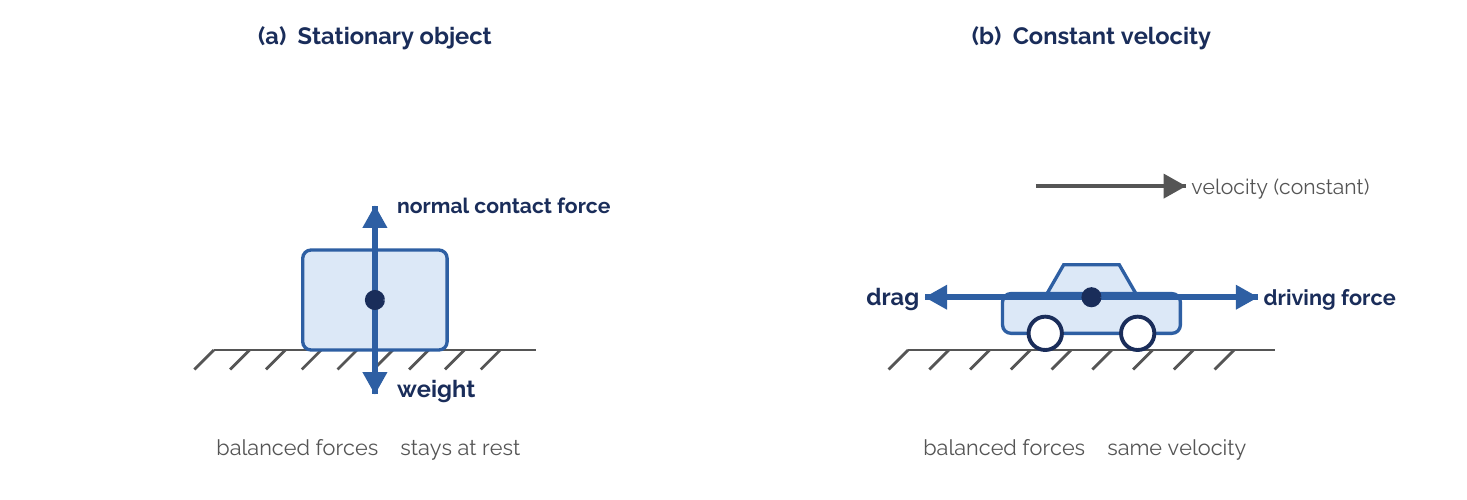
  • If the object is stationary, it remains stationary
  • If the object is moving, it continues to move at the same speed and in the same direction — so it continues at the same velocity
Balanced forces on a stationary object and on a car at constant velocity
Fig 5.1 — When forces are balanced (resultant = 0) the motion does not change: an object stays at rest, or keeps moving at the same velocity.

Questions

Q1
State Newton's First Law of motion. (2)
Model AnswerAn object at rest stays at rest, and a moving object continues at the same velocity (same speed and direction), unless acted upon by a resultant (unbalanced) force.
Q2
A car is parked on a flat, level road. (a) Is there a resultant force acting on the car? (b) Describe the motion of the car. (2)
Model Answer(a) No — the forces are balanced, so the resultant force is zero. (b) The car stays stationary (at rest).
Q3
A train travels in a straight line at a constant speed of 30 m/s. What does this tell you about the resultant force on the train? Explain your answer. (2)
Model AnswerThe resultant force is zero (the forces are balanced). Constant speed in a straight line means constant velocity, and by Newton's First Law there is no acceleration, so the resultant force must be zero.
Q4
A spacecraft is moving through deep space with its engines switched off, far from any planet or star, so that no forces act on it. Describe how it will move and explain why, using Newton's First Law. (2)
Model AnswerIt continues to move in a straight line at a constant velocity (constant speed and direction) forever. With no resultant force there is no acceleration, so its velocity cannot change.
Q5
For each object, state whether the resultant force is zero or not zero: (a) a parked lorry. (b) a car speeding up. (c) a skydiver falling at a constant (terminal) velocity. (d) a cyclist slowing down. (2)
Model Answer(a) Zero (parked = at rest). (b) Not zero (accelerating). (c) Zero (constant velocity). (d) Not zero (decelerating is a change in velocity).

Part 2 · Newton's Second Law

When there is a resultant force, the object accelerates. The acceleration is directly proportional to the resultant force and inversely proportional to the mass.

F = m × a

F = resultant force (N), m = mass (kg), a = acceleration (m/s²). A bigger resultant force gives a bigger acceleration; a bigger mass gives a smaller acceleration.
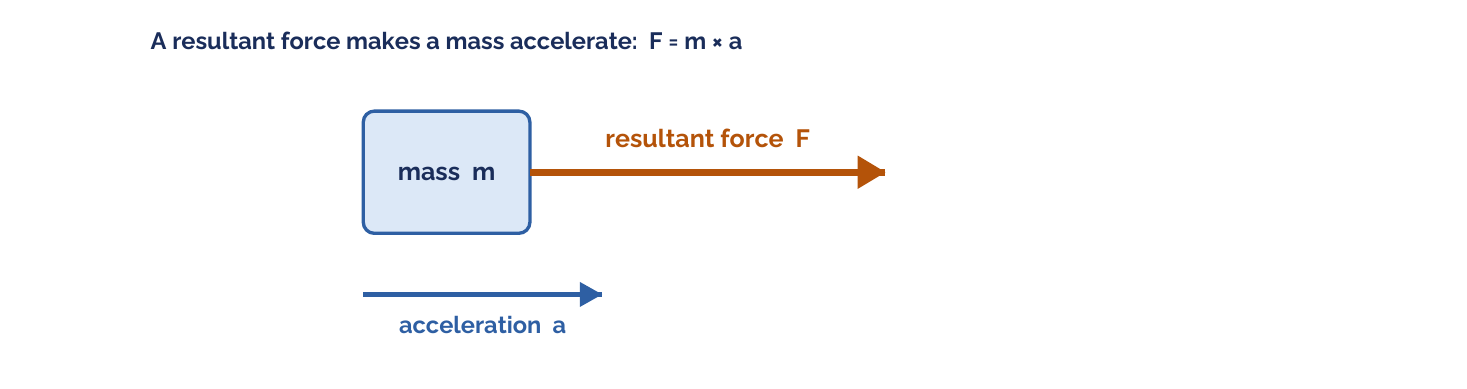
A resultant force F acting on mass m produces acceleration a, F = m times a
Fig 5.2 — A resultant force F acting on a mass m produces an acceleration a in the direction of the force, where F = m × a.
Worked Example — A trolley of mass 8 kg is pushed along a smooth floor and accelerates at 3 m/s². Calculate the resultant force on the trolley.
V
m = 8 kg   a = 3 m/s²   F = ?
E
F = m × a
S
F = 8 × 3
S
F = 24
U
N (Newtons)

Questions

Q6
State Newton's Second Law of motion. (2)
Model AnswerWhen there is a resultant force, the object accelerates. The acceleration is directly proportional to the resultant force and inversely proportional to the mass: F = m × a.
Q7
Give the units and symbol for each term in F = m × a: (a) Force (F) (b) Mass (m) (c) Acceleration (a). (3)
Model Answer(a) F: Newtons (N)(b) m: kilograms (kg)(c) a: metres per second squared (m/s²)
Q8
Work out the force in each of the following:(a) mass = 4 kg, acceleration = 2 m/s²(b) mass = 150 kg, acceleration = 3 m/s²(c) mass = 20 kg, acceleration = 2.7 m/s²(d) mass = 500 kg, acceleration = 5 m/s². (3)
Model Answers(a) F = 4×2 = 8 N(b) F = 150×3 = 450 N(c) F = 20×2.7 = 54 N(d) F = 500×5 = 2 500 N
Q9
How much force is needed to accelerate a 66 kg skier at 2 m/s²? (2)
Model AnswerF = 66 × 2 = 132 N
Q10
What is the resultant force on a 1 000 kg lift that is accelerating at 9.8 m/s²? (2)
Model AnswerF = 1000 × 9.8 = 9 800 N
Q11
A 50 kg skater pushed by a friend accelerates at 5 m/s². How much force did the friend apply? (2)
Model AnswerF = 50 × 5 = 250 N

Part 3 · Newton's Second Law Rearranged

Sometimes the resultant force is known and we need to find the mass or the acceleration instead. Always start from F = m × a, then rearrange to make the unknown the subject.

Remember to convert grams to kilograms first (1 g = 0.001 kg, so divide grams by 1 000).

Example (finding mass) — A resultant force of 18 N makes an object accelerate at 6 m/s². Calculate the mass.
V
F = 18 N   a = 6 m/s²   m = ?
E
F = m × a
S
18 = m × 6
S
m = 18 / 6 = 3
U
kg (kilograms)
Example (finding acceleration) — A resultant force of 40 N acts on a 5 kg box. Calculate the acceleration.
V
F = 40 N   m = 5 kg   a = ?
E
F = m × a
S
40 = 5 × a
S
a = 40 / 5 = 8
U
m/s²

Questions

Q12
Work out the mass in each of the following:(a) a = 5 m/s², F = 12 N(b) a = 25 m/s², F = 200 N(c) a = 15 m/s², F = 3 N(d) a = 0.5 m/s², F = 3 N. (3)
Model Answers(a) m = 12/5 = 2.4 kg(b) m = 200/25 = 8 kg(c) m = 3/15 = 0.2 kg(d) m = 3/0.5 = 6 kg
Q13
Work out the acceleration in each of the following:(a) F = 20 N, m = 5 kg(b) F = 7 N, m = 14 kg(c) F = 2 000 N, m = 1 250 kg(d) F = 0.75 N, m = 0.45 kg. (3)
Model Answers(a) a = 20/5 = 4 m/s²(b) a = 7/14 = 0.5 m/s²(c) a = 2000/1250 = 1.6 m/s²(d) a = 0.75/0.45 = 1.67 m/s²
Q14
What is the acceleration of a 50 kg object pushed with a resultant force of 500 N? (2)
Model Answera = 500/50 = 10 m/s²
Q15
A resultant force of 250 N is applied to an object that accelerates at 5 m/s². What is the mass of the object? (2)
Model Answerm = 250/5 = 50 kg
Q16
A resultant force of 20 N acts upon a 500 g block. Calculate the acceleration of the block. (2)
Model Answerm = 500 g = 0.5 kg. a = 20/0.5 = 40 m/s²

Part 4 · Newton's Third Law

Whenever one object exerts a force on a second object, the second object exerts an equal and opposite force back on the first.

  • These two forces are called an action–reaction pair — equal in size, opposite in direction, and the same type of force
  • Importantly, the two forces act on different objects, so they never cancel each other out
  • Example: a book pushes down on a table; the table pushes up on the book with an equal and opposite force
Action-reaction pair: book pushes down on table, table pushes up on book
Fig 5.3 — An action–reaction pair. The book pushes down on the table and the table pushes up on the book with a force that is equal in size but opposite in direction.

Questions

Q17
State Newton's Third Law of motion and give an example. (2)
Model AnswerWhenever one object exerts a force on a second object, the second object exerts an equal and opposite force back on the first. Example: when you push on a wall, the wall pushes back on you with an equal and opposite force.
Q18
A swimmer pushes backwards against the water with a force of 200 N. (a) Describe the force the water exerts on the swimmer (size and direction). (b) In which direction does the swimmer move? (2)
Model Answer(a) The water pushes the swimmer forwards with an equal and opposite force of 200 N. (b) The swimmer moves forwards.
Q19
A book rests on a table and pushes down on the table with a force of 8 N. (a) State the size and direction of the force the table exerts on the book. (b) Name the law that explains this. (2)
Model Answer(a) 8 N upwards. (b) Newton's Third Law.
Q20
A rocket pushes hot gas downwards out of its engines. Explain, using Newton's Third Law, how this makes the rocket move upwards. (2)
Model AnswerThe rocket exerts a downward force on the gas. By Newton's Third Law the gas exerts an equal and opposite (upward) force on the rocket, pushing it upwards.

Part 5 · Newton's Laws Acting Together

Real situations involve several forces at once. To solve them, work in two steps.
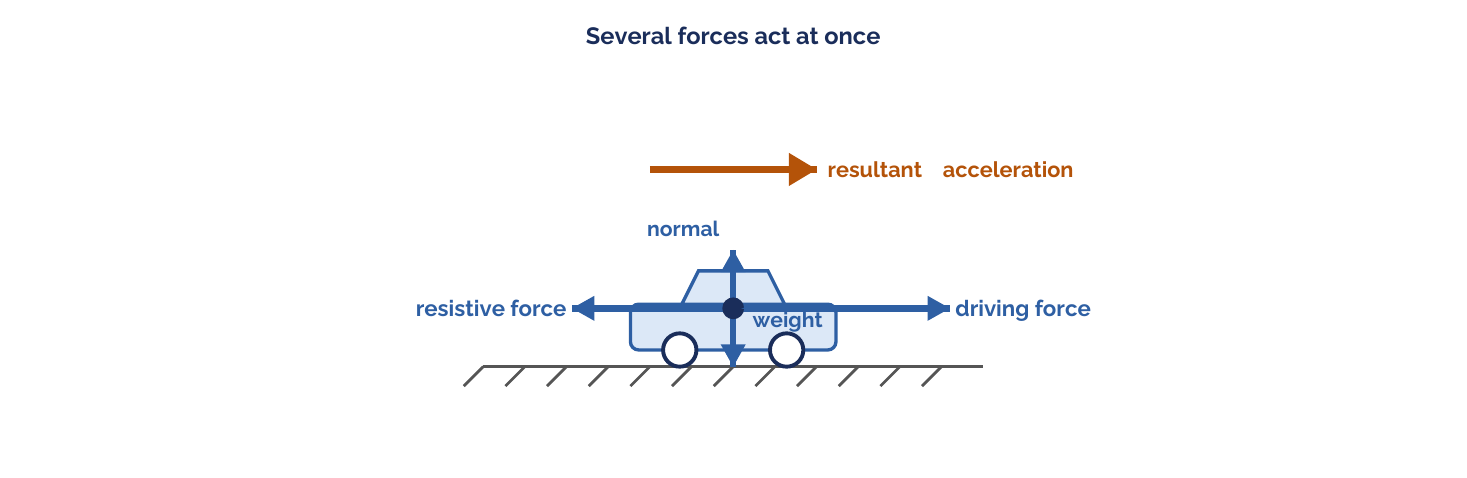
  • Step 1: find the resultant force. If it is zero the object is at rest or at constant velocity (Newton's First Law)
  • Step 2: if the resultant force is not zero, use F = m × a with the resultant force (Newton's Second Law) to find the acceleration
  • Remember to use the resultant force — not just one of the forces — and convert grams to kilograms first
Several forces on a moving car: vertical forces balanced, horizontal forces give a resultant
Fig 5.4 — Several forces act on a moving car. The vertical forces are balanced; the horizontal forces give a resultant that accelerates the car (F = m × a).

Questions

Q21
A 200 g block is pulled across a table by a horizontal force of 40 N, with a frictional force of 8 N opposing the motion. (a) Calculate the resultant force. (b) Calculate the acceleration of the block. (3)
Model Answer(a) Resultant = 40 − 8 = 32 N. (b) m = 0.2 kg. a = 32/0.2 = 160 m/s².
Q22
An object of mass 300 g is falling in air and experiences a force due to air resistance of 1.5 N. Determine the net (resultant) force acting on the object and calculate its acceleration. (g = 9.8 N/kg) (3)
Model Answerm = 0.3 kg. Weight = 0.3 × 9.8 = 2.94 N down. Air resistance = 1.5 N up. Net force = 2.94 − 1.5 = 1.44 N down. a = 1.44/0.3 = 4.8 m/s².
Q23
A 60 kg person on a 15 kg sled is pushed with a force of 300 N. What will be the person's acceleration? (2)
Model AnswerTotal mass = 60 + 15 = 75 kg. a = 300/75 = 4 m/s².
Q24
A 1 000 kg car has a driving force of 3 000 N and experiences 1 000 N of resistive forces. (a) Calculate the resultant force. (b) Calculate the acceleration of the car. (3)
Model Answer(a) Resultant = 3000 − 1000 = 2 000 N. (b) a = 2000/1000 = 2 m/s².

Exam Question — Q5: Newton's Laws (9 marks)

A car of mass 1 200 kg is driven along a straight, level road. Fig 5.5 shows the two horizontal forces acting on the car.
The two horizontal forces acting on the car: driving force and resistive force
Fig 5.5 — The two horizontal forces acting on the car.
EQ5a
When the car is accelerating, the driving force is ______ the resistive force. Choose one: smaller than / equal to / larger than. (1)
Model AnswerLarger than the resistive force.
EQ5b
At one moment the driving force is 4 200 N and the resistive force is 1 800 N. Calculate the resultant force acting on the car. (1)
Model AnswerResultant force = 4 200 − 1 800 = 2 400 N.
EQ5c
The mass of the car is 1 200 kg. Calculate the acceleration of the car at this moment. Use the equation F = m × a. (3)
Model Answera = F / m = 2 400 / 1 200 = 2.0 m/s².
EQ5d
The driver adds heavy luggage so the car's total mass increases. The driving force and resistive force are unchanged. Explain what happens to the acceleration of the car. (2)
Model AnswerThe acceleration decreases. For a fixed resultant force the acceleration is inversely proportional to the mass (a = F / m), so a larger mass gives a smaller acceleration.
EQ5e
As the car speeds up the resistive force increases, until the car travels at a constant maximum speed. Explain, in terms of the forces acting, why the car can no longer accelerate. (2)
Model AnswerThe resistive force has increased until it is equal to the driving force, so the forces are balanced. The resultant force is now zero, so there is no acceleration and the car moves at constant velocity (Newton's First Law).

Terminal Velocity

Do Now

Q1
If the resultant force on an object is zero, what can you say about its motion?
Model AnswerThe object moves at constant velocity (or remains stationary).
Q2
A skydiver jumps from a plane. Name the two main forces acting on them during the fall.
Model AnswerWeight (downwards) and air resistance (upwards).
Q3
Which force increases as the skydiver falls faster?
Model AnswerAir resistance increases as speed increases.
Q4
What does it mean if two forces are "balanced"?
Model AnswerTwo forces are balanced when they are equal in size and opposite in direction, giving a resultant force of zero.

Part 1 · The Forces on a Falling Object

When an object falls through the air, two forces act on it: its weight (downwards, caused by gravity) and air resistance (upwards, opposing its motion).
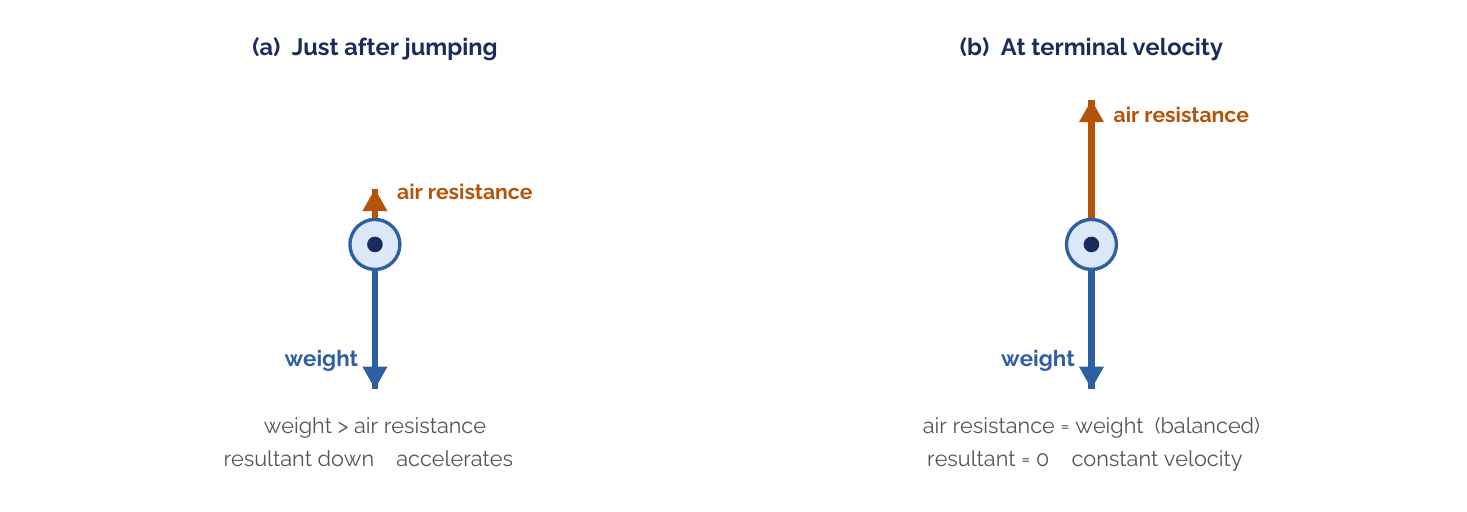
  • The weight stays the same throughout the fall; air resistance increases as the object moves faster
  • Just after the object starts to fall, air resistance is small, so weight is greater than air resistance — there is a resultant force downwards, so the object accelerates
  • As it speeds up, air resistance increases, so the resultant force gets smaller and the acceleration decreases
  • Eventually air resistance equals the weight. The resultant force is now zero, so there is no acceleration — the object falls at a steady speed called the terminal velocity
Forces on a falling object just after jumping (unbalanced) and at terminal velocity (balanced)
Fig 7.1 — Forces on a falling object: just after jumping (unbalanced) and at terminal velocity (balanced).

Questions

Q1
Name the two forces acting on a skydiver as they fall through the air, and state the direction of each. (2)
Model AnswerWeight, acting downwards; air resistance (drag), acting upwards.
Q2
Explain why a skydiver accelerates just after jumping from the plane. (2)
Model AnswerAt the start the speed is low, so air resistance is small. Weight is greater than air resistance, giving a resultant force downwards, so the skydiver accelerates.
Q3
As the skydiver speeds up, state what happens to each of the following: (a) the air resistance, (b) the resultant force, (c) the acceleration. (3)
Model Answer(a) air resistance increases; (b) the resultant force decreases; (c) the acceleration decreases.
Q4
What is meant by the term "terminal velocity"? (2)
Model AnswerThe steady (constant) maximum speed reached by a falling object when air resistance equals its weight, so the resultant force is zero.
Q5
State what is true about the forces acting on an object when it is falling at its terminal velocity. (1)
Model AnswerThe forces are balanced — air resistance is equal to the weight, so the resultant force is zero.

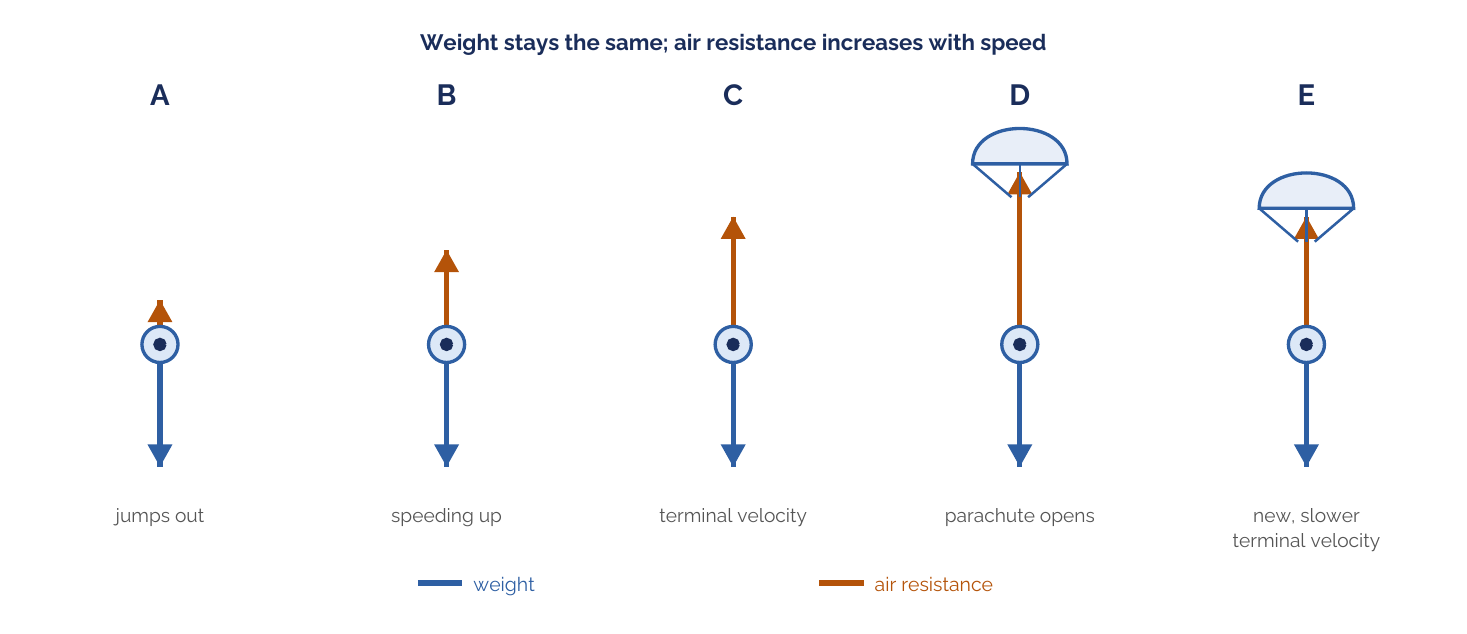
Part 2 · The Stages of a Skydive

  • Stage A: The skydiver jumps from the plane. Weight pulls her down. Air resistance is very small at first, so she starts to accelerate
  • Stage B: As she falls faster, air resistance increases and acts in the opposite direction to her weight
  • Stage C: Air resistance continues to increase until it equals her weight. The forces are balanced, so she falls at a constant speed — her terminal velocity
  • Stage D: She opens her parachute. There is now a very large upward air resistance force, so she decelerates (slows down)
  • Stage E: As she slows down, air resistance decreases until it equals her weight again. She reaches a new, slower terminal velocity and lands safely
The five stages of a skydive A to E showing weight and air resistance arrows
Fig 7.2 — The stages of a skydive. Weight is constant; air resistance changes with speed and with the open parachute.

Questions — Fill in the missing words

Q6
A — The skydiver jumps out of the plane and the downward force of her ______ pulls her down. Her air resistance at the start is very ______ but soon she starts to ______. (2)
Model Answerweight; small; accelerate.
Q7
B — As she accelerates, the air resistance force ______ and acts in the opposite direction to her ______. (1)
Model Answerincreases; weight.
Q8
C — As she accelerates faster, the air resistance force continues to ______ until eventually it is the ______ as her weight. She is now moving at a ______ speed, called her ______ velocity. The two forces are ______. (2)
Model Answerincrease; same; constant; terminal; balanced.
Q9
D — She opens her parachute. There is now a very ______ air resistance force, so she starts to ______ (slow down). (1)
Model Answerlarge; decelerate.
Q10
E — As she decelerates, the air resistance force ______ until it is the ______ size as her weight. She is now again falling at a ______ speed, but has a new and slower ______ velocity. (2)
Model Answerdecreases; same; constant; terminal.

Part 3 · Velocity-Time Graphs

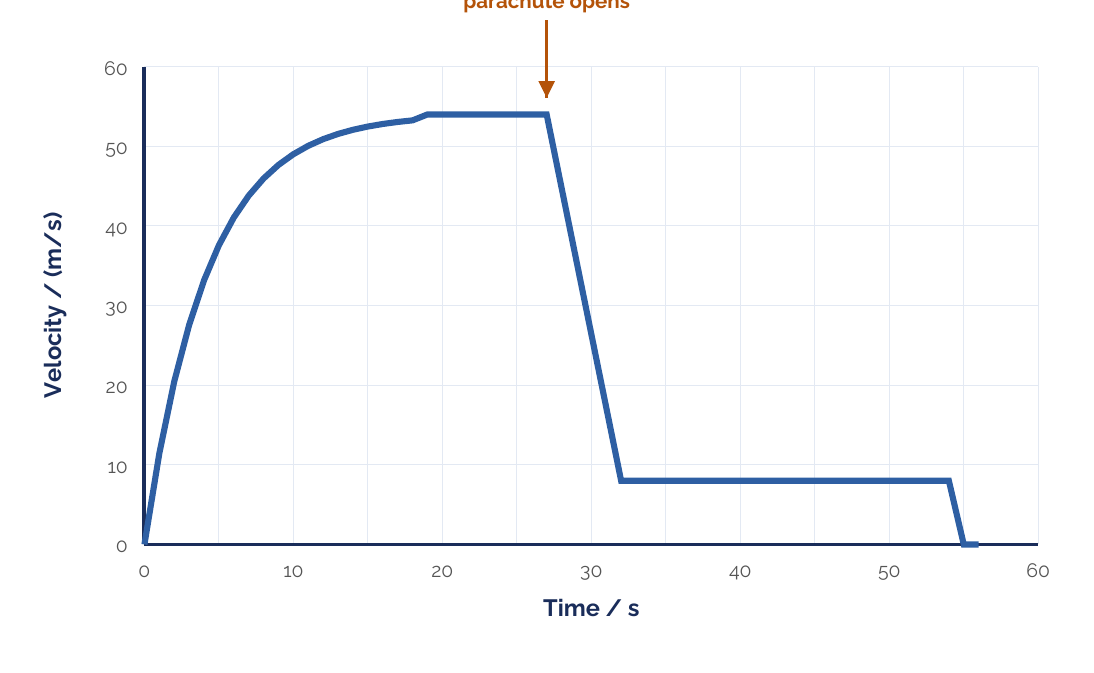
A velocity-time graph shows how the speed of a falling skydiver changes over time. Its shape tells the whole story of the jump.

  • A steep, rising line means the skydiver is accelerating
  • A horizontal line (zero gradient) means zero acceleration — a constant speed, or terminal velocity
  • When the parachute opens, the line falls steeply (decelerating), then levels off at a lower, slower terminal velocity before reaching zero on landing
  • Opening the parachute greatly increases the cross-sectional area, so air resistance increases sharply — air resistance equals the weight at a lower speed
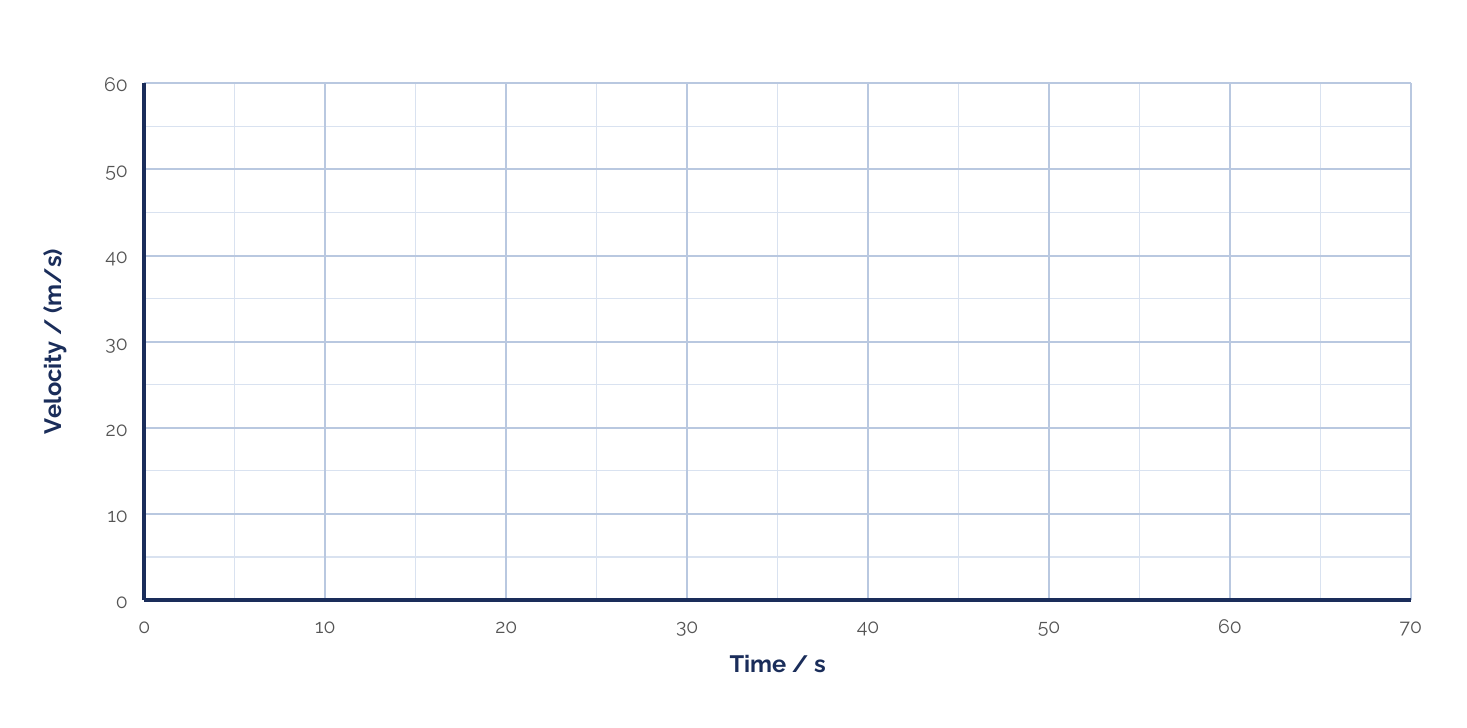
Time (s)051015202530354045505560
Velocity (m/s)028434850505049121010100
Blank grid for plotting velocity against time, axes 0 to 70 s and 0 to 60 m/s
Fig 7.3 — Grid for plotting the skydiver's velocity-time graph.

Questions

Q11
The table above shows the velocity of a skydiver over time. Plot the points on the grid (Fig 7.3) and draw a smooth curve through them. Label these parts of the journey on your graph: 1 acceleration, 2 terminal velocity, 3 parachute opens, 4 deceleration, 5 lands. (4)
Model AnswerSmooth curve: rises steeply from 0 to ~50 m/s (0–20 s); horizontal at 50 m/s (20–30 s); falls steeply to ~10 m/s (35–40 s); horizontal at 10 m/s (40–55 s); drops to 0 at 60 s. Labels: 1 on the rising part, 2 on the first flat part, 3 where the line starts to fall, 4 on the steep falling part, 5 where it reaches zero.
Q12
Using the idea of forces, explain why the skydiver reaches a terminal velocity. (3)
Model AnswerInitially weight is greater than air resistance, so the resultant force is downwards and she accelerates. As her speed increases, air resistance increases. Eventually air resistance equals her weight, the resultant force is zero and the acceleration is zero, so she falls at a constant (terminal) velocity.
Q13
Using the idea of forces, explain why opening the parachute reduces the skydiver's terminal velocity. (3)
Model AnswerOpening the parachute increases the cross-sectional area, greatly increasing air resistance. Air resistance is now greater than her weight, giving a resultant force upwards, so she decelerates. As she slows, air resistance decreases until it again equals her weight, at a lower speed — a new, slower terminal velocity.

Exam Question — Q7: Terminal Velocity (9 marks)

A parachutist of mass 80 kg jumps from a helicopter. Fig 7.4 shows how their vertical velocity changes from the moment they jump until they land. (g = 9.8 N/kg)
Velocity-time graph of a parachutist: rises to terminal velocity, then parachute opens and a lower terminal velocity is reached
Fig 7.4 — Vertical velocity of the parachutist against time.
EQ7a
Calculate the weight of the parachutist. Show your working and give the unit. (3)
Model AnswerW = m × g = 80 × 9.8 = 784 N (unit: newtons, N).
EQ7b
Before the parachute opens, the parachutist reaches a terminal velocity. Explain, in terms of the forces acting, why a terminal velocity is reached. (3)
Model AnswerJust after jumping, weight is greater than air resistance, so there is a resultant force downwards and the parachutist accelerates. As the speed increases, air resistance increases. When air resistance becomes equal to the weight, the resultant force is zero and there is no acceleration, so the speed stays constant — the terminal velocity.
EQ7c
Using the graph and the idea of forces, explain what happens to the parachutist's motion when the parachute opens. (3)
Model AnswerOpening the parachute increases the cross-sectional area, so air resistance increases sharply and becomes greater than the weight. The resultant force now acts upwards, so the parachutist decelerates — shown by the steep fall on the graph. As they slow down, air resistance decreases until it again equals the weight, giving a new, lower terminal velocity — the lower flat section of the graph.

Momentum

Do Now

Q1
What is the difference between speed and velocity?
Model AnswerSpeed is the magnitude of how fast an object moves (scalar). Velocity is speed in a specific direction (vector).
Q2
State Newton's Second Law of motion (F = m × a).
Model AnswerThe resultant force on an object equals its mass multiplied by its acceleration: F = m × a.
Q3
A 2 kg object accelerates at 3 m/s². Calculate the force acting on it.
Model AnswerF = m × a = 2 × 3 = 6 N.
Q4
Why is velocity a vector quantity but speed is a scalar?
Model AnswerVelocity includes both magnitude (speed) and direction, making it a vector. Speed only has magnitude.

Part 1 · Momentum: p = m × v

Any mass that is moving carries momentum.

p = m × v

p = momentum (in kg m/s), m = mass (in kg), v = velocity (in m/s). Because the equation contains velocity (a vector), momentum is also a vector: it acts in the direction the object is moving.
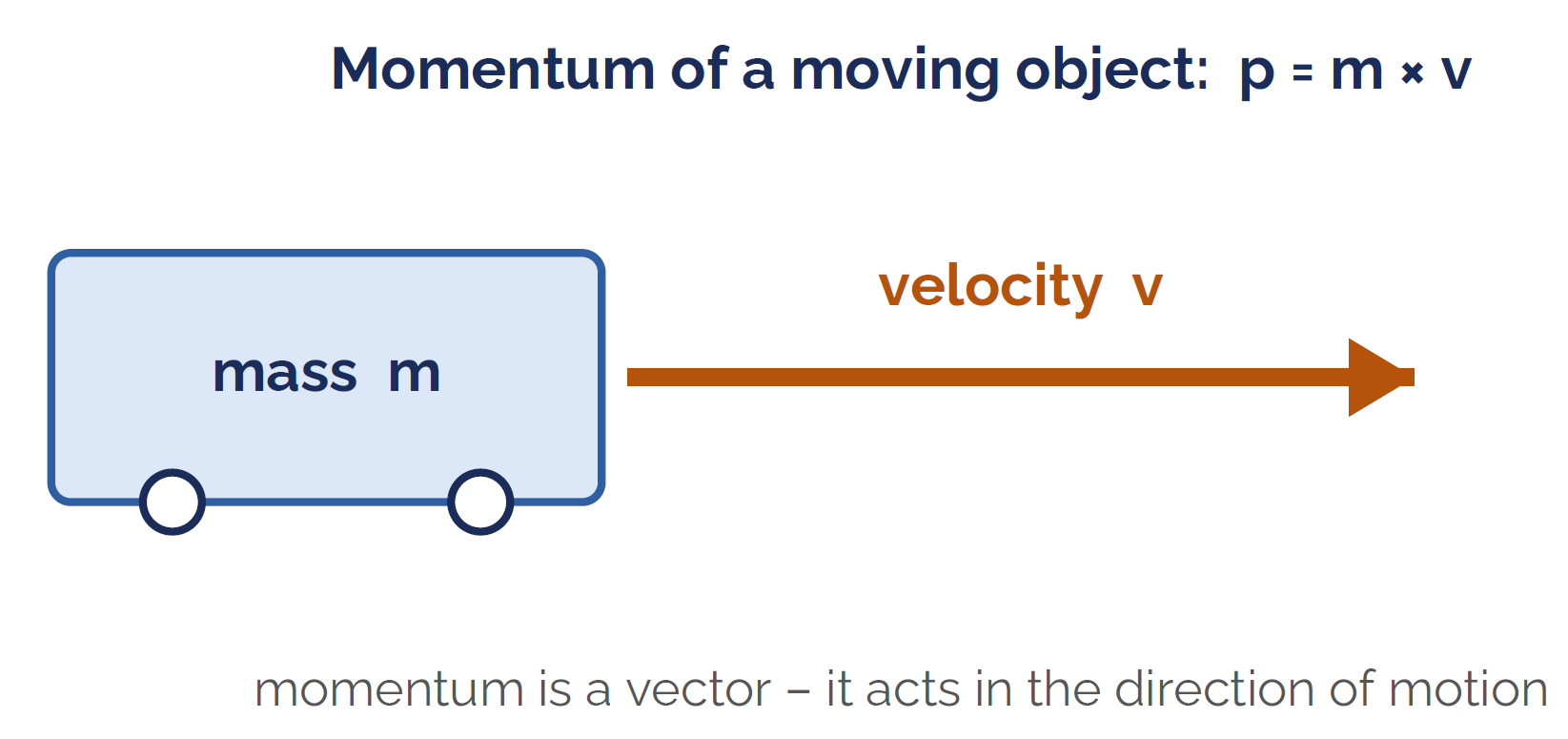
A moving mass m with velocity v; momentum p = m times v acts in the direction of motion
Fig 8.1 — Momentum p = m × v is a vector, acting in the direction of motion.
Worked Example — Dr Edmunds drops his iPad. Just before it hits the ground it is travelling at 5 m/s. The iPad has a mass of 500 g. Calculate its momentum.
V
v = 5 m/s   m = 500 g = 0.5 kg   p = ?
E
p = m × v
S
p = 0.5 × 5
S
p = 2.5
U
kg m/s

Questions

Q1
What is momentum? State whether it is a scalar or a vector quantity, and explain why. (2)
Model AnswerMomentum is the product of mass and velocity. It is a vector because it contains velocity (which is a vector), so it has both magnitude and direction.
Q2
Write the equation for momentum. State the units for each quantity. (2)
Model Answerp = m × v. p in kg m/s, m in kg, v in m/s.
Q3
Calculate the momentum if:(a) m = 0.3 kg, v = 7 m/s(b) m = 5 kg, v = 12 m/s. (2)
Model Answers(a) p = 0.3 × 7 = 2.1 kg m/s(b) p = 5 × 12 = 60 kg m/s
Q4
Calculate the momentum of a football of mass 500 g travelling at 10 m/s. (2)
Model Answerm = 0.5 kg. p = 0.5 × 10 = 5 kg m/s.
Q5
Calculate the momentum of a mouse of mass 400 g running through the grass at 3 m/s. (2)
Model Answerm = 0.4 kg. p = 0.4 × 3 = 1.2 kg m/s.

Part 2 · Rearranging: Finding Mass and Velocity

If the momentum is known, you can still find a missing mass or velocity — always starting from p = m × v.

  • Write p = m × v, substitute in the values you know, and then rearrange to make the unknown the subject
  • Do not learn a separate rearranged formula: substitute first, rearrange afterwards
Example (finding mass) — A trolley has a momentum of 600 kg m/s while moving at 12 m/s. Calculate its mass.
V
p = 600 kg m/s   v = 12 m/s   m = ?
E
p = m × v
S
600 = m × 12
S
m = 600 / 12 = 50
U
kg
Example (finding velocity) — A 6 kg bowling ball has a momentum of 90 kg m/s. Calculate its velocity.
V
p = 90 kg m/s   m = 6 kg   v = ?
E
p = m × v
S
90 = 6 × v
S
v = 90 / 6 = 15
U
m/s

Questions

Q6
Calculate the velocity if:(a) p = 1.5 kg m/s, m = 0.3 kg(b) p = 17 kg m/s, m = 8.5 kg. (2)
Model Answers(a) v = 1.5 / 0.3 = 5 m/s(b) v = 17 / 8.5 = 2 m/s
Q7
Calculate the mass if:(a) p = 1 400 kg m/s, v = 20 m/s(b) p = 1 800 000 kg m/s, v = 9 m/s. (2)
Model Answers(a) m = 1 400 / 20 = 70 kg(b) m = 1 800 000 / 9 = 200 000 kg
Q8
An athlete running at 8 m/s has a momentum of 520 kg m/s. What is her mass? (2)
Model Answerm = 520 / 8 = 65 kg.
Q9
Cristiano Ronaldo kicks a football with a momentum of 50 kg m/s. If the mass of the football is 500 g, what velocity has he kicked it at? (2)
Model Answerm = 0.5 kg. v = 50 / 0.5 = 100 m/s.
Q10
Dr Edmunds runs with a momentum of 700 kg m/s. If his velocity is 10 m/s, what is his mass? (2)
Model Answerm = 700 / 10 = 70 kg.
Q11
A rocket has a momentum of 700 000 000 kg m/s and travels at 1 400 m/s. What is its mass? (2)
Model Answerm = 700 000 000 / 1 400 = 500 000 kg.

Part 3 · Momentum with Unit Conversions

Always convert quantities to SI units before using p = m × v.
  • Useful conversions: 1 tonne = 1 000 kg; 1 kg = 1 000 g; 1 km = 1 000 m; 1 mile ≈ 1 600 m
  • To convert a speed in km/h to m/s, multiply by 1 000 then divide by 3 600
  • If a speed is not given directly, find it from distance and time: v = s / t
  • Remember to convert minutes and hours into seconds (1 minute = 60 s, 1 hour = 3 600 s)

Questions

Q12
A car that weighs 2 tonnes is travelling at 20 m/s. Calculate its momentum. (2)
Model Answerm = 2 000 kg. p = 2 000 × 20 = 40 000 kg m/s.
Q13
A train is travelling at 80 mph and has a mass of 100 tonnes. Calculate its momentum. (1 mile = 1 600 m) (2)
Model Answerv = 80 mph = 80 × 1 600 / 3 600 = 35.56 m/s. m = 100 000 kg. p = 100 000 × 35.56 = 3 556 000 kg m/s.
Q14
An eagle travels 150 m in 12 seconds and has a mass of 4 kg. Calculate its momentum. (2)
Model Answerv = 150 / 12 = 12.5 m/s. p = 4 × 12.5 = 50 kg m/s.
Q15
An aeroplane of mass 200 tonnes travels 900 km in 90 minutes. Calculate its momentum. (2)
Model Answerm = 200 000 kg. v = 900 000 / 5 400 = 166.7 m/s. p = 200 000 × 166.7 = 33 340 000 kg m/s.
Q16
A car has a momentum of 24 000 kg m/s while travelling at 72 km/h. Calculate its mass. (3)
Model Answerv = 72 km/h = 72 000 / 3 600 = 20 m/s. 24 000 = m × 20, so m = 24 000 / 20 = 1 200 kg.
Q17
A train travelling at 144 km/h has a momentum of 1 600 000 kg m/s. Calculate its mass. Give your answer in tonnes. (3)
Model Answerv = 144 km/h = 144 000 / 3 600 = 40 m/s. 1 600 000 = m × 40, so m = 1 600 000 / 40 = 40 000 kg = 40 tonnes.
Q18
A motorbike and rider have a momentum of 4 500 kg m/s at a speed of 54 km/h. Calculate their total mass. (3)
Model Answerv = 54 km/h = 54 000 / 3 600 = 15 m/s. 4 500 = m × 15, so m = 4 500 / 15 = 300 kg.
Q19
A sprinter running at 36 km/h has a momentum of 600 kg m/s. Calculate the sprinter's mass. (3)
Model Answerv = 36 km/h = 36 000 / 3 600 = 10 m/s. 600 = m × 10, so m = 600 / 10 = 60 kg.
Q20
A bullet of mass 20 g has a momentum of 8 kg m/s. Calculate its velocity. (3)
Model Answerm = 20 g = 0.02 kg. 8 = 0.02 × v, so v = 8 / 0.02 = 400 m/s.
Q21
A small boat of mass 2 tonnes has a momentum of 30 000 kg m/s. Calculate its velocity. (3)
Model Answerm = 2 tonnes = 2 000 kg. 30 000 = 2 000 × v, so v = 30 000 / 2 000 = 15 m/s.
Q22
A tennis ball of mass 60 g has a momentum of 3.6 kg m/s. Calculate its velocity. (3)
Model Answerm = 60 g = 0.06 kg. 3.6 = 0.06 × v, so v = 3.6 / 0.06 = 60 m/s.
Q23
A goods wagon of mass 5 tonnes has a momentum of 40 000 kg m/s. Calculate its velocity. (3)
Model Answerm = 5 tonnes = 5 000 kg. 40 000 = 5 000 × v, so v = 40 000 / 5 000 = 8 m/s.

Exam Question — Q8: Momentum (5 marks)

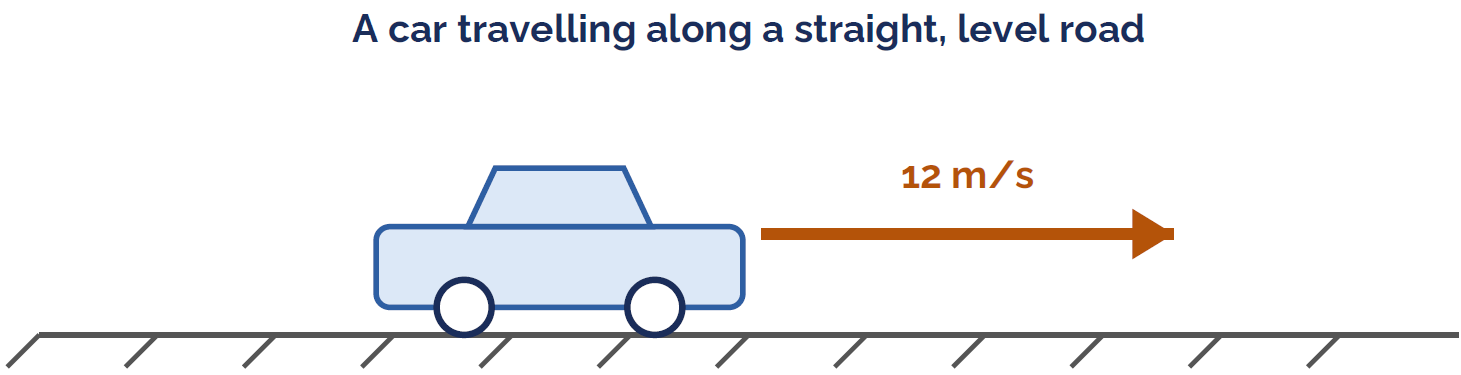
Figure 8.2 shows a car of mass 900 kg travelling along a straight, level road at 12 m/s.
A car travelling along a straight level road at 12 m/s
Fig 8.2 — A car of mass 900 kg travelling at 12 m/s.
EQ8a
State what is meant by the momentum of a moving object. (1)
Model AnswerMomentum = mass × velocity; it is a vector in the direction of motion.
EQ8b
Calculate the momentum of the car. Show your working and give the unit. (2)
Model Answerp = m × v = 900 × 12 = 10 800 kg m/s; unit: kg m/s.
EQ8c
The car slows down and stops at a set of traffic lights. State the momentum of the car when it is stationary, and explain your answer. (2)
Model AnswerMomentum = 0 kg m/s. When stationary the velocity is zero, and p = m × 0 = 0.

Conservation of Momentum

Do Now

Q1
Write the equation for momentum. State the units.
Model Answerp = m × v. Units: kg m/s.
Q2
Calculate the momentum of a 1 200 kg car travelling at 15 m/s.
Model Answerp = 1 200 × 15 = 18 000 kg m/s.
Q3
What is the momentum of a stationary object? Explain why.
Model AnswerZero. Because velocity = 0, and p = m × v = m × 0 = 0.
Q4
What is Newton's Third Law? Give an example.
Model AnswerEvery force has an equal and opposite reaction force. Example: a rocket expels gas backwards; the gas pushes the rocket forwards.

Part 1 · The Law of Conservation of Momentum

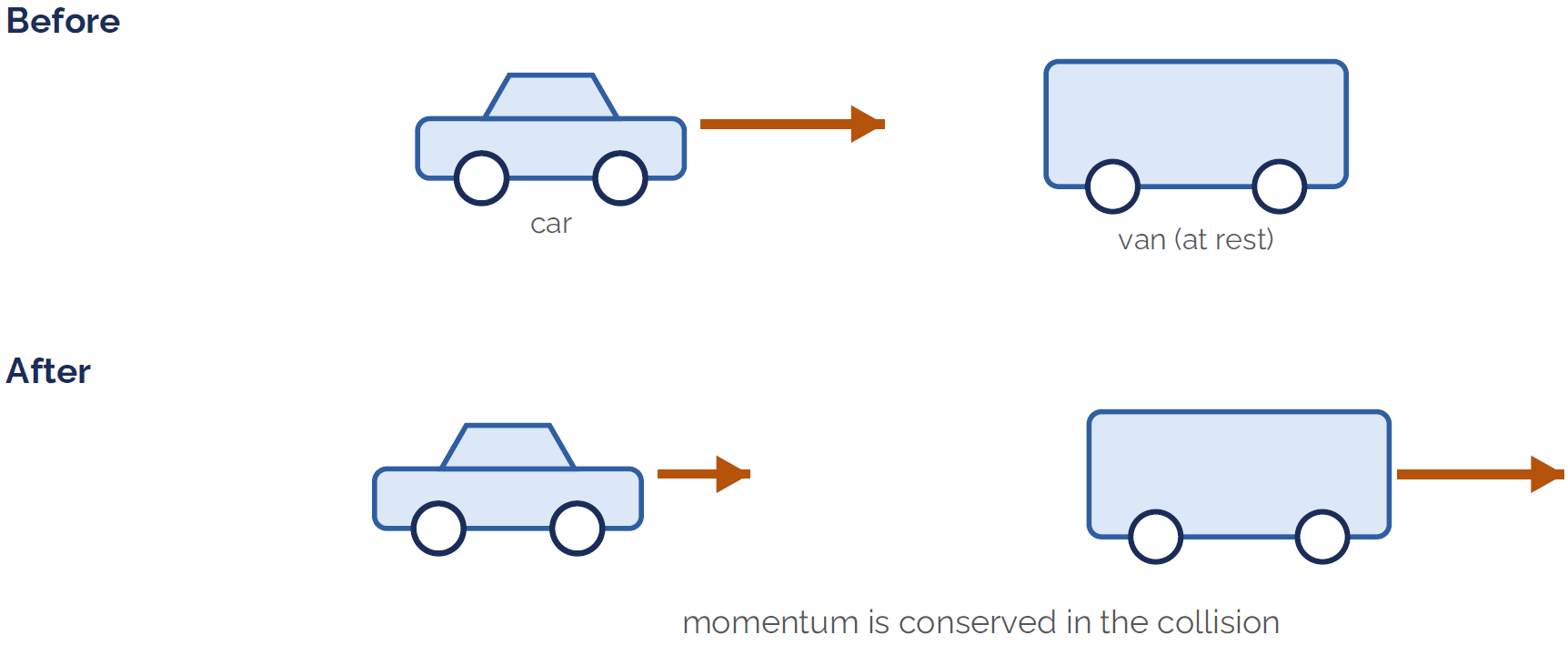
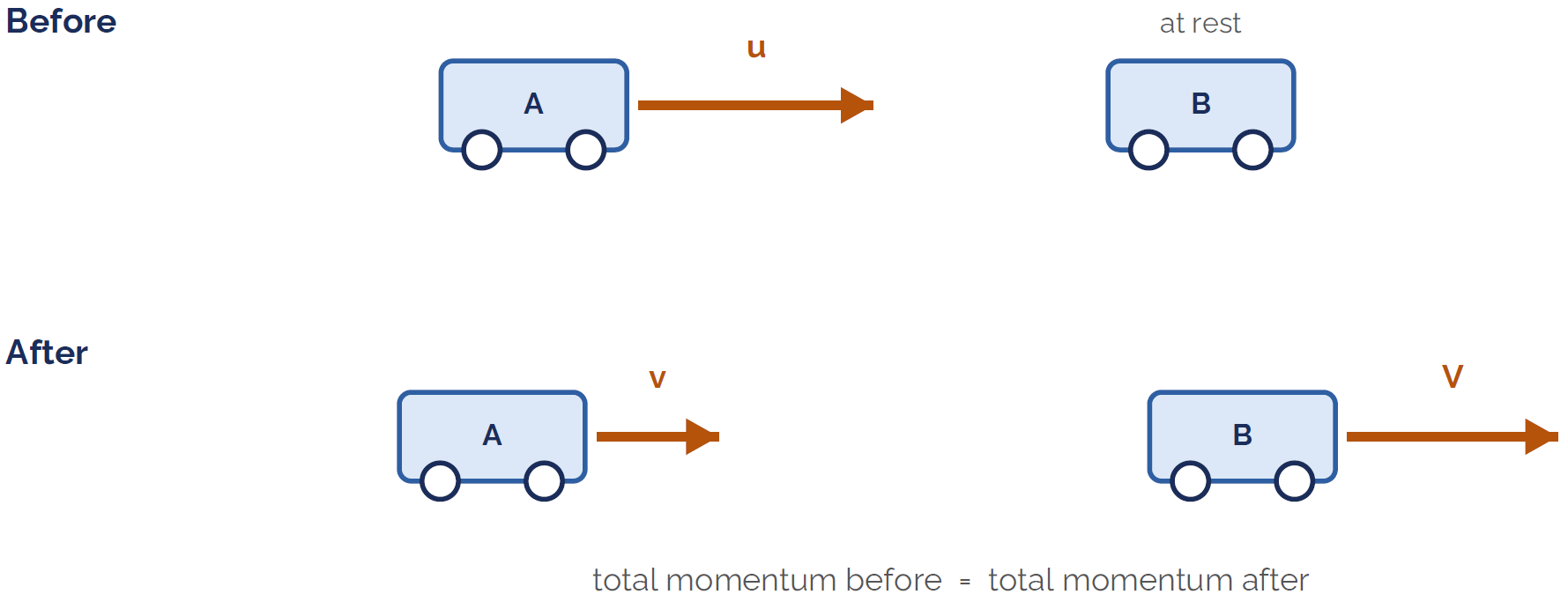
Conservation of momentum means that the total momentum before a collision or explosion equals the total momentum afterwards (when no external forces act).
  • This happens because the forces acting on each object during a collision are equal and opposite (Newton's Third Law)
  • The momentum lost by one object is gained by the other, so total momentum is conserved
  • Equation: total momentum before = total momentum after
A collision: object A strikes a stationary object B; total momentum before equals total momentum after
Fig 9.1 — A collision: object A strikes a stationary object B. Total momentum is the same before and after.

Questions

Q1
What is meant by "conservation of momentum"? (2)
Model AnswerThe total momentum of a system stays the same before and after a collision or explosion, provided no external forces act.
Q2
Why is momentum conserved in a collision? (Hint: think about Newton's Third Law.) (2)
Model AnswerDuring a collision, Newton's Third Law says the forces on the two objects are equal and opposite. Equal and opposite forces acting for the same time produce equal and opposite changes in momentum, so the total momentum is unchanged.
Q3
A white car (1 000 kg) travelling at 50 m/s collides with a green car (800 kg) at rest. After the collision the white car moves at 20 m/s (in the same direction).(a) Calculate the change in momentum of the white car.(b) How much momentum did the green car gain?(c) Calculate the velocity of the green car after the collision. (5)
Model Answer(a) Initial p = 1 000 × 50 = 50 000 kg m/s. Final p = 1 000 × 20 = 20 000 kg m/s. Change = 30 000 kg m/s.(b) By conservation of momentum, the green car gains exactly what the white car lost = 30 000 kg m/s.(c) v = 30 000 / 800 = 37.5 m/s.

Part 2 · Collision Calculations

For a collision where one object is initially at rest, work in two steps.

  • Step 1: find the change in momentum of the moving object = (m × u) − (m × v)
  • Step 2: this momentum is transferred to the second object. Its velocity = momentum gained ÷ its mass
  • Always keep the units consistent (kg, m/s, kg m/s)
Step 1: momentum gained — A 1 500 kg car at 12 m/s hits a stationary 2 000 kg car. After the collision the first car moves at 4 m/s. Find the momentum gained by the second car.
V
m = 1 500 kg   u = 12 m/s   v = 4 m/s
E
p = m × v
S
before: p = 1 500 × 12 = 18 000
S
after: p = 1 500 × 4 = 6 000
S
gained = 18 000 − 6 000 = 12 000
U
kg m/s
Step 2: velocity of car 2 — The second car (2 000 kg) gains 12 000 kg m/s. Find its velocity after the collision.
V
p = 12 000 kg m/s   m = 2 000 kg   v = ?
E
p = m × v
S
12 000 = 2 000 × v
S
v = 12 000 / 2 000
S
v = 6
U
m/s

Questions

Q4
A 1 000 kg car travelling at 40 m/s collides with an 800 kg car at rest. After the collision the first car moves at 10 m/s.(a) Calculate the change in momentum of the first car.(b) Calculate the velocity of the second car after the collision. (4)
Model Answer(a) Initial p = 1 000 × 40 = 40 000. Final p = 1 000 × 10 = 10 000. Change = 30 000 kg m/s.(b) v = 30 000 / 800 = 37.5 m/s.
Q5
A 1 000 kg car travelling at 30 m/s collides with an 800 kg car at rest. After the collision the first car moves at 5 m/s.(a) Calculate the change in momentum of the first car.(b) Calculate the velocity of the second car after the collision. (4)
Model Answer(a) Initial p = 1 000 × 30 = 30 000. Final p = 1 000 × 5 = 5 000. Change = 25 000 kg m/s.(b) v = 25 000 / 800 = 31.25 m/s.
Q6
A car (1 200 kg) at 15 m/s crashes into a stationary van (2 400 kg). After the collision, the car moves at 3 m/s in the same direction.(a) Calculate the change in momentum of the car.(b) Calculate the velocity of the van after the collision. (4)
Model Answer(a) Change = 1 200 × 15 − 1 200 × 3 = 18 000 − 3 600 = 14 400 kg m/s.(b) v = 14 400 / 2 400 = 6 m/s.

Part 3 · Explosions and Recoil

Conservation of momentum also applies to explosions (objects flying apart).
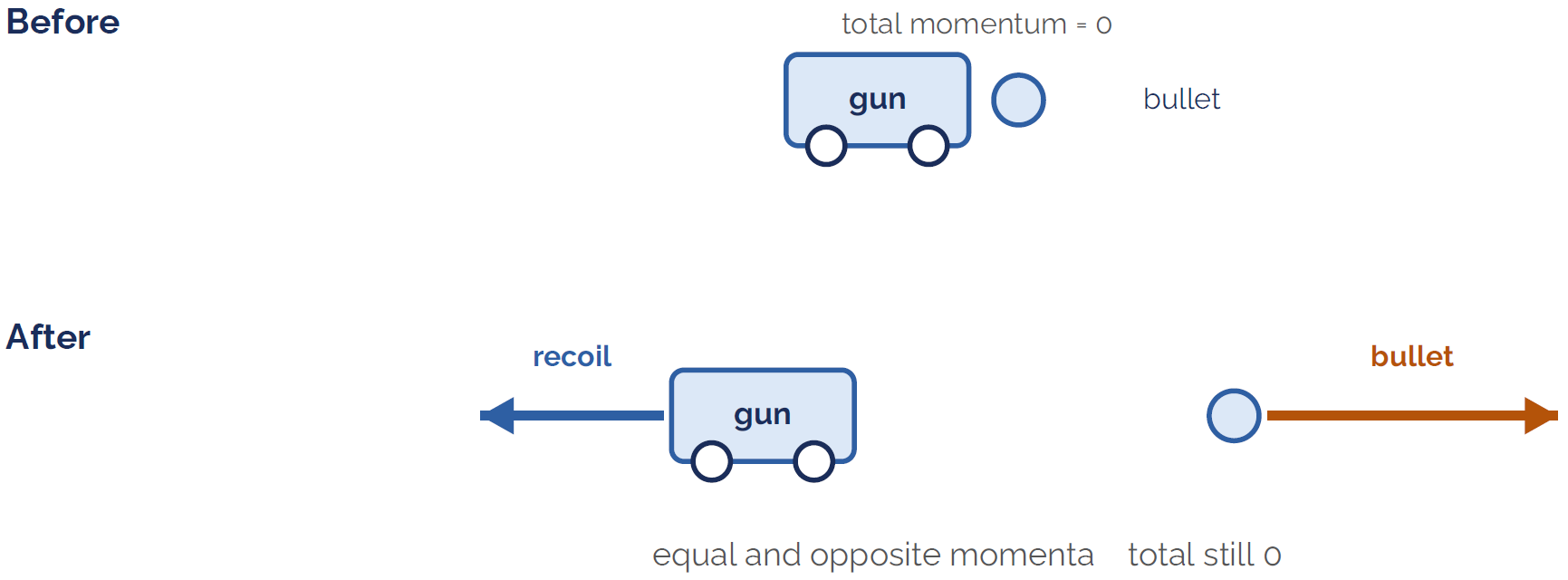
  • Before an explosion, total momentum = 0 (both objects at rest)
  • After the explosion, the two objects move in opposite directions with equal and opposite momenta, so the total is still zero
  • Example: firing a rifle. The bullet moves forward; the rifle recoils backward
  • A bullet (0.01 kg) fired from a rifle (2 kg) that recoils at 1 m/s: momentum of rifle = 2 × 1 = 2 kg m/s, so momentum of bullet = 2 kg m/s; vbullet = p / m = 2 / 0.01 = 200 m/s
Recoil: before firing total momentum is zero; afterwards the gun and bullet carry equal and opposite momenta
Fig 9.2 — Recoil: before firing the total momentum is zero; afterwards the gun and bullet carry equal and opposite momenta.

Questions

Q7
Explain why a gun recoils when fired, using the idea of conservation of momentum. (2)
Model AnswerBefore firing, total momentum = 0. After, the bullet gains forward momentum. By conservation, the gun gains an equal and opposite backward momentum, so it recoils.
Q8
What is the momentum of a cannonball before the cannon is fired? Give a reason. (1)
Model AnswerZero kg m/s. The cannonball is stationary before firing; v = 0 so p = 0.
Q9
A cannon fires a cannonball forwards at 250 m/s. The cannonball has a mass of 1 kg. Calculate the momentum of the cannonball after the cannon is fired. (2)
Model Answerp = 1 × 250 = 250 kg m/s.
Q10
The cannon has a mass of 1 000 kg. Using conservation of momentum, calculate the recoil speed of the cannon. (4)
Model AnswerTotal before = 0. Cannon momentum = 250 kg m/s backward. m = 1 000 kg. v = 250 / 1 000 = 0.25 m/s.
Q11
What is the momentum of a paintball before the gun is fired? Give a reason. (1)
Model AnswerZero kg m/s. The paintball is stationary before firing; v = 0 so p = 0.
Q12
A gun fires a paintball forwards at 90 m/s. The paintball has a mass of 0.003 kg. Calculate the momentum of the paintball after the gun is fired. (2)
Model Answerp = 0.003 × 90 = 0.27 kg m/s.
Q13
The gun has a mass of 500 g. Using conservation of momentum, calculate the recoil speed of the gun. (4)
Model AnswerTotal before = 0. Gun momentum = 0.27 kg m/s backward. m = 0.5 kg. v = 0.27 / 0.5 = 0.54 m/s.

Exam Question — Q9: Conservation of Momentum (6 marks)

Figure 9.3 shows a car of mass 1 000 kg moving at 20 m/s towards a stationary van of mass 2 000 kg. The car collides with the van. After the collision the car is at rest and the van moves forward.
A car collides with a stationary van, shown before and after the collision
Fig 9.3 — A car collides with a stationary van (before and after).
EQ9a
In a collision, the total momentum of the objects is usually conserved. What is meant by the term "momentum is conserved"? (1)
Model AnswerThe total momentum of the objects before the collision is equal to the total momentum after the collision (no external forces).
EQ9b
Calculate the change in the momentum of the car. Show clearly how you work out your answer and give the unit. (3)
Model AnswerChange = (1 000 × 20) − (1 000 × 0) = 20 000 − 0 = 20 000 kg m/s; unit: kg m/s.
EQ9c
Use the idea of conservation of momentum to calculate the velocity of the van after the collision. Show your working. (2)
Model AnswerMomentum gained by van = 20 000 kg m/s. v = 20 000 / 2 000 = 10 m/s.

Stopping Distance

Do Now

Q1
What is the equation for speed in terms of distance and time?
Model Answerspeed = distance / time (v = s / t).
Q2
Name two forces that act on a moving car.
Model AnswerAny two: driving force (thrust), friction, air resistance, weight, normal contact force.
Q3
What effect does friction have on a moving vehicle?
Model AnswerFriction opposes motion and causes the vehicle to decelerate (slow down).
Q4
State Newton's First Law of motion.
Model AnswerAn object at rest remains at rest, and a moving object continues at constant velocity, unless acted upon by a resultant force.

Part 1 · Thinking Distance

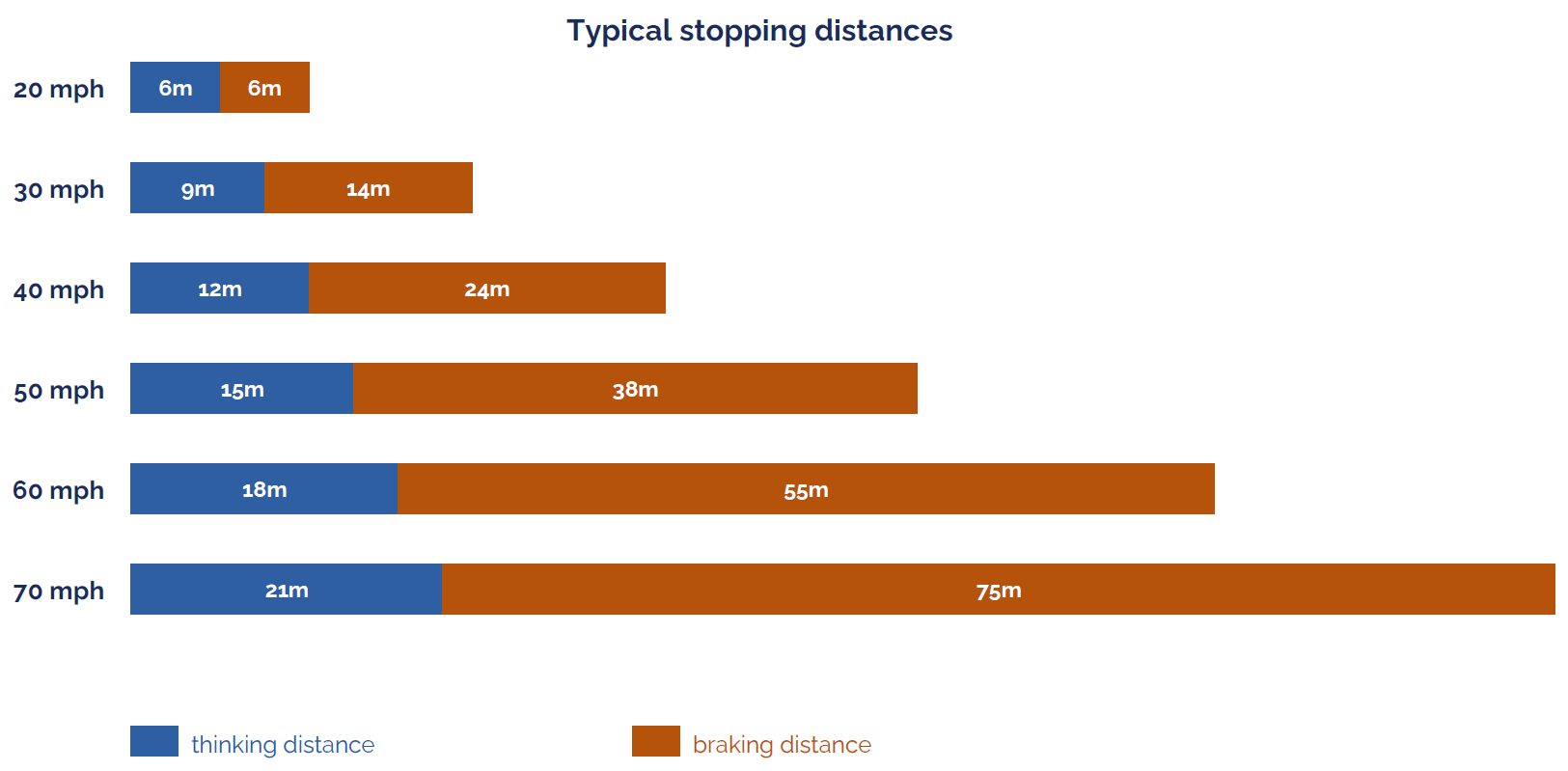
Thinking distance is the distance the vehicle travels while the driver reacts to a hazard — from seeing the hazard to pressing the brake — before the brakes are applied.
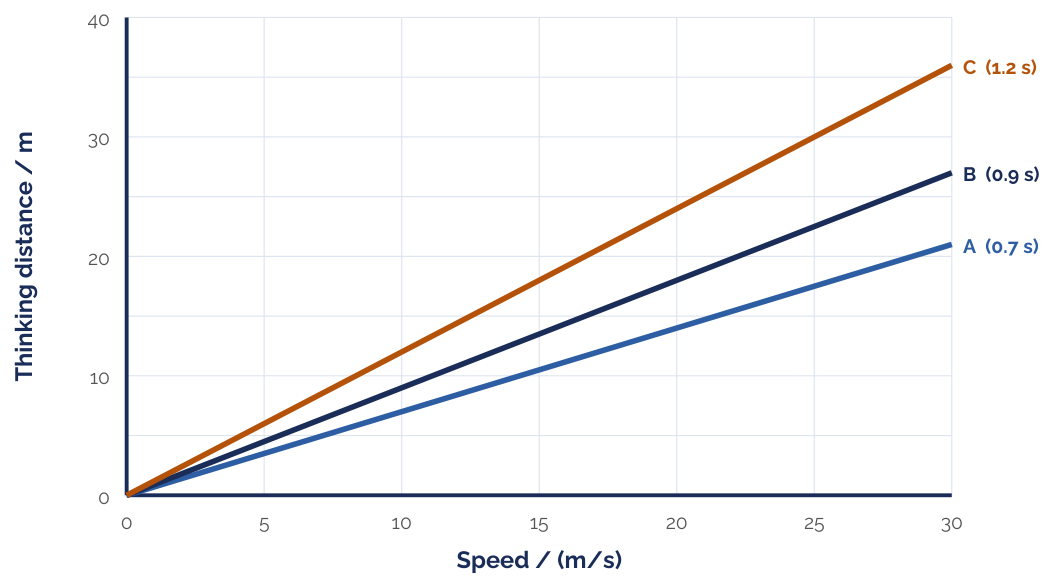
  • Reaction time is the time taken to react. For a healthy, alert driver it is typically 0.2–0.9 s
  • Thinking distance is calculated from: thinking distance = speed × reaction time
  • Thinking distance is therefore directly proportional to speed: double the speed and the thinking distance doubles
  • Factors that increase the thinking distance by increasing the reaction time: tiredness, alcohol, drugs (including some medicines) and distractions (such as using a phone or loud music)
Graph of thinking distance against speed for three drivers A, B and C with different reaction times
Fig 10.1 — Thinking distance against speed for three drivers with different reaction times.
DriverConditionReaction time (s)
Awide awake0.7
Busing a hands-free phone0.9
Cvery tired and listening to music1.2

Questions

Q1
(a) What is meant by the thinking distance? (b) What is meant by a driver's reaction time? (2)
Model Answer(a) The distance the car travels during the driver's reaction time, before the brakes are applied. (b) The time between seeing the hazard and pressing the brake.
Q2
Write the equation that links thinking distance, speed and reaction time. (1)
Model Answerthinking distance = speed × reaction time.
Q3
Describe two factors that increase the thinking distance, and explain how each one does so. (2)
Model AnswerAny two of tiredness / alcohol / drugs / distractions. Each increases the reaction time, so the car travels further before the brakes are applied, increasing the thinking distance.
Q4
Driver A (reaction time 0.7 s) is travelling at 22 m/s (about 50 mph). Calculate the thinking distance. (2)
Model Answerthinking distance = speed × reaction time = 22 × 0.7 = 15.4 m.
Q5
The table cannot be used to tell whether driver C's longer reaction time is caused by being tired or by listening to music. Explain why. (2)
Model AnswerDriver C is tired AND listening to music at the same time — two variables have been changed at once. The test is not fair, so you cannot tell which factor (or how much of each) causes the longer reaction time.
Q6
The three lines in Fig 10.1 show thinking distance against speed for drivers A, B and C. Match each line to the correct driver and explain how you decided. (2)
Model AnswerSteepest line = driver C (longest reaction time, 1.2 s); middle line = driver B (0.9 s); least steep = driver A (0.7 s). The gradient of each line equals that driver's reaction time.

Part 2 · Braking Distance

Braking distance is the distance the vehicle travels from the moment the brakes are applied to the moment it stops.
  • During braking, the kinetic energy of the vehicle is transferred to thermal (heat) energy in the brakes by the work done against friction — the brakes, tyres and road warm up
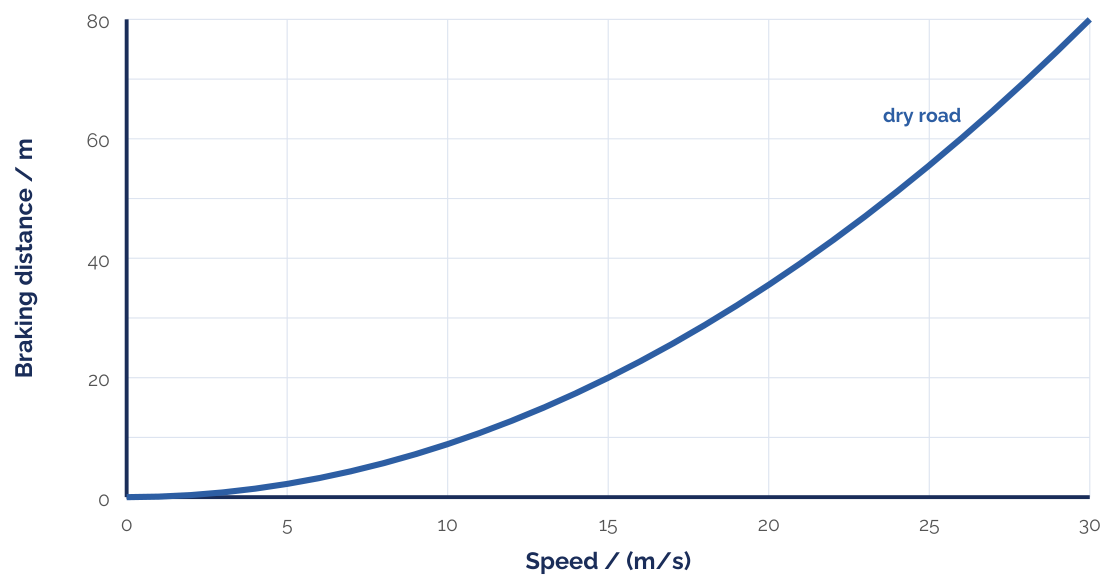
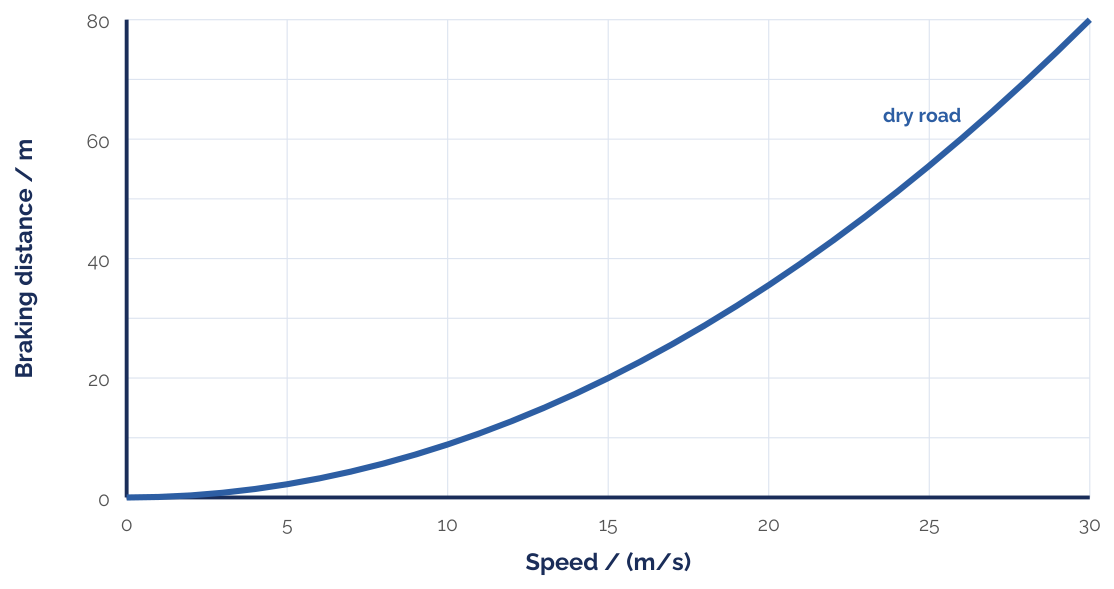
  • Braking distance is proportional to the speed squared (v²): doubling the speed makes the braking distance about four times larger, so a braking-distance–speed graph is a curve
  • Factors that increase the braking distance: a higher speed; adverse weather conditions (rain, ice or snow); poor road conditions (a wet, icy or loose/greasy surface); and a vehicle in poor condition (worn brakes or worn tyres)
  • Adverse weather and road conditions reduce the grip (friction) between the tyres and the road, so the vehicle travels further before stopping. A more heavily loaded (greater mass) vehicle also has a longer braking distance
Graph of braking distance against speed: an upward-curving line for a dry road
Fig 10.2 — Braking distance against speed: the curve rises ever more steeply because braking distance is proportional to v².

Questions

Q7
What is meant by the braking distance? (1)
Model AnswerThe distance the vehicle travels from the moment the brakes are applied until it stops.
Q8
Describe the energy transfer that takes place during the braking distance. (2)
Model AnswerThe kinetic energy of the vehicle is transferred to thermal (heat) energy in the brakes (and tyres/road) by the work done against friction. The brakes, tyres and road warm up.
Q9
Braking distance is affected by three kinds of factor. For each one, give an example:(a) the weather;(b) the road;(c) the condition of the vehicle. (3)
Model Answer(a) Weather: rain / ice / snow (reduces grip).(b) Road: a wet, icy or loose/greasy surface.(c) Vehicle: worn brakes or worn tyres. (Any sensible example for each.)
Q10
A car brakes from the same speed on three occasions: on a dry road, in heavy rain, and on ice. Explain, in terms of friction, why the braking distance is longest on ice. (2)
Model AnswerIce gives the least friction (grip) between the tyres and the road, so the braking force is smallest. With a smaller decelerating force the car travels furthest before stopping, so the braking distance is longest on ice (rain reduces friction less than ice; a dry road gives the most grip and the shortest braking distance).
Q11
A graph of braking distance against speed is a curve, not a straight line. Explain why. (2)
Model AnswerBraking distance is proportional to v² (not to v). As the speed increases the braking distance increases more and more steeply, so the graph curves upwards.
Q12
On the same axes as a dry-road braking-distance curve, describe how the curve for an icy road would look. Explain your answer. (2)
Model AnswerThe icy-road curve would be higher than the dry-road curve (above it at every speed). Ice reduces friction, so the braking force is smaller and the car travels further before stopping.
Q13
Modern cars can often stop in a shorter distance. Explain what difference better brakes and better tyres make to the braking distance. (2)
Model AnswerBetter brakes provide a greater friction force for the same effort, giving a larger deceleration. Better tyres increase the grip (friction) between tyre and road. Both reduce the braking distance.

Part 3 · Stopping Distance

stopping distance = thinking distance + braking distance
  • It is the total distance travelled from the moment the driver sees a hazard to the moment the vehicle stops
  • When the speed doubles, the thinking distance doubles (proportional to speed) but the braking distance increases about four-fold (proportional to v²), so the stopping distance grows quickly with speed
  • Adverse conditions increase the stopping distance: e.g. tiredness or alcohol increases the thinking distance, while rain or ice increases the braking distance
Bar chart of typical stopping distances from 20 to 70 mph, split into thinking and braking distance
Fig 10.3 — Typical stopping distances at different speeds (thinking distance + braking distance).

Questions

Q14
Write the equation for stopping distance. (1)
Model AnswerStopping distance = thinking distance + braking distance.
Q15
When the speed of a car doubles, compare how the thinking distance and the braking distance each change. (2)
Model AnswerThinking distance doubles (it is directly proportional to speed). Braking distance increases by about four times (it is proportional to v²). The braking distance therefore grows much faster than the thinking distance.
Q16
At 40 mph the thinking distance is 12 m and the braking distance is 24 m.(a) Calculate the stopping distance at 40 mph.(b) Estimate the stopping distance at 80 mph. (3)
Model Answer(a) Stopping distance = 12 + 24 = 36 m.(b) Speed doubles, so the thinking distance doubles to 24 m; braking distance increases by a factor of 4 to 96 m. Estimated stopping distance = 24 + 96 = 120 m.
Q17
A tired driver is travelling in heavy rain. Explain how these conditions affect:(a) the thinking distance;(b) the braking distance;(c) the overall stopping distance. (3)
Model Answer(a) Tiredness increases the reaction time, so the thinking distance is larger.(b) Rain reduces the grip (friction) between the tyres and the road, so the braking distance is larger.(c) Both parts increase, so the overall stopping distance is much greater — increasing the risk of a collision.

Exam Question — Q10: Stopping Distance (7 marks)

A driver of a car has to make an emergency stop. For this car, at one particular speed, the thinking distance is 9 m and the braking distance is 14 m. Figure 10.4 shows how the braking distance of the car changes with speed on a dry road.
Graph of braking distance against speed for the car on a dry road
Fig 10.4 — Braking distance against speed for the car on a dry road.
EQ10a
Calculate the total stopping distance of the car at this speed. (1)
Model AnswerStopping distance = 9 + 14 = 23 m.
EQ10b
On Figure 10.4, sketch a line to show how the braking distance of the same car would change with speed on an icy road. (Describe your line.) (2)
Model AnswerA curve of the same shape but higher than the dry-road curve (a larger braking distance at every speed).
EQ10c
Which one of the following would also increase the braking distance of the car? Rain on the road / The driver having drunk alcohol / The driver having taken drugs. (1)
Model AnswerRain on the road (reduces grip/friction, so a longer braking distance).
EQ10d
Explain why increasing the speed of a car has a much larger effect on the braking distance than on the thinking distance. (3)
Model AnswerThinking distance = speed × reaction time, so it is directly proportional to speed (doubling speed doubles it). Braking distance is proportional to the speed squared (v²), so doubling the speed makes the braking distance four times larger. The braking distance therefore grows much faster than the thinking distance.
05:00
Space = start/pause · Esc = exit
00:00:00
Esc = exit